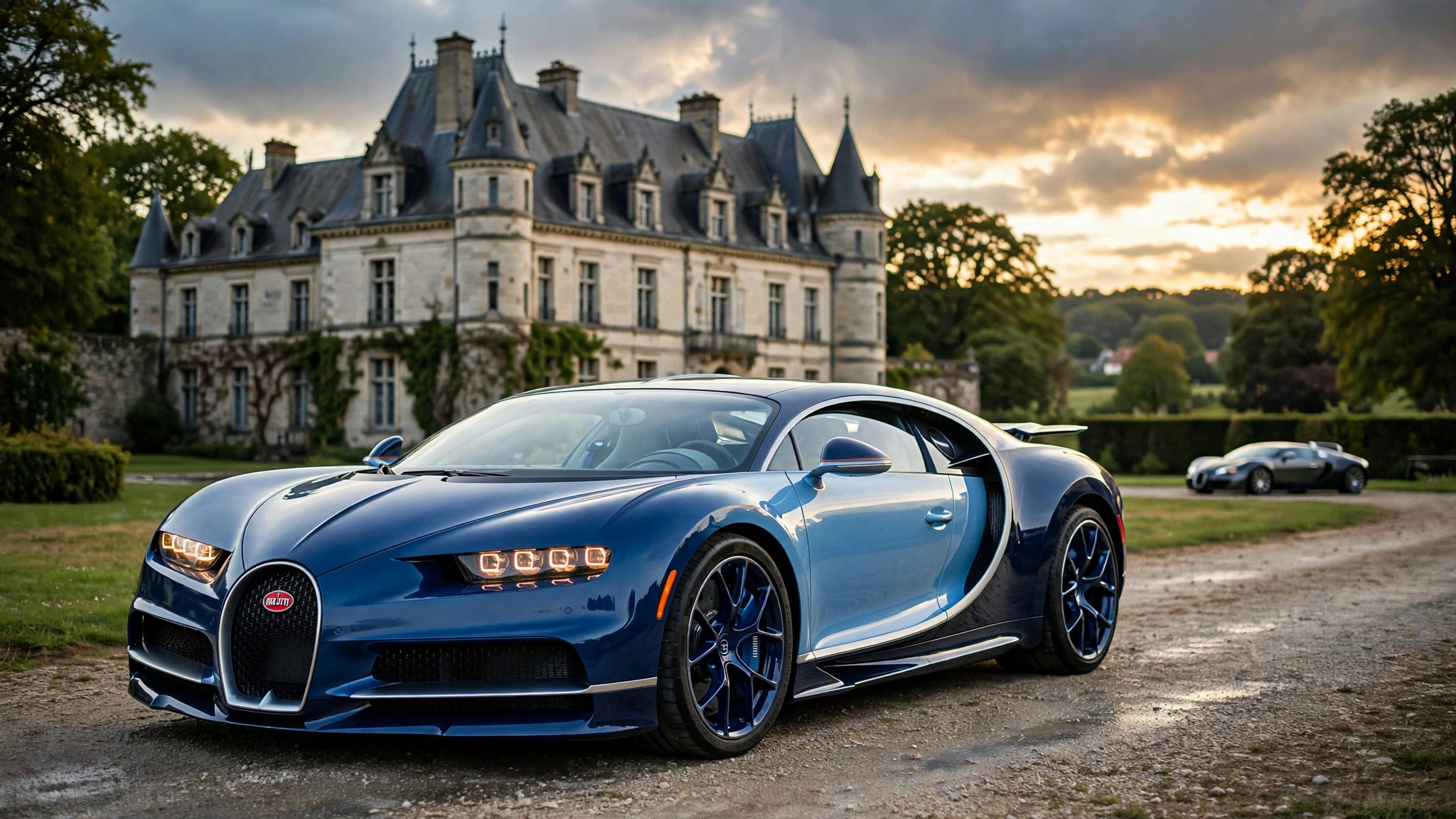
Bugatti Chiron History: From the Veyron to the W16 Finale
By DealShore Motors
The last Chiron ever built wears its own obituary on its skin. Car number 500 — a Super Sport called L’Ultime, finished in May 2024 — is painted in the same Atlantic Blue and French Racing Blue split as the 2016 Geneva show car, and hand-lettered across its body are the places that made it famous: Geneva, Molsheim, Paul Ricard, Cape Canaveral, and Ehra-Lessien, where it broke 300 mph. Bugatti did not just end a model. It closed a 19-year engine program that started with an order nobody thought was sane: build a road car with 1,000 horsepower that could drive to the opera.
This is a research piece from published records, manufacturer data, and documented runs — no invented test drives, no borrowed keys.
Before the Chiron: The Impossible Brief (1998–2005)
Volkswagen bought the Bugatti name in 1998. VW boss Ferdinand Piëch then set the brief that created the modern hypercar: at least 1,000 PS, more than 400 km/h (248 mph), 0–100 km/h in under three seconds — and civilised enough for an evening out. Engineers who said it could not be done were, in several documented accounts, replaced.
The answer was the Veyron 16.4, in production from 2005: an 8.0-litre quad-turbocharged W16 — effectively two narrow-angle V8s joined on one crankshaft — making 1,001 PS (987 hp) and 1,250 Nm, with ten radiators to survive its own heat. In April 2005 it hit 253.81 mph at Ehra-Lessien, the first production car over 250 mph. Price: roughly €1 million, about $1.25 million at launch.
Brutal honesty: the Veyron was a brilliant loss-maker. A widely cited Bernstein Research analysis put the loss at roughly $5 million per car once development was spread over just 450 cars. Piëch was not buying profit. He was buying proof that Volkswagen could out-engineer anyone on Earth. The Chiron inherited that logic — and that bill structure.
The Veyron Era Ends, the Template Is Set (2005–2015)
Bugatti built 450 Veyrons in total: 300 coupes and 150 open-top Grand Sport cars. The Super Sport (2010) pushed output to 1,200 PS and set a verified 267.8 mph production-car record. The Grand Sport Vitesse took the open-top record. Every variant taught Bugatti the same lesson the Chiron would monetise better: the base car creates the legend, the limited editions create the margins.
Production ended in 2015. The successor could not simply be faster — the Veyron had already made “fastest” boring. It had to be better everywhere, and it had to lose less money doing it.
Geneva 2016: The Chiron Arrives
The Chiron — named for Monegasque racing driver Louis Chiron — debuted at the Geneva Motor Show in March 2016, previewed by the Vision Gran Turismo concept in 2015. The headline numbers, as published at launch:
| Veyron 16.4 (2005) | Chiron (2016) | |
|---|---|---|
| Engine | 8.0L quad-turbo W16 | 8.0L quad-turbo W16, heavily redesigned |
| Power | 1,001 PS (987 hp) | 1,500 PS (1,479 hp) |
| Torque | 1,250 Nm (922 lb-ft) | 1,600 Nm (1,180 lb-ft) |
| 0–100 km/h | 2.5 s | 2.4 s |
| Top speed | 253.81 mph verified | 261 mph (420 km/h), electronically limited |
| Production | 450 cars | 500 cars planned |
| Launch price | ~€1 million | ~€2.4 million / ~$2.998 million in the US |
Do not let “same engine” fool you. Bugatti and published technical breakdowns are clear that the Chiron’s W16 was essentially a new engine: only the compact W layout and the 73 mm cylinder pitch carried the same idea, the turbos were about 64% larger, and sequential turbocharging — two turbos working first, all four at full load — was the main reason power jumped by half with the same displacement and the same number of turbos. The engine has 3,712 parts, is assembled by two people over six days, and was tested for over 16,000 hours before sign-off.
The limit was tyres, not power. The road car was capped at 261 mph because no road tyre Bugatti would certify could be trusted beyond it for sustained use. That cap is the most honest number on the spec sheet — and it set up the car’s defining moment.
The Family Grows: Sport, Divo, and the Coachbuilt Era (2018–2020)
Bugatti learned the Veyron lesson and industrialised it:
- Chiron Sport (2018): lighter, sharper, same power — including a 3D-printed titanium exhaust.
- Divo (2018): 40 cars, handling over top speed, sold out on announcement.
- La Voiture Noire (2019): a one-off homage to the lost Type 57 SC Atlantic, reported at $18.7 million — at the time the most expensive new car ever sold.
- Centodieci (2019): 10 cars honouring the EB110 of the 1990s Italian era.
- Chiron Pur Sport (2020): 60 cars, agility and downforce over top speed.
This is where brutal honesty matters for buyers: these are not separate models in any mechanical sense. They share the Chiron’s carbon tub, W16, and gearbox, re-bodied and re-tuned. That is not a criticism — it is the business model. Exclusivity was manufactured from a proven core, which is exactly why values and parts support behave differently from a clean-sheet car.
2 August 2019: 304.773 mph
At Volkswagen’s Ehra-Lessien track in Germany, test driver Andy Wallace drove a near-production Chiron Super Sport 300+ prototype to 304.773 mph (490.484 km/h) — the first production-based car to break 300 mph. The run was one-directional, so it was not a two-way Guinness production record; Bugatti has never hidden that, and neither should any article about it.
The record car used the uprated 1,600 PS (1,578 hp) W16 nicknamed “Thor,” longer gearing, and a longtail body extended by about 25 cm to shrink the draggy wake behind the car. Thirty customer Super Sport 300+ cars followed, at about $3.8–3.9 million each. Bugatti then announced it was done chasing top-speed records — there was, commercially, nothing left to prove.
The Finale: Super Sport, Mistral, Bolide, L’Ultime (2021–2024)
The last chapter split three ways. The Chiron Super Sport (2021) brought the longtail and 1,600 PS formula to a grand-touring brief. The W16 Mistral (2022) — 99 roadsters — was announced as the last road-going W16 model line. The Bolide, first shown as a concept in 2020 and put into a 40-car production run, took the W16 track-only, with none of the road car’s manners and all of its violence.
Then, in May 2024, the 500th and final Chiron coupe: Super Sport L’Ultime. One car, the 2016 launch colours, the handwritten map of the model’s life, “500” on the body, wheel caps, rear wing, and engine cover, and French flags on the mirror caps. Eight years, 500 cars, brief fulfilled.
A postscript the finale headlines missed, as of 2026: Bugatti’s Programme Solitaire one-offs — starting with the Brouillard in August 2025 and the Veyron-inspired F.K.P. Hommage — have kept small numbers of W16-based commissions alive after L’Ultime. So L’Ultime is accurately the last Chiron and the last series-production W16 car, not literally the last W16 ever screwed together in Molsheim. Precision matters more than a clean headline.
What Replaced It: Tourbillon and the V16 Turn
On 20 June 2024, weeks after L’Ultime, Bugatti unveiled the Tourbillon in Molsheim: an all-new 8.3-litre naturally aspirated V16 developed with Cosworth — 1,000 PS on its own, revving to 9,000 rpm, no turbos — plus three electric motors for a combined 1,800 PS (1,775 hp), an analogue, watch-style instrument cluster, 250 cars at €3.8 million net, with deliveries scheduled to begin in 2026.
Under Bugatti Rimac, the original plan for the successor had reportedly been an electric coupé-SUV. Mate Rimac killed it and pushed for the V16. Whatever you think of hybrid hypercars, that decision is why the W16 story has a worthy sequel instead of a silent ending: sixteen cylinders stayed, forced induction and the W layout did not.
Why the Chiron Matters — and What to Check If You Ever Buy One
The Veyron invented the hypercar brief. The Chiron proved it could be run as a business: 500 cars, a derivative family that printed exclusivity from one core, a 300-mph record, and a planned, profitable-feeling exit into a hybrid successor — a very different story from the Veyron’s reported per-car losses.
If you are ever on the buying side, history becomes a checklist:
- Service file, on Bugatti’s calendar. As detailed in our Chiron running-costs breakdown, the four-year cycle replaces turbos, fuel tank, and coolers on time, not on failure — a missed cycle is a six-figure catch-up.
- Variant and provenance. A Sport, Pur Sport, Super Sport, and a coachbuilt derivative are different markets wearing similar bodywork. Verify which car it actually is.
- Tyre and wheel age. On a car certified for 261 mph, old rubber is a safety defect, not a detail.
- Derivative vs. one-off claims. Solitaire and coachbuilt cars live or die on factory documentation. No paper, no premium.
The Bottom Line
From Piëch’s impossible 1,000 PS order in 1998 to a hand-lettered blue coupe in May 2024, the W16 powered just 950 series cars — 450 Veyrons and 500 Chirons — and rewrote what a road car was allowed to be: 253 mph, then 267 mph, then 304.773 mph. The Chiron is the second half of that story and the better-run half. The engine is gone from series production. The brief it proved — no limit stated in public that engineering could not be made to meet — is now the whole industry’s brief.
In this series: our full Chiron specs breakdown, Chiron vs Koenigsegg Jesko comparison, and Chiron running costs — and next, the 2026 used Chiron market guide.
📚 READING PICK FOR THIS HISTORY
When you buy through our links, we may earn an affiliate commission at no extra cost to you.
Bugatti Veyron: A Quest for Perfection — Martin Roach — written with Bugatti’s cooperation, tracing the Veyron programme that created the brief the Chiron inherited: 1,001 PS, 253 mph, ten radiators, and the Molsheim atelier where both cars were hand-built.
Sources (as of October 2026): Bugatti newsroom and published launch data for the Chiron (Geneva 2016), Super Sport 300+ record release (304.773 mph / 490.484 km/h, Ehra-Lessien, August 2019, 30 units), and Tourbillon (unveiled 20 June 2024, 8.3L Cosworth V16 + 3 motors, 1,800 PS, 250 units, €3.8 million); MotorTrend and Autocar reporting on Chiron Super Sport L’Ultime, the 500th and final Chiron (May 2024); CarBuzz technical breakdown of the Chiron W16 redesign (3,712 parts, turbos ~64% larger, sequential turbocharging); published Veyron records (450 cars, 1,001 PS, 253.81 mph in 2005, Super Sport 267.8 mph in 2010) and the Bernstein per-car loss analysis as widely republished; Carscoops reporting on Programme Solitaire W16 one-offs (Brouillard, August 2025; F.K.P. Hommage). Figures vary by variant and market; verify current values with Bugatti before any purchase.
Leave a Reply