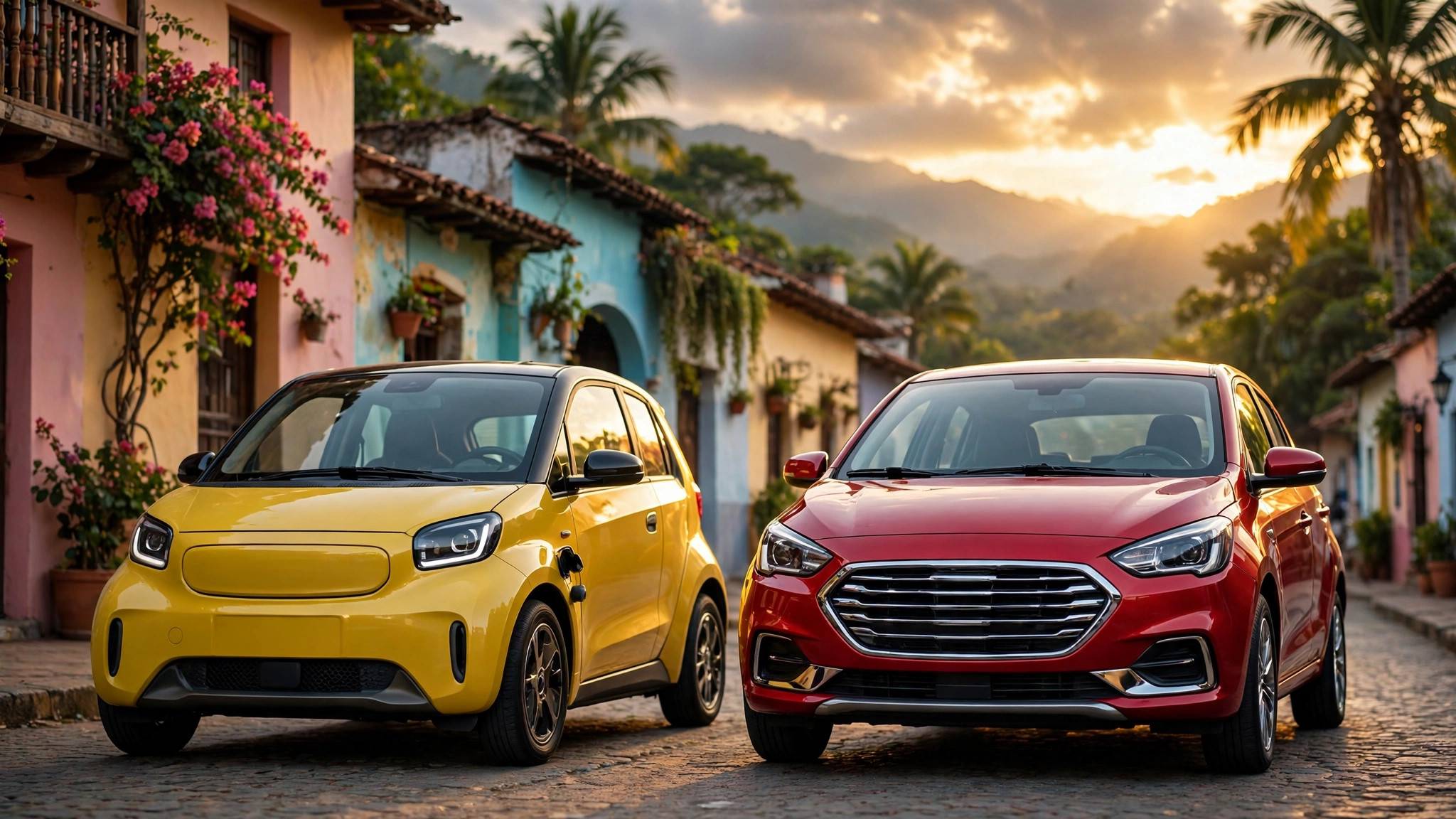
BYD Dolphin Mini vs MG3 Hybrid: Latin America’s Cheapest Electrified Cars, Compared Honestly
By DealShore Motors
There’s a war going on in Latin America right now, and it’s being fought at the bottom of the price list. On one side: the BYD Dolphin Mini — a pure-electric city car so cheap it became the best-selling vehicle in Brazil, all vehicles, in February 2026. On the other: the MG3 Hybrid+, a gasoline-electric hybrid with 194 horsepower that costs about the same as the little BYD but doesn’t need a charging cable.
Both are Chinese. Both are shockingly cheap. Both are selling fast. But they’re completely different machines for completely different buyers — and each has problems the brochures won’t mention. Here’s the honest breakdown.
🔍 Verdict Box
Best pure-electric city commuter: BYD Dolphin Mini — cheapest to buy in most markets, cheapest to run by far, and the proven sales hit (over a million units produced globally by mid-2026). Buy it if you drive mostly in the city and can charge at home.
Best all-rounder: MG3 Hybrid+ — 194 HP, 0–100 km/h in 8 seconds, 170 km/h top speed, and zero range anxiety. The hybrid drivetrain means it works anywhere there’s a gas station. But it had a seat-safety recall in Mexico in September 2026 and long-term hybrid reliability is still unproven.
| BYD Dolphin Mini | MG3 Hybrid+ | |
|---|---|---|
| Powertrain | Pure electric (55 kW motor) | 1.5L gas engine + electric motor, self-charging hybrid |
| Combined output | 74–75 HP, 135 Nm | 194–196 HP, 425 Nm |
| Battery | 30.08 kWh (300 km NEDC) / 38.88 kWh (380 km NEDC) | 1.83 kWh Li-ion (hybrid only) |
| 0–100 km/h | ~14 s (est.) | 8.0 s |
| Top speed | 130 km/h | 170 km/h |
| Fuel/charging | DC fast charge 30–80% in ~30 min | 4.4 L/100 km WLTP (real world ~5.0–5.8) |
| Price (Mexico) | $399,800 MXN base (~US$22,200) | $422,000 MXN Excite (~US$23,400) |
| Battery warranty | 5 years / 150,000 km (vehicle) | 7 years (hybrid battery) |
Prices are official 2026 figures; MXN→USD conversions are approximate.
The BYD Dolphin Mini: the one that conquered Brazil
Let’s start with what the numbers actually say, because they’re ridiculous. The Dolphin Mini (sold as the Seagull in Colombia, and the Dolphin Surf in Europe) hit 62,000+ cumulative sales in Brazil, became the best-selling vehicle in Brazil in February 2026 — not the best-selling EV, the best-selling vehicle, period — and took 55.2% of Argentina’s EV segment in the first nine months of 2026. BYD builds it at its Camaçari plant in Bahia, which matters: locally-assembled cars mean better parts pipelines than pure imports.
It’s cheap, it’s cute, it’s electric, and for city driving it’s genuinely excellent. Range anxiety? The big-battery version does 380 km NEDC — that’s weeks of city commuting per charge. DC fast charging at 30 minutes from 30–80% is fine for a city car.
The honest negatives (this is the part that matters)
Post-crash electronic lockout. This is the ugliest documented issue. Mexican repair shops have shown cases where, after even a moderate collision, the Dolphin Mini displays “EV Power Limited,” refuses to engage Drive or Reverse, and drains the battery — requiring a specialist electronic release procedure before the car can even be towed normally. That’s not a rumor; it’s documented repair-shop video evidence. A car that bricks itself after a fender-bender is a real ownership risk.
Insurance is a real problem in Mexico. Insurer HDI Seguros suspended policies for 20+ Chinese brands in 2024 — the Dolphin Mini included — and only reaccepted them with premium surcharges up to 20%. Some Mexican insurers have resorted to paying owners cash instead of sourcing replacement parts, because parts delays run from one month to a full year. If you buy one, call your insurer before you sign, not after.
Parts delays are the industry’s #1 Chinese-car problem. A September 2026 Brazilian study found Chinese models (MG4, Denza B5, Geely EX5) among the hardest cars in the country to source glass and collision parts for, with waits over 90 days. Spain’s CESVIMAP flagged the same issue: extended repair times driven by parts unavailability and missing technical documentation.
Regulatory smoke. Profeco (Mexico’s consumer protection agency) opened a review of BYD in September 2026 after one of its hybrids caught fire on the México–Toluca highway. As of mid-September 2026, no recall had been ordered and the cause was still under investigation — but it’s worth knowing the file exists.
The MG3 Hybrid+: the hot hatch in a budget suit
The MG3 Hybrid+ takes the opposite approach: it’s a car first and an electrified product second. A 1.5L four-cylinder making 102 HP pairs with a 136 HP electric motor for a combined 194–196 HP and 425 Nm of torque through a 3-speed hybrid automatic. That’s Golf GTI-adjacent torque numbers in a budget hatchback. It hits 100 km/h in 8 seconds and tops out at 170 km/h — the Dolphin Mini isn’t playing in this league on the highway.
Fuel economy claims 4.4 L/100 km on the WLTP cycle; independent testing puts real-world consumption at 4.7–5.3 in mixed driving and 5.0–5.8 on the highway. Respectable for a 194-HP car, but don’t believe the brochure number. The hybrid battery warranty is a solid 7 years, and you get 6 airbags plus ADAS (automatic emergency braking, blind-spot monitoring on top trims) — safety equipment that genuinely matters in Latin America.
Pricing is aggressive: $422,000 MXN for the base HEV Excite in Mexico (with promotional pricing seen as low as $377,000), COP $94,990,000 in Colombia (~US$23,800), and from CLP 14,990,000 in Chile (~US$15,800) — the Chilean price makes it one of the cheapest hybrid cars on the continent.
The honest negatives
It had an active recall in Mexico (September 2026). Profeco called back 6,000 MG3 units (model years 2024–2026) after Euro NCAP lab tests showed the driver’s seat can displace 11.5 mm forward in a frontal crash. The fix is a free support kit. No injuries were reported — but if you’re buying used, verify the recall was performed. This is the kind of thing to check in the first five minutes.
The hybrid system has a known weakness on long climbs. Reviewers and owners found that when the small 1.83 kWh battery depletes after sustained hard driving — long mountain climbs, the kind Latin America is full of — performance drops noticeably. MG has acknowledged it: a MY26.5 update (motor and generator software tweaks) was announced in October 2026 to address exactly this. Buy a 2026.5 model or verify the update was applied.
Reliability is unproven. This is MG’s first non-plug-in hybrid system. Toyota’s hybrid record was built over two decades; MG’s was built over two years. Reviewers are blunt: it needs real owner data before anyone can vouch for it. Budget plastics and a gearbox that feels “worked” when pushed round out the list.
The deciding factor nobody talks about: service and parts
Here’s the brutal-honesty summary, and it applies to both cars equally: the car isn’t the risk — the support network is.
Brazilian and Mexican data agree that parts availability for Chinese brands is the single biggest ownership problem — collision parts, glass, and low-rotation components can take months. Insurance surcharges in Mexico hit 20%. And both brands’ Latin American service networks are still thin compared to Toyota, Nissan, or even Volkswagen.
So before either car, do this:
- Call your insurer and get a real quote. If it’s 20% higher than a Toyota Yaris, factor that into your 5-year cost math — it can erase the fuel savings.
- Ask the dealer (in writing) for average parts delivery times for fenders, bumpers, and windshields — the parts you’ll actually need after a fender-bender.
- For the MG3: verify the seat recall fix was performed and the MY26.5 software update is on the car.
- For the Dolphin Mini: ask how charging works at your home specifically — a car with no home charging and a 130 km/h top speed is a second-car, not an only-car.
The Bottom Line
Buy the Dolphin Mini if you want the cheapest possible cost per kilometer, drive mostly in the city, and can charge at home. It’s the proven one — the sales numbers don’t lie.
Buy the MG3 Hybrid+ if you need a real highway car, can’t or won’t charge, and want hot-hatch performance for budget-car money. Just know you’re an early adopter of its hybrid system.
The YouTube crowd is right that both are remarkable value. But value isn’t just the sticker price — it’s the sticker price plus insurance, plus parts, plus the days your car sits waiting for a bumper from Shanghai. Do the full math, and either of these can be the right call.
Sources: BYD Mexico official pricing (my-car.mx, informabtl.com); MG Motor Mexico official pricing (mgmotor.com.mx); Profeco recall notices (Mexico, Sept 2026); lado.mx and revistaflow.com on the MG3 recall and MY26.5 update; El Horizonte (Feb 2026) on Chinese-brand insurance and parts delays; Autoglass Brazil study (Sept 2026); CESVIMAP (Spain); confirmado.net (Brazil pricing); onmotor.es and testcoches.es on real-world MG3 consumption and reliability.
Leave a Reply