Check Engine Light On? The 10 Most Common Codes and What They Cost to Fix
By DealShore Motors
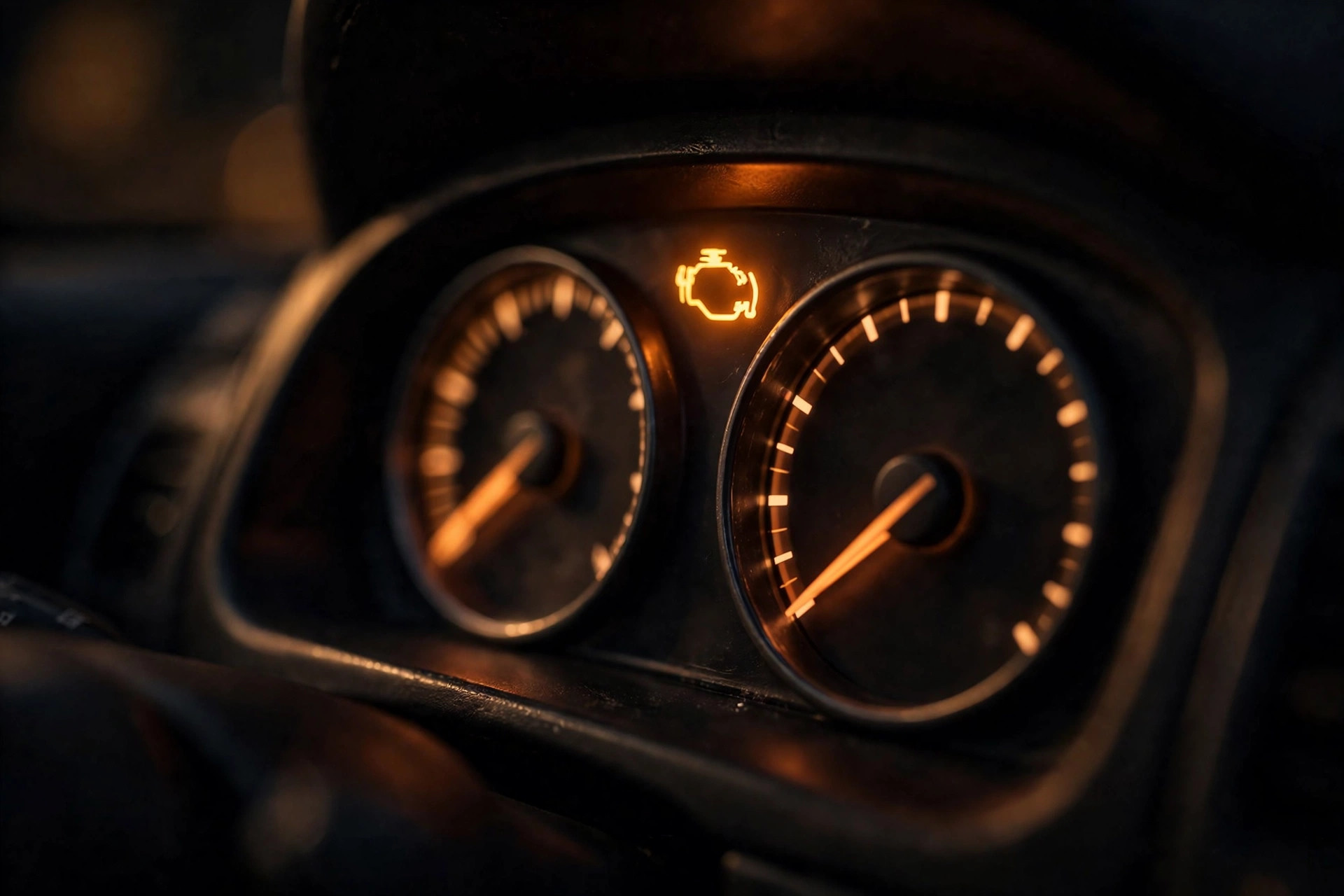
That little orange engine icon is the most misunderstood light in your car. Across the U.S., mechanics pull roughly the same handful of diagnostic trouble codes (DTCs) over and over. Fleet data from Networkfleet, analyzing tens of thousands of vehicles, consistently names three repeat offenders: P0300 (misfires), P0171 (lean mixture), and P0420 (catalytic converter efficiency) — with 47 percent of all codes tied to emissions systems. CarMD’s Vehicle Health Index adds a striking detail: P0420 alone accounts for about 6.3 percent of all check-engine cases, and nearly 7 in 10 of those cars have between 102,000 and 178,000 miles on them.
If your light just came on, you’re almost certainly looking at one of ten very ordinary problems. Here’s what each one means, how urgent it is, and what it costs — parts, labor, dealer vs. independent shop, and whether you can fix it in your own driveway.
First: How to Read the Code (Free)
Every car sold in the U.S. since the 1996 model year has an OBD-II port under the dashboard, usually on the driver’s side. Plug in a scanner, turn the key to “on,” and the car’s computer tells you exactly what’s bothering it.
You don’t even need to buy the scanner. AutoZone, O’Reilly Auto Parts, and Advance Auto Parts will read your codes for free in the parking lot and hand you a printout. Prefer to own the tool? A basic Bluetooth OBD-II adapter is $20–$40 and pairs with free phone apps.
One rule before we go further: the code is a symptom, not a diagnosis. P0171 says “the engine is running lean” — it doesn’t say whether that’s a $12 vacuum hose or a $300 mass airflow sensor. Anyone who quotes a repair from the code alone, without testing, is guessing with your money.
Why You Shouldn’t Just Clear Codes
Disconnect the battery or hit “clear” on the scanner and the light goes off — but the problem isn’t solved:
- It comes back. The computer re-runs its self-tests every drive cycle. Within 20–100 miles, the light returns.
- You erase the evidence. Stored codes and freeze-frame data (the exact conditions when the code triggered) are what technicians diagnose from. Clearing them is like deleting security footage before the detective arrives.
- You’ll fail emissions. Inspection stations check monitor readiness. Freshly cleared monitors read “not ready” — an automatic failure.
The One Rule That Matters: Flashing vs. Steady
A steady light means: something’s wrong, get it checked, keep driving. A flashing light means: the engine is misfiring right now, dumping raw fuel into the exhaust — stop driving. That fuel superheats the catalytic converter and can destroy a $1,500–$2,500 exhaust component in minutes, turning a cheap repair into a disaster. Pull over, shut it off, and tow it.
Now, the ten codes, in rough order of how often shops actually see them.
1. P0420 — Catalyst System Efficiency Below Threshold (Bank 1)
What it means: Your catalytic converter isn’t cleaning the exhaust like it should. The computer compares the upstream and downstream oxygen sensors; when they start reading alike, the converter has quit doing its job.
What causes it: An aging or contaminated converter (most common past 100,000 miles) — but also exhaust leaks, a lazy downstream O2 sensor, or upstream problems like burning oil that poisoned the catalyst. Rule out the cheap stuff before buying the expensive part.
Urgency: 🟡 Drive, but schedule the fix. The car runs normally and you won’t damage anything new. But you’ll fail emissions, and the code never fixes itself.
What it costs: The expensive one. A direct-fit aftermarket converter job typically runs $945–$2,475 out the door, parts and labor included. RepairPal’s figures for cars like the Camry, Accord, and Civic land at $1,342–$1,518 all-in. At a dealer with an OEM converter, expect $1,500–$3,200+ — the part alone can run $1,700–$1,900. Independent shops with direct-fit units are usually the smart money.
Warranty check first: Federal law requires catalytic converters to be covered for 8 years or 80,000 miles. Under that mileage, the dealer replacement is free. Many owners never learn this until after they’ve paid.
DIY? Moderate. A bolt-on converter with clean flanges is a doable driveway job — $200–$1,000 in parts.
2. P0171 / P0174 — System Too Lean (Bank 1 / Bank 2)
What it means: Too much air, too little fuel — the engine is running lean, burning hot like a campfire with too much oxygen and not enough wood.
What causes it: The greatest hits: a cracked vacuum hose or intake boot, a dirty or failing mass airflow (MAF) sensor, a clogged fuel filter, or a weak fuel pump. Seeing P0171 and P0174 together on a V6/V8 points at something feeding both banks, like the MAF sensor or one big vacuum leak.
Urgency: 🟡 Drive, but don’t ignore it. Chronic lean running overheats pistons and burns valves over time. Short trips: fine. A cross-country road trip with a known lean code: not fine.
What it costs: Wildly variable, because the causes range so widely. A vacuum leak repair: $120–$210. A MAF sensor installed: $150–$400. A fuel pressure regulator: $225–$375. A fuel pump: $1,370–$1,690. A $10 can of MAF sensor cleaner fixes many dirty-sensor cases.
DIY? Very. A MAF sensor comes off with two screws — cleaning it is a 10-minute job.
3. P0300 (and P0301–P0312) — Random/Multiple Cylinder Misfire
What it means: One or more cylinders aren’t firing properly. You’ll feel it as a rough idle, a shake under acceleration, or lost power. P0300 means it’s random or across cylinders; the numbered codes (P0301, P0302…) point at specific cylinders.
What causes it: The classic trio covers most cases: worn spark plugs, failing ignition coils, or bad plug wires on older cars. Less common: clogged injectors, vacuum leaks, a jumped timing chain, or low compression. Roughly 3 in 5 gasoline-engine misfires trace back to plugs or coils.
Urgency: 🔴 Flashing = stop driving now. A misfire sends unburned fuel into the converter, which can melt its internals in minutes. A steady P0300? Drive gently to a shop this week.
What it costs: Usually cheap. Spark plugs: $60–$225 at a shop ($40–$120 in parts DIY). An ignition coil: $150–$300 installed, with the coil itself $40–$80. A full coil set on a V6/V8: $260–$590. Fuel injectors: $200–$800 each.
DIY? Plugs and coil packs are among the most beginner-friendly repairs on a modern car.
4. P0442 / P0455 — EVAP System Leak (Small / Large)
What it means: The evaporative emissions system — which traps fuel vapors so they don’t escape into the air — has a leak. P0442 is a small leak (a hole around 0.020 inches); P0455 is large (0.040 inches or more). These are emissions codes, not engine codes: your engine doesn’t know or care.
What causes it: In a huge percentage of cases, a loose or damaged gas cap — the single most common cause, which is why shops check it first. Then: cracked EVAP hoses, a stuck purge valve, a bad vent valve, or a cracked charcoal canister. Overfilling past the first click at the pump can flood the canister and trigger this too.
Urgency: 🟢 Drive normally. An EVAP leak won’t hurt your engine or strand you.
What it costs: Best case is free — tighten the cap until it clicks and drive a few days; the light may clear on its own. A new gas cap: $20–$60 installed. Purge valve: $140–$300. Vent valve: $160–$350. Charcoal canister: $250–$600. A shop smoke test to find the leak: $60–$150.
DIY? The most DIY-friendly code on this list. Tighten or replace the cap, inspect hoses for cracks — the common fixes run $15–$150 in parts.
5. P0401 — EGR Flow Insufficient
What it means: The exhaust gas recirculation valve isn’t returning enough exhaust gas to the intake. The EGR system feeds a small amount of inert exhaust back into the cylinders to lower combustion temperatures and cut nitrogen-oxide emissions.
What causes it: Carbon buildup — the valve or its passages get coked with soot, especially on cars that mostly do short trips.
Urgency: 🟡 Drive, but expect symptoms. Stuck closed: pinging under load, rough idle, failed emissions. Stuck open: stalling and hard starting. Either way, the car keeps moving.
What it costs: EGR valve replacement on a typical gasoline car: $340–$530 at a shop. Sometimes a $10 can of carburetor cleaner fixes it — a favorite DIY win. Diesel trucks are a different universe: EGR cooler replacement can run $1,500–$5,000 because of the labor involved.
DIY? On most gasoline cars, the EGR valve is accessible — a few bolts and a gasket.
6. P0131–P0167 — Oxygen Sensor Circuit Codes
What it means: One of your oxygen sensors — the snitches that tell the computer how the mixture is burning — is reading wrong, reading slow, or dead. These codes cover everything from “circuit low voltage” (P0131) to “heater circuit malfunction” (P0135/P0141).
What causes it: The sensor aging out (typical life: 60,000–100,000 miles) or wiring damaged by road debris or exhaust heat.
Urgency: 🟡 Drive, but fix it sooner than later. A bad O2 sensor makes the computer guess at the mixture — fuel economy often drops 10–40 percent — and can eventually kill the catalytic converter. A $200 sensor today protects a $2,000 converter tomorrow.
What it costs: $100–$250 per sensor parts and labor at an independent shop; dealers can reach $275–$525. DIY, the sensor itself is $20–$80.
DIY? One of the easiest repairs here — if the sensor is accessible. You need a slotted 22mm O2 sensor socket and penetrating oil. Budget 30–45 minutes per sensor.
7. P0128 — Coolant Thermostat (Below Regulating Temperature)
What it means: Your engine isn’t reaching normal operating temperature. The thermostat — the gatekeeper that lets the engine warm up before opening to the radiator — is stuck open (or the coolant temperature sensor is lying).
What causes it: A stuck-open thermostat, 9 times out of 10.
Urgency: 🟡 Drive, but watch the temperature gauge. An engine that never warms up gets terrible fuel economy and runs rich, which contaminates the oil and builds carbon.
What it costs: One of the cheapest shop repairs: roughly $150–$400 parts and labor — about an hour of labor plus a $30–$70 part.
DIY? Very, on most cars. The thermostat usually sits under one housing with two or three bolts. Drain some coolant, swap it, refill, bleed the air.
8. P0446 — EVAP Vent Control Circuit
What it means: The vent solenoid — the valve that lets fresh air into the EVAP system during the computer’s leak tests — isn’t responding. Same EVAP family as P0442/P0455, but this code points at the valve’s electrical circuit rather than a physical leak.
What causes it: A failed vent solenoid or corroded wiring/connector — they live near the rear wheel, exposed to road spray.
Urgency: 🟢 Drive normally. Emissions code. The car runs exactly the same. You’ll fail an inspection, but you won’t hurt anything.
What it costs: The vent solenoid: $30–$150 in parts; $160–$350 installed at a shop.
DIY? Yes. The vent valve usually sits near the charcoal canister at the rear, held by a bracket and one electrical connector. Twenty minutes with basic hand tools.
9. P0430 — Catalyst System Efficiency Below Threshold (Bank 2)
What it means: Exactly the same problem as P0420 — on the other side of a V6, V8, or V10. Bank 1 is the side with cylinder 1; bank 2 is the other one. If you’re seeing both P0420 and P0430, both converters are tired — the underlying cause (burning oil, chronic misfires, rich running) has usually been cooking them for a long time.
What causes it: Same causes as P0420.
Urgency: 🟡 Drive, but schedule the fix. No new damage from driving — but emissions failure is guaranteed.
What it costs: Same $945–$2,475 per side as P0420, and on some V-engines the converters are manifold-integrated, pushing labor up.
DIY? Same as P0420: moderate for bolt-on, shop work for welded or integrated units.
10. P0011 / P0014 — Camshaft Position Timing Over-Advanced
What it means: The variable valve timing (VVT) system can’t control the camshaft properly — the intake cam (P0011) or exhaust cam (P0014) is stuck advanced when the computer asked for something else. VVT adjusts valve timing on the fly for power and efficiency, and it runs on engine oil pressure.
What causes it: Here’s the twist — the number-one cause is low or dirty engine oil. VVT solenoids meter oil pressure to the cam phasers, so skipped oil changes or a low dipstick are the most common trigger.
Urgency: 🟡 Check your oil level immediately, then drive to fix it. If the oil is critically low or the engine is rattling from the timing area, stop. Otherwise, this is a “this week” repair.
What it costs: Start with the free check: oil level and condition. An oil and filter change: $50–$100. A VVT solenoid replacement: $100–$300 parts and labor at an independent shop — the solenoid itself is often $40–$80. Luxury cars cost more: a BMW 740i averages $740–$797.
DIY? Often, yes. On many cars the VVT solenoid sits right on top of the valve cover: one connector, one bolt. Pull it, clean the screen with brake cleaner, test it with a battery (it should click), reinstall.
The Smart Play
A single check-engine code on a healthy car is a repair bill, not a death sentence. But do the math honestly: a $2,400 catalytic converter on a $3,000 car is 80 percent of the car’s value for one emissions component.
Two rules that will save you thousands:
- Diagnose, then replace. A $60–$150 smoke test or a proper diagnostic hour beats throwing $400 of parts at a $50 problem.
- Fix cheap codes first. Misfires (P0300) and oxygen sensors (P0131–P0167) destroy catalytic converters when ignored. The $200 repair today is the $2,000 repair prevented.
The check-engine light is your car’s way of asking for help in a language of five characters.
Dealing with a check-engine light right now? DealShore Motors is building the driver’s library for buying, owning, and fixing smart — new deep dives every week.
Sources: CarMD Vehicle Health Index data (P0420 frequency and mileage distribution); Networkfleet DTC analysis of tens of thousands of OBD-II vehicles (top codes P0300, P0171, P0420); JEGS most-common OBD-II codes reference; RepairPal estimator data; CarBuzz catalytic converter replacement estimates; a-premium and scanneranswers P0300 cost breakdowns; Advance Auto Parts and O’Reilly Auto Parts free check-engine-light testing services.
Leave a Reply