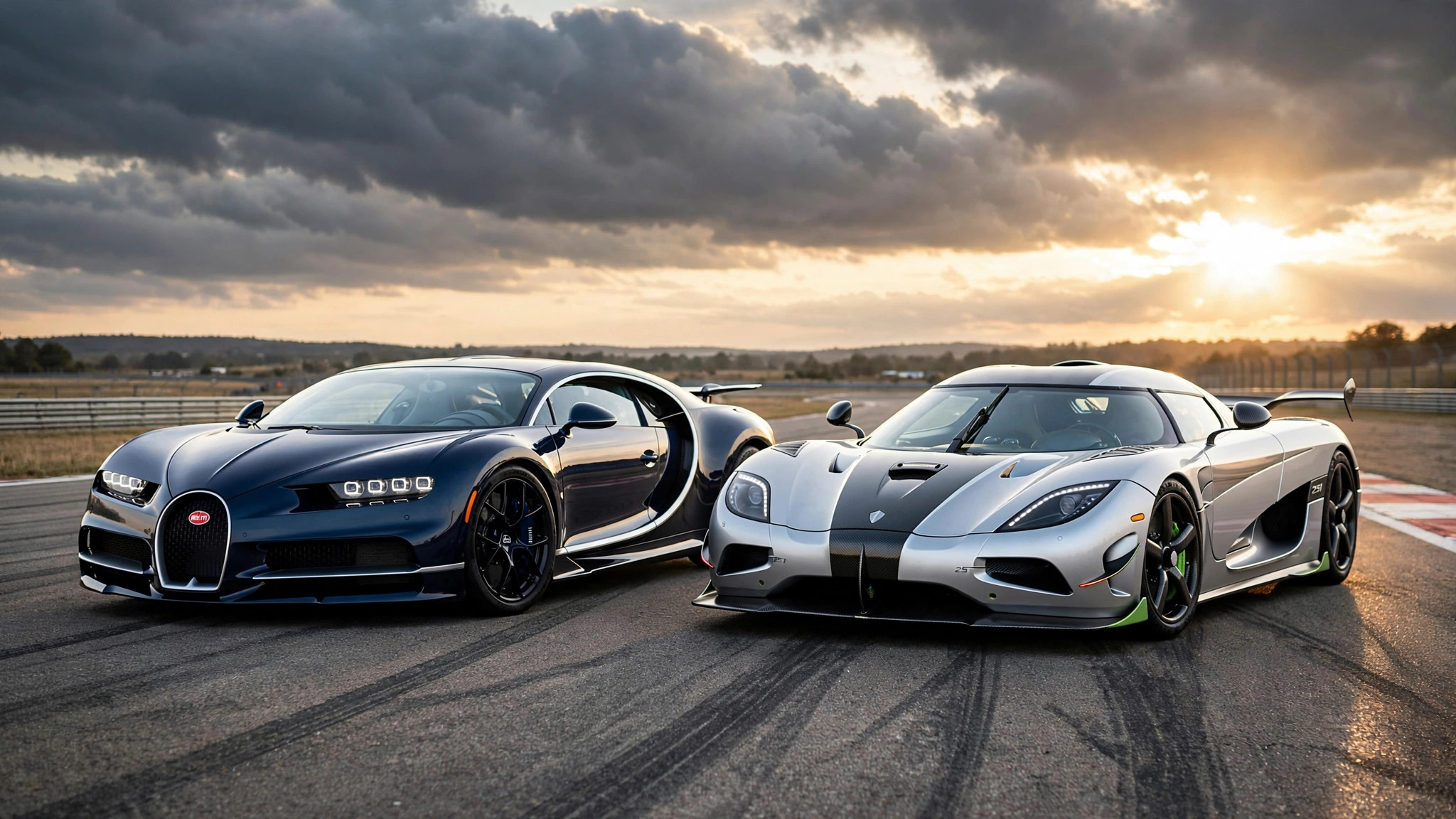
Bugatti Chiron vs Koenigsegg Jesko: Hypercar Kings Compared
By DealShore Motors
In 2017, a Bugatti Chiron needed 41.96 seconds to launch from a standstill to 400 km/h (249 mph) and brake back to zero. Seven years later, a Koenigsegg Jesko did the exact same run in 27.83 seconds — more than fourteen seconds quicker. In the hypercar world, fourteen seconds isn’t a margin. It’s a different sport.
But here is the twist that makes this comparison worth writing honestly: the Chiron is still the only one of the two to have officially broken 300 mph, with a verified 304.77 mph run. The Jesko’s claimed 330 mph top speed? As of October 2026, it has never actually been attempted. One car holds the verified crown. The other holds the stopwatch crown. So who is really the king?
🏁 VERDICT BOX
The Bugatti Chiron is the proven 300-mph car — verified record, all-wheel drive, and a cabin refined enough to cross a continent in. The Koenigsegg Jesko is the most violently fast-accelerating production car ever measured, and the most exciting engineering story in the business. The Chiron is the finished monument; the Jesko is the still-loading weapon. Neither is a rational purchase, and that is entirely the point.How this comparison was made: no manufacturer PR, no borrowed opinions. Every number below comes from published manufacturer specifications or independently verified record runs (Racelogic VBOX data). Claims that have not been verified — like the Jesko’s 330 mph top speed — are labeled exactly that.
The Tale of the Tape
| Bugatti Chiron | Koenigsegg Jesko | |
|---|---|---|
| Engine | 8.0L quad-turbo W16 | 5.0L twin-turbo V8 |
| Power | 1,479 hp (1,103 kW) @ 6,700 rpm | 1,600 hp on E85 / 1,280 hp on pump gas |
| Torque | 1,600 Nm @ 2,000–6,000 rpm | 1,500 Nm |
| Specific output | ~185 hp per liter | ~320 hp per liter (on E85) |
| 0–100 km/h (0–62 mph) | 2.4 s | ~2.5 s (claimed) |
| Top speed | 420 km/h (261 mph), electronically limited — 490.48 km/h (304.77 mph) verified (Super Sport 300+) | 330 mph claimed, unverified |
| 0–400–0 km/h best | 41.96 s (2017) | 27.83 s (2024) |
| Gearbox | 7-speed dual-clutch | 9-speed Light Speed Transmission |
| Drive | All-wheel drive | Rear-wheel drive |
| Weight | ~1,995 kg | ~1,390 kg (Absolut) |
| Power-to-weight | 0.74 hp/kg | 1.15 hp/kg (E85) |
| Production | 500 cars (2016–2024, ended) | 125 planned |
| Price new | ~$3.3M (Super Sport ~$3.9M) | ~$3M |
| Pros | Verified 300+ mph; AWD traction; genuine luxury; proven residuals | Devastating acceleration; record machine; engineering theater |
| Cons | 2-ton weight; tire-limited top speed; enormous thirst; W16 era is over | 300-mph claim unproven; RWD only; tiny dealer network |
16 Cylinders of Opulence vs 8 Cylinders of Violence
The Chiron’s engine is the last of a species. The 8.0-liter W16 — essentially two narrow-angle V8s sharing one crankshaft, force-fed by four turbochargers — is the most excessive production engine ever built. It makes 1,479 horsepower the way a power station makes electricity: massively, effortlessly, almost boringly. Bugatti engineered it to feel refined at 400 km/h, not just to reach 400 km/h. That is a harder problem, and it shows in the price.
The Jesko’s 5.0-liter twin-turbo V8 is the opposite philosophy: half the cylinders, five-eighths the displacement, and — on E85 biofuel — more power. At roughly 320 horsepower per liter, it is one of the most power-dense production engines in history, with a flat-plane crankshaft that lets it rev like a race engine. Here is the asterisk Bugatti fans will enjoy: on regular pump gas, the Jesko makes 1,280 horsepower — less than the Chiron. The full 1,600 only arrives with E85 in the tank. Koenigsegg is upfront about this. It is still a legitimate engineering flex, but know what you are comparing.
Brutal honesty on both sides: the W16 is dead. Chiron production ended in 2024 after 500 cars, and its successor, the Tourbillon, uses a V16 hybrid. You are comparing the final monument of an extinct engine against a V8 that represents where internal combustion is actually going.
Top Speed: The Verified Crown vs The Unproven Claim
This is where the comparison gets uncomfortable for Koenigsegg fans — and honesty demands it.
Bugatti proved it. On August 2, 2019, at Volkswagen’s Ehra-Lessien test track, test driver Andy Wallace took a Chiron Super Sport 300+ — massaged to 1,578 horsepower with a stretched tail — to a verified 490.484 km/h (304.773 mph). Independently measured. On the record books. Done.
Koenigsegg has not. Company founder Christian von Koenigsegg says the Jesko Absolut’s gearing, 1,600 horsepower, and slippery 0.278 drag coefficient make 330 mph (531 km/h) theoretically possible — the highest top-speed claim ever attached to a production car. But as of October 2026, the run has never happened. The reasons are real, not excuses: almost no venue on earth is long and safe enough, and no tire manufacturer will currently certify rubber for sustained 330-mph running. Koenigsegg’s record energy went into acceleration runs instead.
A claim is not a record. Until the Jesko does the run, the Chiron owns top speed — and anyone telling you otherwise is selling something.
One more honest footnote, this time against Bugatti: the standard Chiron is electronically limited to 420 km/h (261 mph) — not because the W16 is done, but because Michelin will not certify a tire beyond that speed. The engine was never the limit. The rubber was. Both of these cars are faster than tire technology allows, which tells you everything about where the real engineering frontier sits.
The 0–400–0 War: Where the Jesko Ended the Argument
If top speed belongs to Bugatti, the sprint-and-stop war belongs to Koenigsegg — completely, embarrassingly, historically.
The 0–400–0 km/h run (standstill to 400 km/h and back to zero) has been the hypercar arms race’s favorite battlefield, and its history reads like a Bugatti–Koenigsegg–Rimac group chat:
- 2017: Bugatti Chiron — 41.96 s (Juan Pablo Montoya)
- 2017: Koenigsegg Agera RS — 37.28 s (weeks later)
- 2019: Koenigsegg Regera — 31.49 s
- 2023: Rimac Nevera — 29.94 s
- 2023: Koenigsegg Regera — 28.81 s (reclaimed)
- 2024: Koenigsegg Jesko Absolut — 27.83 s
- 2025: Rimac Nevera R — 25.79 s
- 2025: Koenigsegg Jesko Absolut — 25.21 s (reclaimed again)
The Jesko’s 2024 run, driven by factory test driver Markus Lundh at an airfield in Örebro, Sweden, peaked at 412 km/h in a single Racelogic-verified run on E85 and standard Michelin Pilot Sport Cup 2 R tires — setting four production-car records at once (0–400–0, 0–400, 0–250–0 mph, 0–250 mph). The 2025 reclamation run, on new software managing the gearbox and traction, took another 2.6 seconds off.
And in June 2026, the Jesko Absolut did something arguably more impressive: on Koenigsegg’s home airfield in Ängelholm — unprepped surface, production tires, rear-wheel drive — it ran the quarter-mile in 8.54 seconds at 305 km/h and the half-mile in 12.76 seconds at 373 km/h, the fastest speeds ever recorded for a production car at those distances. Koenigsegg then pushed the software that made it possible to every Jesko Absolut owner via over-the-air update. Your move, everyone else.
Gearboxes: The 7-Speed Veteran vs the 9-Speed Alien
The Chiron’s 7-speed dual-clutch is a known quantity — a Ricardo-built unit engineered to survive 1,600 Nm of torque launch after launch. It is excellent and utterly conventional.
The Jesko’s Light Speed Transmission is the single most interesting gearbox in production. Nine speeds, seven clutches, and the ability to jump from any gear to any other gear in virtually zero time — seventh straight to fourth, no sequential stepping. In the acceleration runs above, that means the engine never leaves its power band. It is a large part of why a rear-drive car with “only” 1,600 horsepower demolishes all-wheel-drive rivals off the line. Conventional dual-clutches now look like antiques next to it.
Weight Is the Whole Story
Here is the number that explains nearly everything: 1,995 kg vs 1,390 kg. The Jesko Absolut weighs 600 kilograms — a grand piano — less than the Chiron. Carbon fiber everything, a compact V8, no all-wheel-drive hardware.
Power-to-weight tells the tale: 1.15 hp per kilo for the Jesko (on E85) against 0.74 for the Chiron. That gap is why the 0–400–0 times are fourteen seconds apart, and no amount of W16 majesty closes it.
Aero splits the Jesko itself in two. The Jesko Attack is the track weapon: 1,400 kg of downforce at 250 km/h from its enormous active wing. The Jesko Absolut deletes the wing, stretches the tail, and chases a 0.278 drag coefficient — the low-drag missile built for the top-speed run that hasn’t happened yet. The Chiron, by contrast, is one car trying to do everything: 400+ km/h stability and road manners, which is why it weighs two tons.
Living With Them (Relatively Speaking)
Neither car is “usable” in any normal sense, but they fail at usability differently.
The Chiron is all-wheel drive, rides with genuine composure, has a cabin trimmed like a private jet, and even offers a small front trunk. Bugatti’s dealer and service network is tiny but real and global. It is the hypercar you could — theoretically, insanely — drive across a continent.
The Jesko is rear-wheel drive with up to 1,600 horsepower going through the back tires alone. It is rawer, louder in character, and demands more respect. Koenigsegg’s service network is a boutique operation supporting a few hundred cars worldwide. Buying one is joining a very small, very passionate club with a very long parts pipeline.
Brutal honesty for both: tires, brakes, and services cost hypercar money on top of the purchase price, insurance is its own negotiation, and every mile you drive one is a mile of depreciation roulette — or appreciation, if you bought right. We will break down real Chiron running costs in a dedicated piece soon.
Price and Rarity
- Bugatti Chiron: ~$3.3M new (Super Sport ~$3.9M), 500 built, production ended 2024. The used market is established and the W16’s extinction supports values.
- Koenigsegg Jesko: ~$3M, 125 planned across Attack and Absolut. Far rarer, far less liquid — selling one means finding one of a few dozen qualified buyers on earth.
Both typically trade at or above list. Neither is an “investment” you should count on, whatever auction headlines suggest.
So Who Wins?
It depends on what “king” means — and this is the honest answer most comparisons dodge:
- If king means the fastest verified top speed: the Chiron. 304.77 mph, independently measured, on the books. The Jesko’s 330 mph is a simulation until proven otherwise.
- If king means the most devastating acceleration and braking ever measured in a production car: the Jesko, and it isn’t close. Fourteen seconds in 0–400–0 is a generational gap.
- If king means engineering ambition per dollar: the Jesko — a tiny Swedish company out-gunning a Volkswagen Group titan with half the cylinders.
- If king means the complete, finished, proven object: the Chiron — all-weather, all-wheel-drive, luxurious, done.
They are not really fighting the same fight anymore. The Chiron is the monument at the end of the W16 era. The Jesko is the missile still climbing. Pick your king accordingly.
🏁 Own the rivalry on your shelf
The real cars cost around $3 million. These don’t — and they’re the closest most of us will ever get:
– LEGO Technic Bugatti Chiron — 3,599 pieces, 1:8 scale, with a working W16 engine model, active rear wing, and paddle-shift gearbox. A genuine collector build. → https://www.amazon.com/dp/B07C8L9CRJ?tag=dealshore-20
– Koenigsegg Jesko 1:24 diecast — alloy body, opening doors and hood, lights and sound. The Absolut’s attitude in palm size. → https://www.amazon.com/dp/B0CYSW9R2H?tag=dealshore-20When you buy through our links, we may earn an affiliate commission at no extra cost to you.
Sources
- Bugatti — Chiron and Chiron Super Sport 300+ published specifications and the 490.484 km/h verified record (Ehra-Lessien, August 2019).
- Koenigsegg — Jesko published specifications; 0–400–0 km/h 27.83 s record run (Örebro, June 2024, Racelogic-verified); 0–249–0 mph 25.21 s reclamation (August 2025); quarter-mile and half-mile production-car records (Ängelholm, June 2026).
- New Atlas — “Koenigsegg Jesko grabs four world records” (record history and context): https://newatlas.com/automotive/koenigsegg-jesko-0-400-0/
- Autoblog — “Koenigsegg Jesko Absolut retakes 0-249-0 mph record” (August 2025): https://www.autoblog.com/news/koenigsegg-jesko-absolut-snatches-0-249-0-mph-world-record-from-rimac-nevera-r
- duPont Registry — Jesko Absolut quarter-mile/half-mile records (June 2026): https://news.dupontregistry.com/blogs/koenigsegg-news/koenigsegg-jesko-absolut-sets-new-production-car-top-speed-records-over-the-quarter-mile-and-half-mile
- Carwow — fastest production cars 2026 roundup (theoretical vs verified top speeds): https://www.carwow.co.uk/blog/fastest-cars-in-the-world
- Related on DealShore Motors: our full Bugatti Chiron specs breakdown — power, torque, 0–60, top speed, and production data.
Leave a Reply