What to Check Before Buying a Used Car in Haiti: The 25-Point Inspection Checklist
By DealShore Motors
Most buyers in Port-au-Prince learn this the hard way: a huge share of used cars on Haitian lots started life at a US auto auction — where hurricane write-offs go to find new owners. Hurricane Ian alone flooded 358,000+ vehicles in 2022, and those cars get dried out, detailed, and resold in Caribbean markets under clean out-of-state titles.
Add salt air that eats metal, roads that punish suspensions, and an import market where odometer rollback is a cottage industry — and buying a used car in Haiti without a checklist is gambling with extra steps.
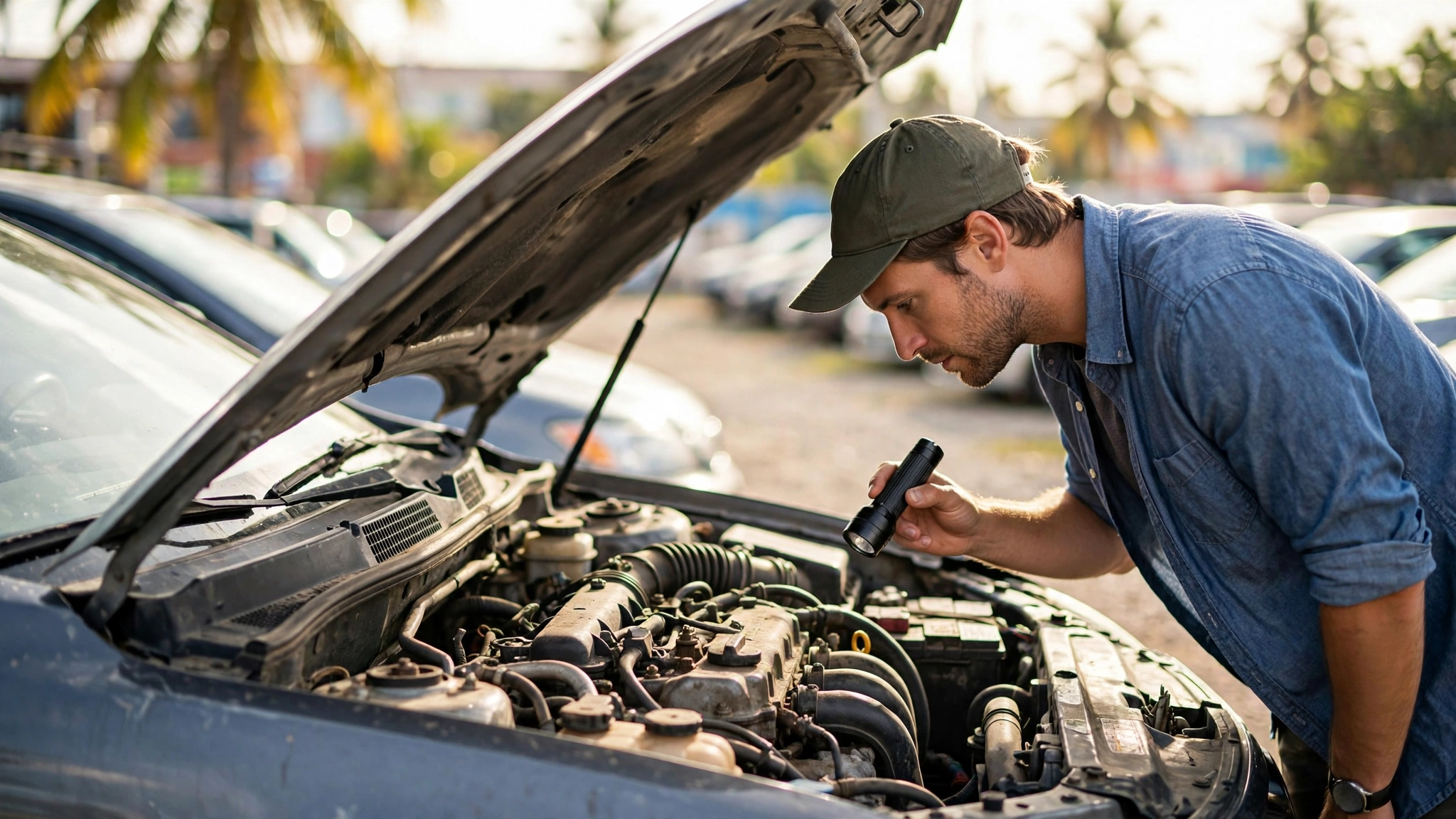
The checklist: 25 points, about an hour, with a flashlight, a $20–$40 paint gauge, a $15–$30 OBD2 scanner, paper towels, and a friend. Each point: what to check, how, and what it costs in USD if it’s bad.
Part 1: Paperwork & History (Points 1–4)
1. Run the VIN through NICB VINCheck — it’s free
The 17-character VIN is on the dashboard and door jamb. The NICB’s free VINCheck searches insurer reports covering ~92% of the US market, flagging salvage, flood, or theft. Five searches per day.
How: Enter the VIN before visiting. A flood or salvage hit = walk away.
Cost if skipped: A flood car can cost $12,000–$20,000 in electrical gremlins. The check costs zero. Note: uninsured flood cars won’t appear — the physical checks below still matter.
2. Read the title and registration like a detective
The VIN on the documents must match the car — all 17 characters. The seller’s name must match the title; “I’m selling it for my cousin” is how stolen and lien-burdened cars change hands. Watch for title washing: a flood/salvage car re-titled in another state so the new paperwork looks clean. Red flags: a recently issued out-of-state title, or ownership changing hands two or three times in months.
How: Compare VINs character by character; ask where and when the car was imported.
Cost if bad: Walk away — you can’t fix a washed title, and reselling becomes your problem.
3. Hunt for odometer fraud — rampant in import markets
A rolled-back odometer turns a tired 200,000-mile car into a “fresh” 80,000-mile one, adding thousands to the price. Look for the mismatch: heavy wear (shiny steering wheel, bald pedal rubber, sagging seat) on a low-mileage car; replacement or mismatched tires under 50,000 miles (factory tires last ~30,000–50,000); old stickers or receipts showing higher mileage than today’s odometer — odometers don’t decrease on their own.
How: Read every mileage entry on any history report in order — each ≥ the last. Cross-check wear, tires, stickers.
Cost if bad: Walk away. A rolled-back car is past the maintenance its odometer claims — budget $2,000–$5,000 in catch-up repairs.
4. Decode the VIN and check open recalls
The free NHTSA VIN decoder confirms the real make, model, year, engine, and specs — useful when a seller “isn’t sure.” The recall lookup shows unrepaired safety recalls, including Takata airbag recalls affecting millions of Caribbean cars.
How: Decode + recall lookup on the same VIN at nhtsa.gov.
Cost if bad: Recalls are fixed free — but dealer support for US-spec cars in Haiti is thin, so verify the fix exists.
Part 2: Exterior & Frame (Points 5–9)
5. Check for salt-air rust — underneath, not on top
Sellers wax the top; rust starts underneath. Check rocker panels, wheel wells, subframe, mounts, brake lines, exhaust. Surface rust (wipeable orange dust) is cosmetic. Flaking, bubbling, or perforated metal is structural — poke gently with a screwdriver; if it goes through, the panel is done. Rusted brake lines are a safety issue: a burst line means no brakes.
How: Kneel with a flashlight; check the spare-tire well — a rust trap.
Cost if bad: Surface treatment $200–$500; structural repair $1,500+; brake lines $300–$800. Perforated subframe = walk away.
6. Read the paint with a thickness gauge
Factory paint: ~80–180 microns, uniform across panels. A jump — 120 on the hood, 320 on the fender — means repaint, and repaint usually means damage. Over 300 = body filler; over 1,000 = major structural work.
How: Baseline on the roof or A-pillars (rarely damaged), then every panel; compare left to right.
Cost context: A resprayed bumper is a $300 touch-up story; fender + door + quarter panel at 400+ is an undisclosed major accident — negotiate $1,500–$3,000 off, or walk away if the frame is involved.
7. Spot accident-repair tells
Uneven panel gaps, paint mismatch in sunlight, differing orange-peel texture, overspray on seals, doors that don’t close with the same thunk, headlights newer than the car. Under hood and trunk: factory welds are uniform dots; repairs show grinding marks or hand-smeared seam sealer.
How: Walk around twice — shade, then direct sun. Sunlight exposes what shade hides.
Cost if bad: Cosmetic work $500–$1,500; structural damage = walk away, no exceptions.
8. Hunt for flood water lines
Detailers can’t reach everywhere. Pull each seatbelt fully out — stains or a tide mark on the webbing means the car sat in water. Lift carpets, press the padding: dampness, mud, or musty smell = flood. Lift the spare-tire cover: silt or moisture in the well. Check inside headlights/taillights for fogging or a water line. Unpainted screw heads under the dashboard rust fast after a flood. Smell the cabin with doors closed — musty odor or heavy air freshener are both red flags.
How: Seatbelt pull + carpet lift + trunk well + sniff test. Ten minutes.
Cost if bad: Walk away. Flood damage surfaces 6–12 months later; corrosion keeps advancing toward the airbag system and ECU long after the car looks dry.
9. Inspect the frame and underbody
On a lift if possible; otherwise one side up on a curb. Look for bent frame rails, cracked subframes, leaking differentials. Fresh, thick undercoating on an older car often hides rust or repairs.
How: Visual check underneath; question asymmetry (one side clean, one coated).
Cost if bad: Frame straightening $800–$2,500; cracked subframe = walk away.
Part 3: Engine & Fluids (Points 10–13)
10. Read the oil — it tells the engine’s life story
Dipstick out, wipe, dip again. Healthy: amber to dark brown, translucent. Milky “chocolate milkshake” oil = coolant in the oil — blown head gasket or cracked block. Walk away. Gritty oil or thick sludge = skipped changes; on a turbo engine, that’s fatal for a turbo spinning at up to 250,000 RPM on a film of oil.
How: Dipstick + paper towel. Two minutes.
Cost if bad: Head gasket $1,500–$2,500; sludged engine replacement $3,000–$6,000.
11. Check coolant, transmission fluid, brake fluid
Coolant (overflow reservoir — never open the radiator cap hot): green, orange, or pink. Brown/rusty or an oily film = a cooling system eating itself. Transmission fluid (where a dipstick exists): pinkish-red and clean-smelling; dark brown or burnt = the transmission has been cooking. Brake fluid: clear to light amber; dark and moisture-absorbed lowers the boiling point — a safety issue on Haiti’s mountain descents.
How: Three reservoirs, three paper towels, three minutes.
Cost if bad: Cooling overhaul $400–$1,000; burnt fluid = budget a $2,500–$4,500 rebuild, or walk away.
12. Cold-start the engine — never inspect warm
Warmth hides cold-start problems, so ask the seller not to warm the car up — an already-warm engine on arrival is a red flag. On a cold start, watch the exhaust 30 seconds: brief white vapor is normal; blue smoke = burning oil; thick white smoke that won’t clear = burning coolant (head gasket); black = running rich. Knocking (bottom end — walk away); ticking that doesn’t fade (lifter/valve issues).
How: Hand on the hood to confirm cold. Start it yourself; watch and listen 60 seconds.
Cost if bad: Valve seals $800–$1,500; worn rings = rebuild $3,000–$6,000; knocking = walk away.
13. Check for leaks — then check where it parks
Fresh drips under the engine; finger-wipe hose connections, oil pan, transmission bell housing. Have the seller move the car and read the ground: black = engine oil, red/pink = transmission or power steering, green/orange = coolant, clear = usually just AC condensation (normal in Haiti’s heat).
How: Ground check + finger wipe along seams.
Cost if bad: Minor seep $150–$400; rear main or transmission seal $600–$1,200 (transmission comes out).
Part 4: Transmission (Point 14)
14. Make the transmission prove itself
Automatics dominate Haitian imports, and a failing one is among the priciest surprises. Warm engine, shift slowly P-R-N-D: each engagement smooth within two seconds. Hard clunks or delays = worn clutches or valve-body trouble. On the drive: slipping (RPMs flare, speed doesn’t rise), harsh/delayed shifts, shuddering = walk away. CVTs (Nissan/Honda/Toyota): whining under acceleration. Manuals: clutch engages in the top third of travel, not at the floor.
How: Slow shift test + focused attention on shift quality.
Cost if bad: Automatic rebuild $2,500–$4,500; CVT replacement $3,000–$5,000; clutch $600–$1,200.
Part 5: Suspension, Brakes & Tires (Points 15–17)
Haiti’s roads — potholes, unpaved stretches, curb-sized speed bumps — are the ultimate suspension test. Check what it cost the car.
15. Bounce-test the suspension; listen over bumps
Push each corner down hard — one rebound and settle. Repeated bouncing = worn shocks/struts. Slow drive, windows down: clunking = ball joints, bushings, sway-bar links; creaking = dry bushings; rhythmic thumping with speed = wheel bearing. Tire read: feathered edges = alignment/tie rods; cupping = worn shocks.
How: Bounce test + slow drive, windows down + tire-wear reading.
Cost if bad: Struts/shocks $400–$1,000/pair; control arms/ball joints $300–$800/side; wheel bearing $250–$500.
16. Test the brakes like your life depends on it — it does
Firm stop from ~50 km/h: straight line, firm pedal — not spongy, not sinking. Pulsation = warped rotors. Grinding = pads gone, rotors eaten. Pulling = stuck caliper or collapsed hose. Test the parking brake on a hill.
How: Firm stop from speed + pedal feel + hill test.
Cost if bad: Pads + rotors $250–$600/axle; caliper $200–$400; full overhaul with lines $600–$1,200.
17. Read the tires: age, wear, matching
Tread matters less than the DOT date code — “2419” = 24th week of 2019. Over six years is suspect regardless of tread; tropical heat hardens rubber. Mismatched brands = cheapest-option maintenance attitude. Check the spare: missing or flat in Haiti, where a flat can strand you far from help, is a real problem.
How: DOT codes on all four + spare; tread check; brand match.
Cost if bad: Decent set $400–$800 — build it into your offer if aged out.
Part 6: Electronics & AC (Points 18–19)
Heat, humidity, and flood history are brutal on electronics — flood cars grow electrical faults months after purchase. Test everything.
18. Exercise every electrical function
All windows, locks, mirrors, sunroof, wipers (every speed), every light, horn, infotainment, Bluetooth, backup camera, gauges. Each warning light must illuminate at startup then go out — one that never lights may be disabled to hide a fault. Then the OBD2 scan: stored codes — even “cleared” ones — tell the truth. Codes across unrelated systems (engine + ABS + airbag) are a classic flood signature. One code = maybe a $50 sensor; a Christmas tree = wiring-harness nightmare.
How: Ten-minute button marathon + $15 OBD2 scan.
Cost if bad: Sensor $50–$300; wiring/ECU $800–$3,000+; flood-pattern codes = walk away.
19. The AC must blow ice-cold — non-negotiable
In Haiti’s heat, AC is the difference between a usable car and a greenhouse. Max AC, five minutes: vent air genuinely cold (~4–10°C / 40–50°F). Lukewarm air, rapid compressor cycling, or grinding = trouble. Run the heat a minute too — a bypassed heater core hides a leak.
How: Max AC, five minutes, hand at the vent.
Cost if bad: Recharge $100–$200 (ask why it leaked); compressor $800–$1,500; buried evaporator $1,000–$2,000 labor alone.
Part 7: Hybrid Checks (Points 20–21)
Hybrids (Prius, Camry/RAV4 Hybrid, and the wave from US auctions) are increasingly common in Haiti — and the battery is the priciest wear item.
20. Check hybrid battery health
Weak signs: engine always running at low speed, economy far below rating, gauge swinging wildly, warning lights (Prius red triangle). A hybrid-capable OBD2 app reads block voltages — one weak block = failing pack. Packs last ~8–12 years or 150,000–250,000 km; tropical heat shortens that.
How: Watch the energy monitor on the drive + block-voltage read if possible.
Cost if bad: Refurbished $2,000–$4,000; new OEM $3,000–$8,000. Price it in or walk away.
21. Check inverter coolant; listen for inverter whine
Hybrids cool the inverter and motors on a second circuit — check that reservoir like engine coolant. Low/dirty fluid risks frying electronics pricier than the engine. A loud whine under acceleration, beyond the normal subtle whir, needs a mechanic’s opinion.
How: Second reservoir check + listening.
Cost if bad: Inverter $2,500–$5,000. Another walk-away candidate.
Part 8: The Test Drive (Points 22–24)
Twenty minutes minimum: highway speed, rough roads, hills, tight turns. Never buy without driving.
22. Listen — the car tells you what’s wrong
Radio off, windows down: speed-dependent whining = wheel bearing/differential; clicking on tight turns = CV joints; squealing at low-speed turns = power steering pump/belt; hissing = vacuum leak; rattling over bumps = heat shields/suspension; siren whine under boost = dying turbo bearings.
How: Radio off, windows down; a friend in the back seat hears what you can’t.
Cost if bad: CV axle $200–$500; wheel bearing $250–$500; turbo $1,500–$3,500.
23. Feel — steering, alignment, vibrations
Straight road, loosen grip briefly: the car must track straight. Steering-wheel vibration = balance or front-end wear; seat vibration = rear wheels/driveshaft. Full lock in a lot: binding or groaning = CV or steering issues.
How: Drift test + full-lock turns.
Cost if bad: Alignment $75–$150; tie rods $200–$400; steering rack $600–$1,200.
24. Heat-cycle it: drive, park, look again
Hood up after the drive: fresh leaks, steam, burning smells, belts squealing hot. Idle two minutes — overheating at idle = fan, thermostat, or water pump trouble, a breakdown waiting to happen in Haiti’s traffic. Confirm both fans kick on.
How: Post-drive hot inspection (don’t touch).
Cost if bad: Thermostat $150–$300; water pump $400–$800; cooling fan $200–$500.
25. Pay a trusted mechanic for a pre-purchase inspection
After your 24 points, the best money you’ll spend: an independent inspection — a mechanic with no connection to the seller, on a lift, typically $50–$150 in Haiti. If the seller refuses, you have your answer.
Negotiating With Your Findings
- Stack the small stuff. Worn tires ($600) + brakes due ($400) + AC recharge ($150) + overdue timing belt ($700) = a $1,850 discount argument. List calmly, with numbers.
- Price big stuff at retail. A slipping transmission isn’t “a small issue” — quote the $3,000 rebuild, subtract in full.
- Walk-away items aren’t negotiation items. Flood, frame damage, milky oil, odometer fraud, washed title — no discounts, just goodbyes.
- Use the inspection report — written findings turn opinions into leverage.
- Be ready to walk away. Another car is always coming off the next boat. The buyer who can leave gets the price.
A used car in Haiti can be your smartest purchase or your most expensive lesson. The difference is an hour with a checklist, a flashlight, and the willingness to say no.
Sources: NICB VINCheck; NICB on title washing; Consumer Reports.
Leave a Reply