By DealShore Motors
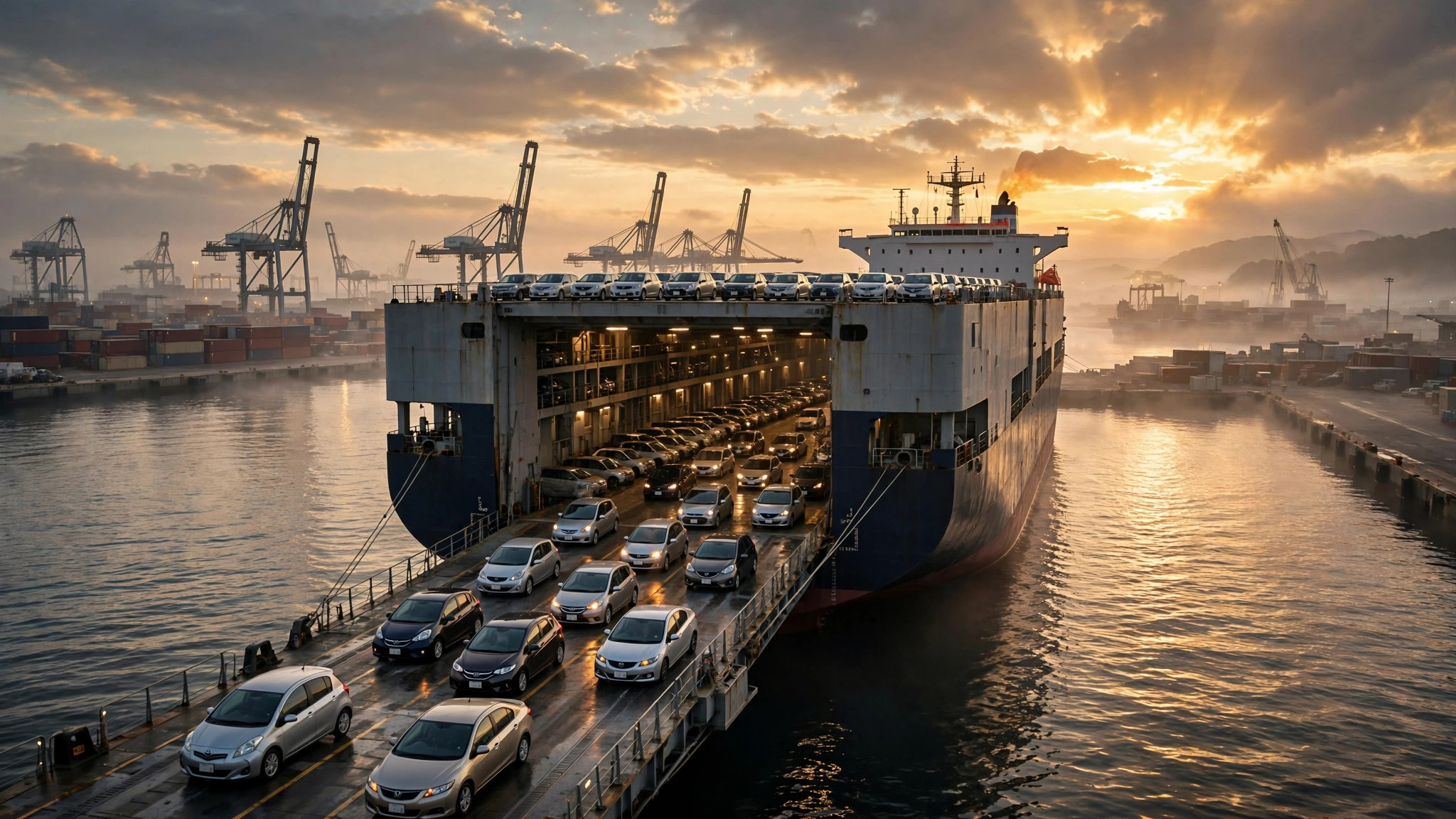
Every week, thousands of cars roll off Japanese auction yards and onto RoRo ships bound for the Caribbean. Many of them are headed for one country in particular: Haiti, where Japanese used cars — Toyota Aqua, Honda Fit, Toyota Corolla, Nissan X-Trail — have become the backbone of everyday driving. They’re cheap to buy, famously reliable, and sip fuel on roads where gasoline prices demand it.
But the price tag on the exporter’s website is never the price you actually pay. Between the Japanese auction floor and Haitian plates, a car passes through eight separate cost gates: the car itself, exporter fees, ocean freight, insurance, Haitian customs duties, port charges, inland transport, and registration. Miss any one of them in your budget and your “$3,000 bargain” can quietly become an $8,000 commitment you didn’t plan for.
Here’s the full 2026 breakdown, step by step, with real numbers — and three worked examples showing exactly what a Toyota Aqua, a Honda Fit, and a bigger SUV would cost to land in Haiti.
Step 1: The car itself — Japanese auction prices
Japan’s used-car auctions move millions of vehicles a year, and prices are refreshingly public. Recent benchmarks (September 2026):
- Toyota Aqua (2013–2016, hybrid): exporter FOB listings run $1,210–$4,450 — a high-mileage 2013 can go for $1,210, while a clean 2016 grade-4 sits near $3,700.
- Honda Fit (2015–2017): average auction price around ¥1,150,000 (about $7,285); lower-grade exporter stock lands $4,000–$6,500 FOB.
- SUVs (Nissan X-Trail, Toyota RAV4, Subaru Forester): popular X-Trail and RAV4 units in Haiti-friendly grades typically go $6,000–$9,000 FOB.
Conversions use roughly ¥158 = $1, the October 2026 rate. A weak yen — which is what we’ve had — makes every Japanese car cheaper for dollar buyers.
Auction grades matter enormously. Japan grades cars 3 through 5 (5 is near-new); grade R means accident-repaired. For Haitian roads, a grade 3.5–4 car with 80,000–130,000 km is the value zone: cheap enough to import profitably, clean enough to run for years.
Step 2: Exporter and agent fees
Unless you personally bid at Japanese auctions, you buy through an exporter — companies like BE FORWARD, CAR FROM JAPAN, Autocom Japan, SAT Japan, or Sainico Ltd (mentioned by name only; do your own homework on each). They typically charge one of two ways: a flat service/agent fee of $100–$300 per car, or they fold their margin into the FOB price they quote you.
On top of that come the unavoidable Japan-side costs: inland transport from the auction yard to the export port (Yokohama, Kobe, Osaka, $100–$200), export documentation ($50–$100), and an optional pre-shipment inspection ($100–$150).
Budget $300–$500 for the full Japan-side service stack.
Step 3: RoRo shipping — the ocean crossing
This is the biggest single line item after the car itself. Vehicles travel to Haiti on RoRo (roll-on/roll-off) ships — giant floating parking garages. Industry-wide, RoRo runs $800–$2,500 per vehicle, and the Japan-to-Caribbean lane sits at the upper end. Recent exporter C&F quotes show per-car freight of roughly $2,200–$2,400 on long Pacific/Caribbean routes — e.g., a $1,700 FOB Toyota Aqua pricing out at $4,081 C&F. For Port-au-Prince, plan on $1,500–$2,000 for a compact and $1,900–$2,600 for an SUV.
The discharge port is Port-au-Prince, Haiti’s main RoRo port (Cap-Haïtien receives cargo too, but Japan-routed sailings there are infrequent — confirm the port with your exporter before paying). Transit time: 7–8 weeks from departure (ETD). Caribbean RoRo sailings aren’t weekly like the Africa routes, so a car can wait two to four weeks at the Japanese port for the right ship. Ask for the named vessel and ETD before assuming any timeline.
Container shipping is the alternative: around $1,500–$4,000 per box. It’s safer — the vehicle is sealed, so pilfering is essentially impossible — but it’s rarely worth it for a single budget car. It makes sense when you’re importing two or three cars together: a 40-foot container can carry them at a per-car cost competitive with RoRo. RORO theft exposure is real — cars on open decks can be pilfered of radios, mirrors, and accessories at either port.
Step 4: Marine insurance
RoRo ships sail through storms, and Haiti’s hurricane exposure is no joke. Marine insurance runs roughly 1.5–2% of the insured value (car price + freight) — about $75–$100 on a $5,000 CIF car. Some exporters bundle basic coverage into C&F quotes; confirm what’s actually covered.
Step 5: Haitian customs duties and taxes — the layered stack
This is where most first-timers get blindsided. Haiti doesn’t charge a single import duty on used cars; it charges a stack of taxes, each calculated on the customs (CIF) value. Here are the official components, drawn from the U.S. Commercial Guide to Haiti:
| Tax | Rate | Base | Notes |
|---|---|---|---|
| Used-vehicle import tax | 10% | CIF value | Applies to all imported used vehicles |
| Environmental Protection Tax (EPT) | 10% | CIF value | Levied on used vehicles, used tires, used batteries |
| Registration tax | 5–20% | Customs value | 5% under HTG 35,000; 20% over HTG 75,000 — virtually every car lands in the 20% bracket |
| Excise tax | 10% | CIF value | Only cars with engines of 2,200cc or more |
| Additional used-vehicle taxes | up to 30% | Customs value | Official band for used vehicle imports; applied per decree |
There is no VAT in Haiti. Duties are payable in gourdes at the prevailing daily exchange rate, and they’re collected by the Haitian Central Bank for goods entering Port-au-Prince.
Read that table carefully: on a typical imported used car under 2,200cc, the stacked taxes reach roughly 40% of the CIF value. For a 2.2L+ SUV, the 10% excise pushes it toward 50%. The “additional taxes” band of up to 30% means the total can go higher depending on how customs classifies the vehicle — which is exactly why you confirm the numbers with a Haitian customs broker before you buy.
Two regulatory facts in your favor: no age restrictions (a 2013 Aqua is as importable as a 2021 one) and no pre-shipment inspection required.
But customs gets to second-guess your paperwork: if they reject your invoice value, they value the car from the Blue Book — which can push your duty bill well above the invoice math. Keep your invoice, export certificate, and bill of lading airtight.
Step 6: Port handling and clearance fees
The ship has docked at Port-au-Prince. Now the Haitian side of the bill begins:
- Terminal deposit: roughly $300 for used vehicles passing through the terminal
- Port handling / THC charges: $200–$400 depending on the terminal and vehicle size
- Clearing agent (expediter) fee: $300–$500 — and this is the fee worth paying
Customs formalities officially take 24–48 hours if all your documents are in order. In practice, clearance stretches when paperwork is off — and every delay costs real money: shipping lines start charging demurrage after about 17 days, and customs levies storage duties of 2% of the customs value per month. An experienced local expediter is the single best money you spend in this entire process, because they move your car through before the clock starts running. Budget $500–$1,000 total for port and clearance if everything goes smoothly; double it if it doesn’t.
Documents you’ll need in hand: original invoice, original export certificate from Japan (plus translated copy), and the original bill of lading — in four original copies, signed by the captain. Lose any of these and your car sits.
Step 7: Inland transport
Once cleared at Port-au-Prince, the car needs to get to its owner: $100–$200 within the metro area, $200–$400 by flatbed to Cap-Haïtien or Gonaïves — Haiti’s roads punish fresh imports, so truck it rather than driving it up RN1. If your exporter can discharge directly at Cap-Haïtien on a given sailing, take it.
Step 8: Registration and plates
Haiti’s registration tax is paid at customs as part of the tax stack above. After clearance, you’ll pay the administrative side: vehicle registration, plates, and the matricule paperwork. These fees are modest — typically $100–$200 — but they involve trips to the DGI (tax authority) offices, and first-timers usually hire their clearing agent to handle them too.
Three worked examples: total landed cost
Now let’s put it all together. These are illustrative estimates built from the ranges above — your exact numbers will move with the auction hammer, the freight market, and the gourde. Every figure is in USD.
Example 1: 2015 Toyota Aqua hybrid (1.5L, ~120,000 km) — the budget king
| Cost step | Amount |
|---|---|
| Auction / FOB price | $3,200 |
| Exporter fees, inland transport, export docs | $400 |
| RoRo freight Japan → Port-au-Prince | $1,700 |
| Marine insurance (~1.5%) | $80 |
| CIF value | $5,380 |
| Used-vehicle tax (10% of CIF) | $538 |
| Environmental Protection Tax (10%) | $538 |
| Registration tax (20% — over HTG 75,000) | $1,076 |
| Port handling + clearing agent | $600 |
| Inland transport (Port-au-Prince area) | $100 |
| Registration / plates | $150 |
| Total landed cost | ~$8,480 |
The Aqua is Haiti’s classic Japan import: 1.5L hybrid, no excise tax, parts everywhere. A $3,200 car in Japan becomes roughly an $8,000–$9,000 car in Haiti — about 2.6x the purchase price. That multiplier is the number to internalize.
Example 2: 2016 Honda Fit hybrid (1.5L, ~90,000 km) — the family hatchback
| Cost step | Amount |
|---|---|
| Auction / FOB price | $4,500 |
| Exporter fees, inland transport, export docs | $400 |
| RoRo freight Japan → Port-au-Prince | $1,800 |
| Marine insurance | $100 |
| CIF value | $6,800 |
| Used-vehicle tax (10%) | $680 |
| Environmental Protection Tax (10%) | $680 |
| Registration tax (20%) | $1,360 |
| Port handling + clearing agent | $600 |
| Inland transport | $150 |
| Registration / plates | $150 |
| Total landed cost | ~$10,520 |
The Fit’s magic interior and Honda reliability make it one of the most-requested used cars in the Caribbean. Lands around $10,000–$11,000.
Example 3: 2016 Toyota RAV4 (2.5L, ~100,000 km) — the SUV with a tax sting
| Cost step | Amount |
|---|---|
| Auction / FOB price | $8,000 |
| Exporter fees, inland transport, export docs | $400 |
| RoRo freight (bigger car) | $2,200 |
| Marine insurance | $160 |
| CIF value | $10,760 |
| Used-vehicle tax (10%) | $1,076 |
| Environmental Protection Tax (10%) | $1,076 |
| Registration tax (20%) | $2,152 |
| Excise tax (10% — engine ≥ 2,200cc) | $1,076 |
| Port handling + clearing agent | $600 |
| Inland transport (flatbed, longer trip) | $200 |
| Registration / plates | $200 |
| Total landed cost | ~$17,540 |
See what happened? The 2.5L engine triggered the 10% excise tax — an extra $1,076 that a 2.0L RAV4 or a Nissan X-Trail 2.0 would have avoided entirely. Engine displacement is a tax decision in Haiti, not just a driving decision. Total: roughly $16,500–$18,500.
The pattern across all three: Haitian taxes and port costs roughly equal the car-plus-freight cost. As a rule of thumb, your landed cost will be 2.3–2.7x the Japanese purchase price for a sub-2.2L car, and more for bigger engines.
The timeline: from auction bid to Haitian plates
| Stage | Time |
|---|---|
| Research, bidding, winning the car | 1–2 weeks |
| Payment (telegraphic transfer) and exporter processing | 1 week |
| Export docs, delivery to Japanese port, vessel booking | 1–3 weeks (depends on sailing availability) |
| Ocean transit, Japan → Port-au-Prince | 7–8 weeks |
| Customs clearance at Port-au-Prince | 24–48 hours if docs are perfect; budget 1–3 weeks realistically |
| Registration and plates | 1–2 weeks |
| Total | ~11–14 weeks |
Three and a half months from “I found it on the exporter’s site” to driving it in Pétion-Ville. Plan your money and your patience accordingly — and never sell a car you don’t physically have yet.
Pitfalls and scams to avoid
Wire fraud is the big one. Never send a telegraphic transfer to a personal account or an unverified company. Legitimate Japanese exporters are registered members of JUMVEA (the Japan Used Motor Vehicle Exporters Association) — check before you pay, and be suspicious of anyone insisting on unusual payment channels.
Auction sheet tampering. The auction sheet is the car’s report card — grade, mileage, accident history. Always demand the original sheet and pay for an independent translation and verification before bidding.
No personal items in RoRo cars. Carriers prohibit loose belongings. Pack the trunk and your stuff gets confiscated or the car gets refused at loading.
The undervalued-invoice trap. Asking an exporter to write a lower invoice value to cut duties backfires in Haiti: if customs rejects your invoice, they value the car from the Blue Book, and the resulting duty bill is usually higher than honest math.
Demurrage and storage creep. Your car gets roughly 17 free days at the port, then the meter runs — customs storage is 2% of the value per month on top. Every day of delay has a price tag. This is why the clearing agent is non-negotiable.
Pilfering on RoRo. Cars on open decks can lose radios, mirrors, and accessories at either port. Photograph everything before loading, remove valuables, and consider container shipping for anything worth real money.
The hybrid battery question. Most Haiti-bound Aquas and Fits are hybrids with 8-to-13-year-old battery packs. A dying one is a $1,500–$2,500 replacement (typical range, Haiti market). Budget a battery health check — or a replacement — in your first year.
Tips for first-time importers
- Start with the tax math, not the car. Pick your engine size first (stay under 2,200cc), then shop. The 10% excise tax is the easiest $1,000 you’ll ever save.
- Get a clearing agent before the ship sails. Not when it arrives — before. They’ll tell you exactly which documents to have couriered and where.
- Keep a 15% contingency fund. Freight moves, the gourde moves, customs interprets. If the math only works with zero slack, the deal doesn’t work.
- Buy grade 3.5–4, not grade R. Accident-repaired cars are cheaper in Japan and vastly more expensive in Haiti, where every pothole reopens the repair.
- Photograph the car at loading. Every angle, the odometer, the interior. It’s your only evidence if something arrives different.
- Ship with a known sailing. Ask for the vessel name and ETD in writing. “It’ll ship soon” is not a schedule.
- Check parts availability first. Aqua, Fit, Corolla, Vitz, X-Trail — parts are everywhere in Port-au-Prince. An obscure model is a beautiful paperweight.
- Time your purchase. Japanese auction prices dip in the shoulder months; freight rates spike around March and September auction peaks. Buying in the quiet months can save you hundreds on both ends.
The bottom line
Importing a used car from Japan to Haiti is one of the best automotive deals in the Caribbean — if you budget the whole chain. The car’s price in Japan is roughly 40% of what you’ll actually spend. The other 60% is freight, insurance, and Haitian taxes, and none of it is negotiable. A $3,200 Toyota Aqua lands around $8,500. A $4,500 Honda Fit lands around $10,500. A $8,000 RAV4 2.5L lands around $17,500 — and the only surprise in that sentence should be how predictable it is.
Haiti puts no age limit on imports and requires no pre-shipment inspection, which keeps the door wide open. Do the math honestly, hire the expediter, verify the exporter — and the pipeline from Yokohama to Port-au-Prince will treat you very well indeed.
Thinking about importing? DealShore Motors covers the full Haitian car market — buying guides, model picks, and cost breakdowns — with new deep dives every week.
Sources
Auction prices (September 2026 averages: Honda Fit ¥1,150,000; Subaru Forester ¥2,300,000): JapaneseCarTrade; used-car market overview and ¥1,233,000 average: Accio. Toyota Aqua FOB listings: Sainico Ltd and BE FORWARD; Honda Fit under-$8,000 pricing: JapaneseCarTrade. RoRo costs ($800–$2,500) and cost factors: Medium, Feb 2026. Haiti import rules, RoRo 7–8 weeks, documents, banks: CAR FROM JAPAN — Haiti. Haitian duties, tax bands, EPT, excise, demurrage, storage: U.S. Country Commercial Guide — Haiti and Haiti Now — Import Tariffs; customs procedures and Blue Book revaluation: toyota-hilux-revo.org; terminal deposit (~$300): IAM Haiti Country Guide; demurrage terms: Hapag-Lloyd Haiti. JPY/USD (~¥158 = $1, Oct 2026): ConverterHub.
Leave a Reply