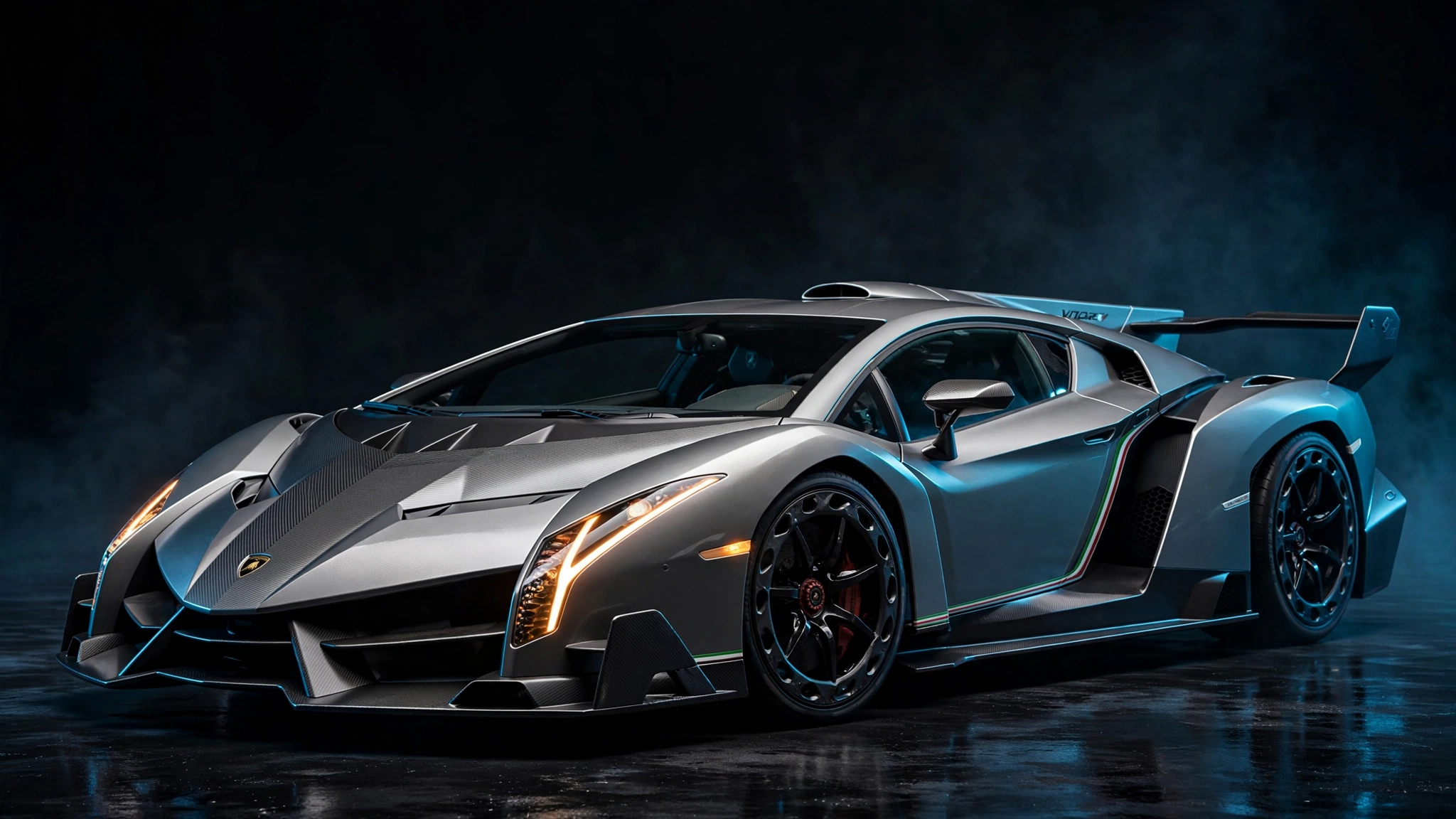
Lamborghini Veneno Specs: 740 HP, 221 MPH, Only 12 Built
By DealShore Motors
Here is the number Lamborghini does not put in big type: under the most extreme body the company has ever sold sits an Aventador. Same 6.5-litre V12 architecture, same carbon monocoque, same ISR gearbox — turned up to 750 PS and wrapped in a racing prototype’s skin. The Veneno cost €3 million plus tax in 2013, roughly ten times an Aventador, and all three coupés were sold before the public ever saw the car at Geneva. You were never buying speed the Aventador couldn’t approach. You were buying the fact that only 12 customer cars would ever exist. This is the full data — and what that data actually means.
This is a research piece built from Lamborghini’s official 2013 press releases and documented public sales — no invented test drives, no borrowed keys.
The Full Spec Sheet
| Veneno Coupé (2013) | Veneno Roadster (2014) | |
|---|---|---|
| Engine | 6,498 cc naturally aspirated V12, 60° | Same |
| Power | 750 PS (552 kW) at 8,400 rpm — 740 hp in US figures | Same |
| Torque | 690 Nm (509 lb-ft) at 5,500 rpm | Same |
| Gearbox | 7-speed ISR single-clutch automated manual, 5 modes | Same |
| Drive | Permanent all-wheel drive | Same |
| 0–100 km/h (0–62 mph) | 2.8 seconds | 2.9 seconds |
| Top speed | 355 km/h (221 mph) | 355 km/h (221 mph) |
| Dry weight | 1,490 kg (3,285 lb) | 1,490 kg (3,285 lb) |
| Power-to-weight | 1.93 kg per PS | 1.93 kg per PS |
| Chassis | Carbon-fibre (CFRP) monocoque, pushrod suspension, horizontal spring/damper units | Same |
| Production | 3 customer cars + 1 factory prototype (“Car Zero”) | 9 customer cars |
| Launch price | €3,000,000 plus tax | €3,300,000 plus tax |
A note on the horsepower argument, because the internet gets it wrong constantly: Lamborghini rates the car at 750 PS. Converted honestly, that is 740 hp — which is why this article’s title and Lamborghini’s own English press release (which rounded to “750 hp”) disagree by ten. Both numbers describe the same engine. Anyone quoting 750 horsepower and 355 km/h in the same breath is mixing metric and imperial units.
Where the Extra Power Came From
The base Aventador LP 700-4 made 700 PS. The Veneno’s extra 50 PS came from unglamorous, effective work: enlarged air intakes and a revised, lower-back-pressure exhaust system. That’s it. No turbochargers, no hybrid assist, no new engine — the L539 V12 breathing a little freer and revving to 8,400 rpm.
The brutal truth about the performance gap: a standard Aventador was already a 2.9-second, 350 km/h car. The Veneno shaved a tenth and added 5 km/h. If performance per euro is your metric, the Veneno is one of the worst deals Lamborghini ever printed. That was never the metric. The metric was the body, the aero programme, and the production cap — and on those, nothing else in the 2013 catalogue was close.
The Body Is the Product
Every panel is carbon fibre over the Aventador’s CFRP monocoque, and every line exists for airflow, not decoration:
- The front end works as one large wing, channelling air around the front wheels instead of into them.
- The massive rear wing and the “shark fin” running from the roof to the rear deck stabilise the car at speed — prototype-racing hardware, homologated for the road.
- A flat underbody and large rear diffuser manage the air underneath; the wheel arches are cut asymmetrically, like a racing car’s, to vent pressure.
- Inside, Lamborghini’s patented Forged Composite and woven CarbonSkin trim cut weight wherever metal or leather would normally sit.
Lamborghini called it “a racing prototype” that happens to be road-legal, and for once the press language undersells it: this is closer to a Le Mans concept with number plates than to a styled special edition.
The 12-Car Split — Read It Carefully
“Only 12 built” is true and misleading at the same time. The real split:
- 3 customer coupés — each finished in one colour of the Italian flag (green, white, red). All sold pre-reveal at €3 million plus tax.
- 1 factory prototype — “Car Zero,” grey metallic with all three flag colours as accents. Lamborghini kept it; it lives at the factory museum (MUDETEC) in Sant’Agata. It is not, and was never, a customer car.
- 9 Roadsters — announced later in 2013, shown aboard an Italian naval vessel in Abu Dhabi, at €3.3 million plus tax, with no roof of any kind — not even a temporary one. A roll bar and your courage are the weather equipment.
So: 12 customer cars, 13 coupés-and-roadsters including the prototype by some counts, 14 airframes if you count generously. Sellers quote whichever number makes their car sound rarest. If you ever see a Veneno advertised, the first question is which of the three categories it actually is — a “1 of 3” customer coupé and a “1 of 9” roadster are different markets entirely.
What They Cost Now (As of 2026)
Launch prices are history. Documented public data points:
- A Veneno Roadster from the seized collection of Equatorial Guinea’s vice-president sold at Bonhams’ Geneva-area sale in September 2019 for CHF 8.28 million — roughly double its launch price, six years on.
- One of the three customer coupés surfaced for sale in Canada in 2025 with just 127 miles on the odometer — effectively a museum piece that has been appreciating in storage its whole life.
- Most Veneno trades are private and undisclosed. Any exact “current value” a website gives you for a 12-car model is an estimate dressed as a fact — including, honestly, any range: the honest statement is multiples of the €3–3.3 million launch prices, set by whichever collector blinks first.
That is the Veneno’s real spec, the one that matters in 2026: it is not a car market, it is a 12-person waiting list with occasional funerals and divorces.
The Bottom Line
The Veneno is an Aventador turned to eleven in exactly three places: airflow, weight, and rarity. 750 PS, 355 km/h, 2.8 seconds, 1,490 kg — real numbers, verified against Lamborghini’s own release, and only marginally beyond the donor car. The other number — 12 customer cars, sold out before the reveal, trading at multiples of list — is the whole point. As engineering, it’s an aero experiment. As an asset, it’s one of the most successful limited runs Lamborghini ever built. Know which of those two things you’re admiring, and the Veneno makes complete sense.
In this series: Veneno vs Sesto Elemento, owning a Veneno, the Veneno’s 50th-anniversary story, and where the 12 cars live now.
🏁 THE ONLY VENENO MOST OF US WILL EVER OWN
When you buy through our links, we may earn an affiliate commission at no extra cost to you.
– Best Choice Products 1:24 Scale Licensed RC Lamborghini Veneno (Red) — officially licensed 1:24 replica with working headlights and taillights: the Veneno experience at roughly one two-hundred-thousandth of the real car’s price.
– Officially Licensed Lamborghini Veneno Remote Control Car (1:24) — licensed Veneno RC with LED lights and dual motors, about 30 minutes of play per charge: a desk-and-driveway tribute to the 12-car original.
Sources (as of October 2026): Automobili Lamborghini official press release, Geneva, 4 March 2013 (750 PS / 552 kW, 0–100 km/h in 2.8 s, 355 km/h, €3 million plus tax, three customer units, 6.5-litre V12, 7-speed ISR, pushrod suspension, CFRP monocoque, Forged Composite and CarbonSkin); Lamborghini Veneno Roadster launch reporting, 2013 (9 units, €3.3 million plus tax, 2.9 s 0–100 km/h); Bonhams Geneva-area sale, September 2019 (Veneno Roadster, CHF 8.28 million, as reported from the Bonhams results); 2025 Canadian listing of a customer coupé with 127 miles (John Scotti Automotive, Montreal, as reported by ItalPassion). Power conversion: 750 PS = 740 hp. Values on a 12-car model are indicative only; most trades are private.
Leave a Reply