Nissan Rogue & Altima: The CVT Problem Every Buyer Must Know About
By DealShore Motors
Walk through any used-car lot in America and you’ll see them everywhere: the Nissan Rogue and Nissan Altima. They’re cheap, they’re comfortable, they get great gas mileage, and the Rogue has been one of the best-selling SUVs in the country for over a decade. On paper, a 2015 Rogue with 80,000 miles for $9,000 looks like the steal of the century.
Here’s what the window sticker won’t tell you: sitting between the engine and the wheels is a transmission with one of the worst reliability records in modern automotive history. Nissan’s Jatco CVT has failed in millions of vehicles — usually between 60,000 and 100,000 miles — spawned multiple class-action lawsuits, forced Nissan into warranty extensions covering well over a million cars, and turned countless “great deals” into $5,000 repair bills. If you’re shopping for a used Rogue or Altima, this is the single most important thing you need to understand before you buy.
What a CVT Is — and Why Nissan’s Are Different
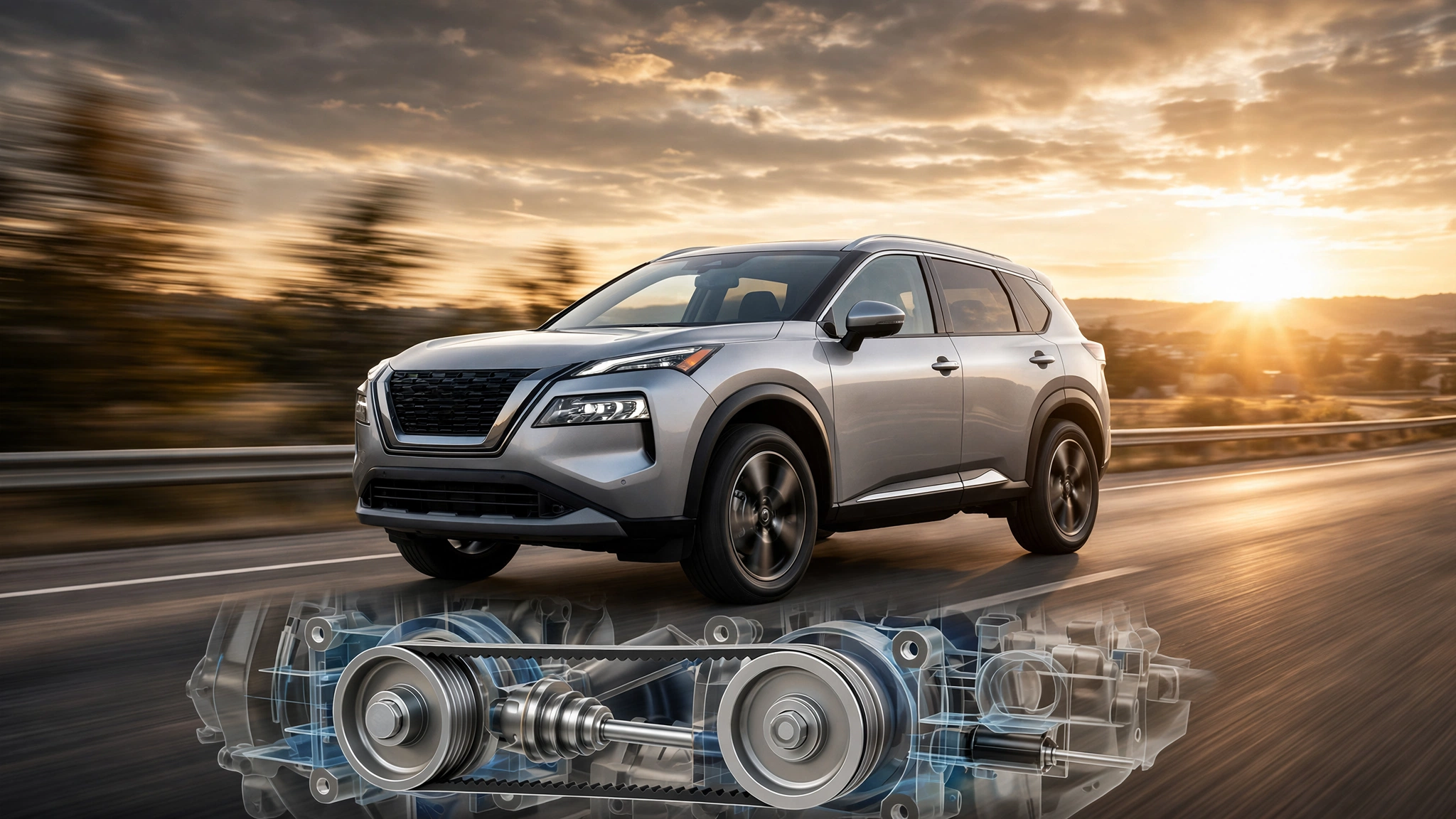
A continuously variable transmission has no gears. Instead of the fixed ratios in a conventional automatic, it uses two pulleys connected by a steel belt (or chain, in some versions). The pulleys change diameter infinitely, so the engine can always hold its ideal RPM — smooth, seamless, and great for fuel economy.
It’s an elegant idea. Toyota and Honda have sold millions of CVTs with strong reliability. So why did Nissan’s version become infamous?
Because Nissan made two engineering choices that turned elegance into fragility — and then compounded the problem with a maintenance schedule that basically ignored reality.
How They Fail: Heat, Pressure, and the “Filled for Life” Mistake
The JF011E (2007–2013 era): death by overheating
The first trouble unit was Jatco’s JF011E (Nissan code RE0F10A), fitted to the 2007–2012 Altima 2.5, the 2008–2013 Rogue, the 2007–2012 Sentra, and others. Its fatal flaw was cooling.
Under sustained load — a long highway climb, a hot summer day, towing anything — the transmission fluid temperature would spike. The steel belt would start to slip on the pulleys, scoring the pulley surfaces. Once the pulleys are scored, the damage is permanent and self-accelerating: more slip, more heat, more wear. Owners would report the car suddenly losing power at highway speed, the transmission falling into “limp mode” to protect itself, and the P0868 diagnostic code popping up — hydraulic pressure loss. According to Autoblog’s reporting on the failure chain, the belt slip deposits wear debris in the fluid, clogs the valve body, and by roughly 100,000 miles the unit is done.
The cooling problem was so pronounced that a classic owner story from repair databases reads like a script: an hour of summer highway driving, the car loses power on a hill, limping to the shoulder with the engine revving and nothing reaching the wheels.
The JF016E / CVT8 (2014–2020 era): the same disease, a new organ
For the second-generation Rogue (2014–2020) and the 2013–2018 Altima, Nissan switched to Jatco’s JF016E (Nissan code RE0F10D), marketed as the CVT8. It did fix the worst thermal problems. But it introduced a new failure chain.
Aggressive torque-converter lockup under hard acceleration put heavy strain on the oil pump’s internal flow-control valve. The valve wore out, hydraulic pressure dropped, the belt slipped, and wear debris contaminated the fluid — which then clogged the valve body and finished the job. Same symptoms, same 60,000-to-100,000-mile window, different root cause. (V6 Altimas of this era used the chain-driven JF017E, which had its own issues but a somewhat better record.)
The compounding sin: “filled for life” fluid
Here’s the part that turned a design weakness into a financial catastrophe. Nissan marketed these CVTs as having “filled for life” fluid — no changes needed, ever. That turned out to be an expensive fiction. Transmission specialists have been blunt about it: the fluid degrades, clutch material and belt dust accumulate, and the whole hydraulic system depends on clean fluid under precise pressure. Industry practice for these units is now a fluid-and-filter service every 30,000 to 60,000 miles, and owners who skipped it because the manual said “lifetime” often bought their transmissions an early death. Even later, more reliable Nissan CVTs are described by mechanics as “ticking time bombs” when the fluid was never serviced.
The Legal History: Three Rounds of Lawsuits
This isn’t forum folklore — it’s court-documented. Here’s the timeline:
2010 — the first warranty extension. After early CVTs failed at alarming rates, Nissan extended the CVT warranty to 120,000 miles (up from the 60,000-mile powertrain warranty) on virtually all 2003–2010 CVT-equipped Nissans: the 2007–2010 Altima, Maxima, Versa, and Sentra; the 2008–2010 Rogue; and the 2003–2010 Murano.
2019–2020 — the first wave of class-action settlements. Three consolidated class actions (Falk, Knotts, and Norman v. Nissan) covered the 2013–2016 Altima, 2013–2017 Sentra, 2012–2017 Versa and Versa Note, and 2013–2017 Juke. Owners reported shaking, jerking, hesitation, and total failure. Nissan — while denying all claims — agreed to extend the transmission warranty by 24 months or 24,000 miles, reimburse qualifying out-of-pocket repairs (full reimbursement for dealer repairs, up to $5,000 per repair for independent-shop work), and issue $1,500 vouchers toward a new Nissan or Infiniti for owners who suffered two or more transmission repairs.
2022 — the big one: ~$277 million. A second round of settlements covered the 2014–2018 Rogue, 2015–2018 Murano, Pathfinder, and Infiniti QX60, and 2016–2018 Maxima. The transmission warranty was extended to 84 months or 84,000 miles, with the same reimbursement structure. A separate filing launched in 2021 had detailed 2014–2016 Rogue owners’ complaints: vehicles revving to high RPM without accelerating, shuddering and lurching at highway speed — described in the filing as “an extreme and unreasonable safety hazard” on freeways.
2021 — the TSB that said the quiet part out loud. Nissan issued Technical Service Bulletin NTB 16-110P to dealerships for 2013–2017 Altimas and 2014–2017 Rogues with stored codes P17F0, P17F1, P0776, P2813, P1715, and/or P0841 — the bulletin explicitly references the “well known CVT judder and hesitation.”
The takeaway for a buyer: Nissan knew. The TSBs, the three settlement waves, and the repeated warranty extensions are a paper trail admitting that these units failed at rates no carmaker accepts for normal designs. Note that most of these extended warranties have now expired by age — a 2015 Rogue is past the 84-month window — so don’t count on Nissan covering anything.
Affected Years: The Specifics
Here’s where owners and complaint databases converge:
Nissan Rogue
– 2008–2013 (first generation): JF011E overheating failures. Old enough now that condition matters more than model year — but assume any un-serviced CVT is suspect.
– 2013–2016: the worst of the second generation. Per NHTSA data, 2013 alone generated the highest volume of CVT-related complaints, with many units needing full replacement between 60,000 and 90,000 miles. Multiple sources flag 2014–2018 as the years to avoid without proof of transmission care.
– 2017–2020: meaningful improvement — revised cooling and components — but CVT health still needs verification. The 2019 and 2020 models are widely considered the best second-generation buys.
– 2021–present (third generation): redesigned transmission, new platform, and the VC-Turbo engine from 2022. The 2025 and 2026 models are posting Rogue’s best reliability scores yet.
Nissan Altima
– 2007–2012: JF011E era — the overheating years. Avoid without a replaced unit or full service history.
– 2013–2018: JF016E era — better cooling, but the oil-pump and valve-body failure chain. The 2013–2016 models were the subject of the class action; problems typically surface at 60,000–100,000 miles.
– 2017–2019 and 2021–2023: the reliable window per owner data. Still CVTs, still needing strict fluid maintenance — but far fewer failures.
One more thing for shoppers: the 2017–2019 Rogue had a separate issue — automatic emergency braking “phantom braking” for nonexistent obstacles. It’s unrelated to the transmission but worth a check on those years.
Symptoms Owners Report
These are the complaints that show up by the hundreds in the NHTSA complaints database and on CarComplaints.com:
- Shuddering or “judder” — a violent shake, especially accelerating from a stop. The signature symptom; it’s even in Nissan’s own TSB language.
- Whining or humming — a high-pitched whine that rises with road speed, like a failing power-steering pump.
- Hesitation and lag — you press the gas, the RPMs climb, and the car barely responds. Then it lunges.
- Sudden power loss — after a long highway drive, the car drops into limp mode: engine revs, wheels get nothing. Pull over, let it cool, and it may recover — until next time.
- Hard deceleration “clunk” — a jolt when slowing down or rolling at low speed.
If a used Rogue or Altima does any of this on a test drive, it’s not a quirk. It’s the transmission telling you what it costs to replace.
What a Replacement Actually Costs
This is the number that matters. Based on current owner reports, repair-shop data, and remanufacturer pricing:
| Option | Typical cost (USD) |
|---|---|
| Dealer-installed new OEM CVT | $4,500–$8,000+ |
| Remanufactured unit (independent shop) | $2,200–$5,600 for the part; $3,800–$7,000 all-in |
| Used unit (salvage/JDM) | $900–$2,000 for the part; $1,500–$3,000 installed |
| Valve body replacement only | $200–$220 for the part; $800–$1,500 with labor |
A few realities behind the numbers: Nissan dealers generally replace rather than rebuild these units, which is why dealer quotes land at the top of the range. A full dealer replacement on an Altima can approach $8,000. Independent shops using remanufactured units are the value play — and a remanufactured unit from a quality rebuilder often carries a 3-year warranty that rivals the factory. The used-unit route is cheapest but you’re buying someone else’s worn CVT, which is a gamble that rarely pays.
Reality check: on a 2015 Rogue worth $9,000, a $5,000 transmission replacement is more than half the car’s value. That’s why these cars are cheap — the market has priced in the risk.
Are the Newer CVTs Any Better?
Yes — with a caveat. The data says:
- The 2017–2020 Rogue and 2017–2019 Altima CVTs fail far less often than their predecessors. Better cooling, revised programming, and updated internals did real work.
- The third-generation Rogue (2021+, especially 2022+ with the VC-Turbo) uses a further-redesigned transmission and is scoring Rogue’s best reliability marks.
- But — and this is the part mechanics won’t stop repeating — even the good ones need strict maintenance. A 2019 Rogue whose fluid was never changed is riskier than a 2015 with receipts for 30,000-mile services. The industry-standard interval for these units is new fluid and both filters every 30,000 to 60,000 miles, despite what any “lifetime fluid” claim in the manual says. On a used Nissan CVT, service history is not a nice-to-have. It’s the whole game.
Buying Used? Here’s What to Check
If you’re still considering a Rogue or Altima — and plenty of smart buyers do, at the right price — run this checklist:
- The 30-minute hot test drive. Don’t just circle the block. Drive it cold, then drive it at highway speed for at least 20 minutes, then accelerate hard onto an on-ramp. Overheating failures show up hot, not cold. Any shudder, whine, hesitation, or power loss is a walk-away — or a $4,000 negotiation.
- Check the fluid. CVT fluid should be relatively clean and clear. Burnt-smelling, dark, gritty fluid means internal wear. Nissan CVTs take specific NS-2 or NS-3 fluid — ask which was used and when.
- Demand service records. You’re looking for CVT fluid services every 30,000–60,000 miles. No records? Price in a fluid service immediately — or price in a replacement.
- Run the VIN. Check for completed TSB/recall work, especially the CVT-related updates. A Nissan dealer can pull the service history if it was dealer-maintained.
- Scan for codes. A $30 OBD-II scanner (or a mechanic’s scan tool) can reveal stored transmission codes like P0868 (hydraulic pressure loss) or the P17F0/P17F1/P0776 family that Nissan’s own TSB covers. Sellers can clear a check-engine light; stored codes often survive.
- Get a pre-purchase inspection — from a transmission-aware mechanic. A general mechanic is fine, but one who knows CVTs will check fluid condition, pull transmission-specific data, and tell you the truth in an hour. This is the best $150 you’ll ever spend on a used Nissan.
- Consider an extended warranty. Third-party warranties on these cars are expensive for a reason — the warranty companies know the failure rates. If the price of coverage is steep, that’s the market telling you the risk is real.
- Factor the transmission into your offer. A 2014–2016 Rogue at market price with no service records isn’t a $10,000 car — it’s a $10,000 car with a potential $5,000 invoice attached. Discount accordingly, or buy a 2019–2020 instead.
The Bottom Line
The Rogue and Altima earned their reputation the hard way — through millions of miles, thousands of complaints, and three waves of litigation. The 2008–2016 Rogues and 2007–2018 Altimas are genuine reliability risks, and no bargain price changes the engineering. But the story has an ending: the 2017–2020 models are solid, the 2021+ generation is genuinely good, and even the risky years can be smart buys at the right price with verified service history.
The CVT doesn’t lie. It just speaks in shudders, whines, and heat — and now you know how to listen.
Shopping smart means knowing what breaks before it breaks you. DealShore Motors is building the enthusiast’s guide to buying used — more deep dives like this every week.
Sources: NHTSA owner complaints database and Nissan Technical Service Bulletins (NTB 16-110P, covering 2013–2017 Altima and 2014–2017 Rogue); CarComplaints.com Nissan Altima/Rogue CVT class-action coverage; TopClassActions coverage of the 2014–2016 Rogue class action (Stringer/Brooks/Papania filings); Autoblog’s CVT reliability analysis (JF011E/JF016E failure chains); Road Ethos and Automotive24 Rogue model-year reliability analyses; owner repair reports from TrueDelta; remanufacturer cost data from Accio and independent transmission-shop pricing.
Leave a Reply