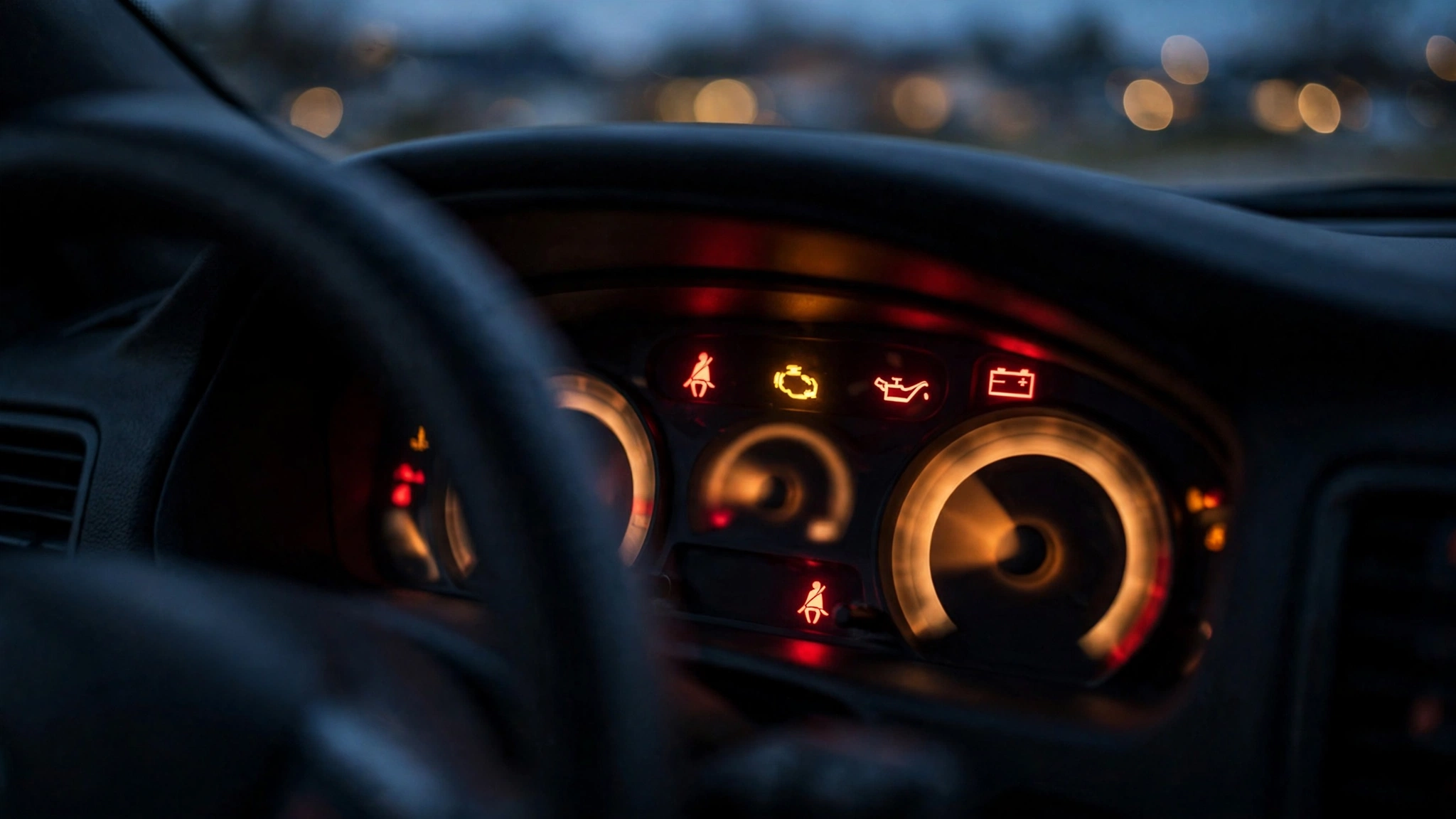
What Does That Dashboard Warning Light Mean? The Illustrated Guide
By DealShore Motors
One red light can be the difference between a $0 fix and a $6,000 engine. The red oil-can light means your engine is running without oil pressure — keep driving and metal grinds on metal; a healthy engine can be scrap in under ten minutes. The amber engine light next to it might mean nothing worse than a loose gas cap. Same dashboard, wildly different stakes, and most drivers were never taught to tell them apart. This guide fixes that: every common light, sorted by color, with what it actually means, what it typically costs, and exactly what to do in the next sixty seconds.
Start With the Color — It Is the Whole System
Car makers use a traffic-light code, and it is standardized enough to trust across brands (the symbols and colors follow international rules such as UN Regulation No. 121 and US federal safety standards):
| Color | Meaning | Your move |
|---|---|---|
| Red | Serious fault or safety risk | Stop as soon as it is safe. Do not “make it home.” |
| Amber / yellow | Something is wrong or a system is off | Keep driving gently if the car feels normal — but get it checked this week, not this year |
| Green / blue | A system is simply switched on | No action. Information only |
One more rule that saves engines: flashing is always worse than steady. A flashing check engine light means an active misfire is dumping raw fuel into the catalytic converter, which can overheat and be destroyed in minutes. Steady amber = book a scan. Flashing amber = slow down, avoid load, get off the road.
The Red Lights: Stop Now
Oil pressure (the oil can)
The single most expensive light to ignore. It does not mean “oil is a little low” — it means oil pressure has collapsed: a failed pump, a major leak, a clogged pickup, or oil so low the pump is sucking air. Pull over, shut the engine off, and check the dipstick after a few minutes. If the level is fine and the light stays on at restart, tow it. Driving on costs an engine ($3,000–$8,000+ for a replacement); the tow costs $75–$150. Owners on r/MechanicAdvice repeat this weekly because someone always tries to limp home. Don’t be the story.
Coolant temperature (thermometer in waves)
Your engine is overheating. Causes: low coolant from a leak, a stuck thermostat, a dead cooling fan, a failed water pump. Turn the heater to full hot (it pulls heat off the engine), stop somewhere safe, shut it off, and never open the radiator or reservoir cap while hot — pressurized coolant causes severe burns. Keep driving and you graduate from a $150 thermostat to a warped cylinder head and a $1,500–$3,000 head-gasket job.
Brake system (circle with “!” — or “BRAKE”)
First check the obvious: is the parking brake fully released? If yes and the light stays on, assume low brake fluid or a hydraulic fault. Low fluid usually means worn pads — or a leak, which means you can lose braking entirely. Pedal feels soft or goes low? Do not drive it. A brake inspection runs $0–$100 at many shops; pads and rotors typically $300–$600 per axle. Your brakes are not the place to gamble.
Battery / charging system (the battery)
This light is lying about its name: it almost never means the battery itself. It means the charging system has failed — usually the alternator or a snapped serpentine belt — and the car is now running on borrowed battery charge. You have maybe 20–45 minutes of driving before the car dies wherever it happens to be. Turn off everything electrical (A/C, heated seats, blower) and drive straight to a shop or a safe place, not home across town. Alternator replacement: typically $400–$900 parts and labor. If the belt snapped, note that the same belt often drives the water pump — watch the temperature gauge, because now the red thermometer light is coming too.
Airbag / SRS (person with a circle, or “SRS”)
The car drives normally, which is exactly the trap: with this light on, the airbag system has a fault and the airbags may not deploy in a crash. Common causes are cheap — a loose connector under a seat, a failed clock spring ($200–$500), a seat sensor. Diagnosis $100–$200. It will not strand you, but it silently removes the protection the car was sold on. Fix it.
Door / hood ajar
Not an emergency at a standstill; a real one at 70 mph if a hood latch lets go. Stop, latch everything properly, move on.
The Amber Lights: Book the Scan This Week
Check engine (the engine outline)
The most misunderstood light on the dash. It is an emissions warning from the OBD-II system (mandatory on US cars since 1996): the computer found a fault that pushes emissions over the legal threshold and stored a code. The honest range is absurd — from a $0 loose gas cap to a $2,500 catalytic converter. The most common triggers, from shop data and owner forums:
| Cause | Typical cost | Urgency |
|---|---|---|
| Loose / failed gas cap (EVAP leak) | $0–$25 | Tighten it; light clears after a few drive cycles |
| Oxygen sensor failure | $150–$400 | This week — it wastes fuel and can kill the converter |
| Spark plugs / ignition coil misfire | $150–$600 | Soon; flashing light = stop driving gently, now |
| Mass airflow sensor | $200–$450 | Soon — rough idle, poor mileage |
| Catalytic converter failure | $1,000–$2,800 | Expensive, and usually murdered by an ignored misfire upstream |
| EVAP leak (hoses, purge valve, canister) | $100–$500 | Not urgent, but you will fail an emissions test |
Two brutal truths: (1) a code names a system, not a guilty part — replacing parts by guessing (“parts cannon”) is how a $40 sensor becomes a $600 bill; (2) clearing the code without fixing the cause fixes nothing. The light will be back, and on a used car, a freshly cleared code is a seller hiding something (see the bulb check below).
ABS (the letters “ABS”)
Your normal brakes still work. What you have lost is anti-lock protection: in a panic stop or on wet pavement, the wheels can lock and the car will skid instead of steer. Most common cause by a wide margin: a wheel speed sensor, $150–$350 per corner installed. Worth fixing before winter or rainy season, not a stop-now light.
Traction / stability control (car with squiggly lines)
Steady on = the system is switched off or has a fault — very often the same wheel speed sensor as the ABS light, which is why the two appear together. Flashing briefly while driving = the system is actively working on a slippery surface; that is normal. If it stays on with the ABS light, scan it once and fix both stories at the same time.
TPMS (horseshoe / exclamation in a U-shape)
One or more tires is at least 25% below the recommended pressure — that is the federal trigger point (TPMS has been required on new US cars since September 2007, under FMVSS 138). Cold mornings cause false-ish alarms as pressure drops with temperature. Check all four tires and the spare with a real gauge, inflate to the door-jamb sticker (not the tire sidewall), and if the light returns within days you have a leak or a dead sensor battery (sensors last ~5–10 years; $50–$150 per corner fitted). Driving on a soft tire overheats the sidewall and is how blowouts are made.
Power steering (steering wheel with “!”)
On electric power steering cars, a fault can make steering suddenly heavy at parking speeds. The car is drivable, but emergency maneuvers take real muscle. Causes range from a dying battery (low voltage confuses the system) to a failed steering motor. Get it scanned; do not just live with it.
Diesel-only: glow plug (the coil spring) and DPF lights
A flashing glow plug light on a diesel often signals an engine-management fault, not just cold-start heaters. A DPF (diesel particulate filter) light means the filter needs a regeneration — usually 15–20 minutes of steady highway driving — and ignoring it until it clogs turns a free highway run into a $1,000+ forced regeneration or replacement.
Maintenance required / service due (wrench, or “MAINT REQD”)
Not a fault. A mileage- or time-based reminder, most often for an oil change. Annoying, harmless — and worth obeying, because the oil-pressure red light above is what eventually shows up for people who ignore this one for years.
Green and Blue: Pure Information
Turn signals, high beams (blue), fog lights, cruise control active, headlights on. If it is green or blue, your car is telling you what you turned on. The one exception people panic about: a blue thermometer on some cars simply means the engine is still cold — drive gently until it goes out.
The 10-Second Bulb Check — The Used-Car Buyer’s Lie Detector
Here is the highest-value trick in this entire guide, and it costs nothing. When you turn the ignition to ON (engine not started), every warning light should illuminate for a few seconds — this is the bulb check, the car proving its warning system works. Then start the engine; all lights should go out within seconds.
A light that never comes on during the bulb check is a red flag the size of a billboard: sellers have been known to remove bulbs, tape over LEDs, or disable lights to hide an airbag fault, an ABS failure, or a chronic check-engine problem. No airbag light at key-on on a car with a “rebuilt” title? Walk away, or price in the worst case and get a pre-purchase inspection. A missing check-engine bulb check plus a scanner showing “not ready” monitors means the codes were cleared right before you arrived. This ten seconds has saved buyers thousands.
What To Do, In Order, When a Light Appears
- Look at the color. Red = stop safely now. Amber = breathe, note it, plan a scan. Green/blue = ignore.
- Check how the car feels. Flashing light, shaking, power loss, steam, burning smell, or a soft brake pedal overrides everything: stop.
- Do the free checks first. Gas cap tight? Parking brake fully off? Tire pressures? Oil on the dipstick? Coolant in the reservoir (cold engine only)?
- Read the code before buying any part. A basic scan at a parts store is often free; a Bluetooth OBD-II reader of your own pays for itself the first time it talks you out of a wrong part.
- Never ignore a light for months. Small faults cascade: a $150 oxygen sensor ignored becomes a $2,000 catalytic converter. The dashboard is the cheapest mechanic you will ever hire — if you listen the first time.
EVs and Hybrids: Same Language, Extra Symbols
Electric cars speak the same color code and add a few of their own: a turtle icon means power is severely limited (nearly empty or overheating battery — limp mode); a “ready” indicator replaces engine noise as proof the car can move; and a 12V battery warning matters just as much as in a gas car, because a dead 12V battery can leave a fully charged EV completely inert. The red-means-stop rule does not change with the powertrain.
The Bottom Line
Your dashboard is not decoration and it is not crying wolf — every light is a specific system reporting a specific state. Red means stop, amber means schedule, green means carry on, flashing means now. Learn the six reds, respect the check engine light enough to read its code before buying parts, and run the ten-second bulb check on any used car before money changes hands. That is the whole skill, and it is worth real money.
DealShore Motors publishes guides like this every week — the stuff the brochure and the seller won’t tell you, in four languages.
Tools That Turn a Mystery Light Into a Known Code
These picks are research-backed selections from owner data, specs, and long-running product lines — not first-hand test results. Confirm compatibility with your exact vehicle before ordering:
Best value code reader: ANCEL AD310 OBD II scanner — a simple wired reader that reads and clears engine fault codes on 1996+ OBD2 vehicles and shows freeze-frame data. No phone, no subscription, lives in the glovebox.
Best overall: BlueDriver Bluetooth Pro OBDII scan tool — pairs with iPhone/Android and goes beyond the engine light: ABS, airbag (SRS), and TPMS codes on supported models, plus repair reports matched to your specific code. The tool that makes the bulb check a full pre-purchase weapon.
For the battery light: NOCO Boost Plus GB40 jump starter — a 1,000-amp lithium jump pack rated for engines up to 6.0L gas / 3.0L diesel. It will not fix a dead alternator, but it removes the “stranded wherever it died” part of a charging failure.
When you buy through our links, we may earn an affiliate commission at no extra cost to you.
Sources: US federal TPMS requirements (FMVSS 138 — warning at 25% below recommended pressure; mandatory on new US vehicles from September 2007); OBD-II standardization for US vehicles from model year 1996; UN Regulation No. 121 warning-symbol/color conventions; AAA guidance on oil-pressure and overheating response (stop and shut off immediately); repair cost ranges compiled from national shop-rate surveys and owner-forum reports (r/MechanicAdvice and model-specific communities) as of 2026 — prices vary by vehicle and region.
Leave a Reply