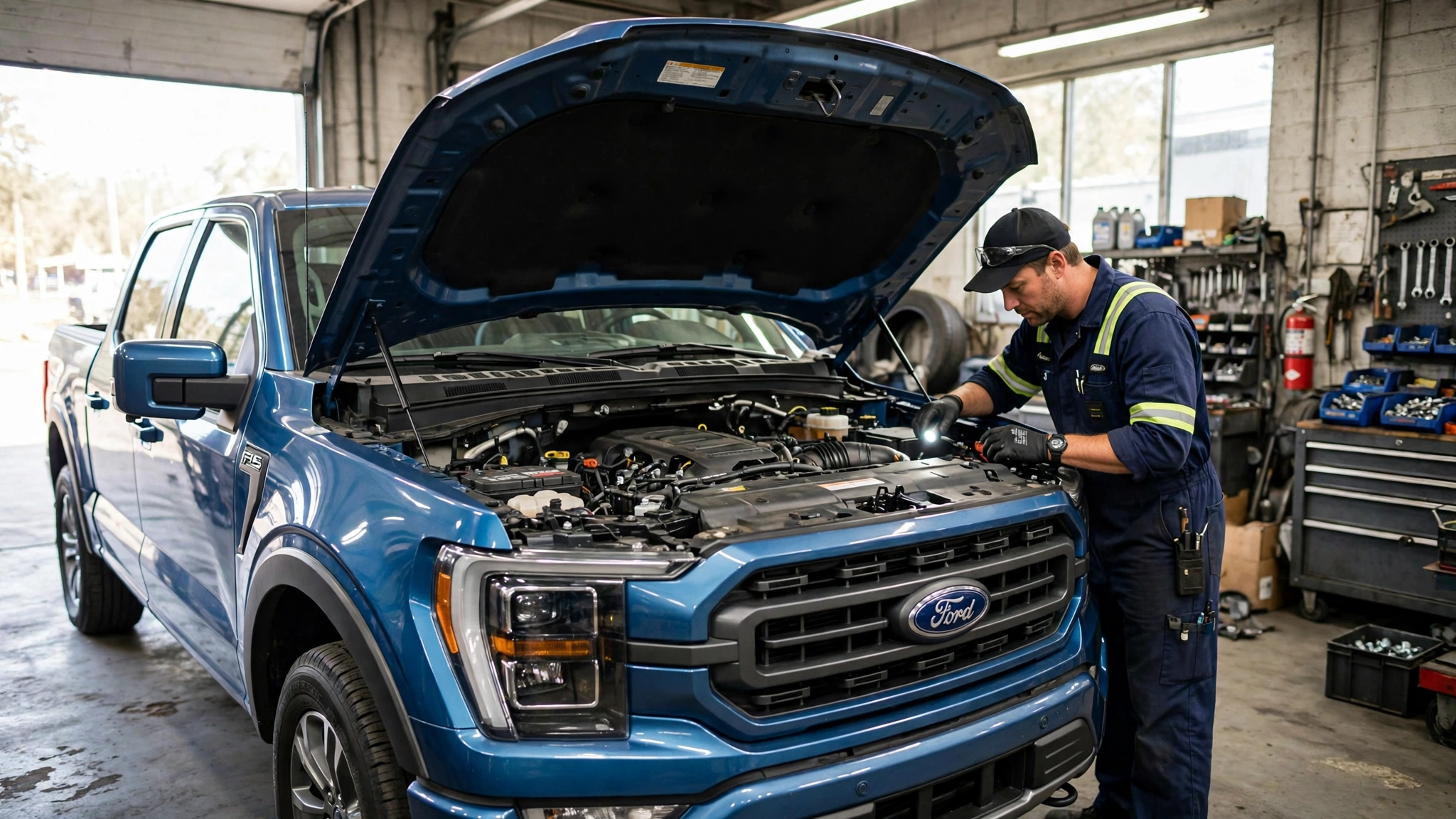
Ford F-150: Most Common Problems by Generation
By DealShore Motors
A $300 spark plug change that turns into a $1,500 extraction job. A cold-start rattle the dealer calls “normal” that ends in a $3,500 timing repair. A transmission that shifts like it was hit with a hammer — right up until the repair estimate lands between $5,000 and $7,000. The Ford F-150 is the best-selling vehicle in America, and it has earned that spot honestly. It has also produced some of the most expensive “known issues” in the truck world, and Ford’s habit of calling them normal does not make your bank account feel any better.
This guide goes generation by generation through the problems owners actually report — pulled from NHTSA complaint data, CarComplaints.com, and owner forums — with the repair costs you will actually face at an independent shop in 2026. If you are shopping used, read the checklist at the end before you hand anyone money.
2004–2008: The 5.4L Triton 3-Valve and the Spark Plug Trap
The eleventh-generation F-150’s 5.4L Triton 3-valve V8 is the engine that taught a generation of mechanics a new swear word. Ford used a two-piece spark plug design that carbon-welds itself into the aluminum head over time. When you try to remove it at the 100,000-mile plug change, the plug snaps in half — the threaded shell comes out, the rest stays buried in the head. This is not a rare fluke. It is the defining repair of this engine.
- Affected years: 2004–2008 with the 5.4L 3V (some early 2009 builds too). The earlier 2-valve Triton engines have the opposite problem: too few threads in the head, so plugs can blow straight out of the engine under load.
- Symptoms: You will not know until plug-change day — then one “routine” job becomes extraction work with a special removal tool, cylinder by cylinder.
- Typical cost: A straightforward plug change runs a few hundred dollars. With broken plugs extracted, expect $500–$1,500+, depending on how many snap. A blown-out plug on a 2V engine needs a thread-repair insert, usually a few hundred dollars per cylinder if the head survives.
The second curse of the 5.4 3V is cam phaser failure. The variable valve timing phasers wear and lose oil pressure control, producing a diesel-like ticking and rattling at idle, rough running, and eventually timing codes. Skipped oil changes accelerate it brutally — this engine sludges when neglected.
- Symptoms: Hot-idle tick/rattle that sounds like a small diesel, stalling at stops, cam/crank correlation codes.
- Typical cost: $2,000–$3,500 for phasers, timing chains, guides, and tensioners done as a complete job. Replacing only the phasers is the classic half-repair that comes back.
The 2004 model year alone logged roughly 2,400 complaints with NHTSA, making it one of the most complained-about trucks of its era. These trucks are cheap now for a reason. Buy one only with proof the plugs and timing work are already done — with receipts.
2011–2016: First-Generation 3.5 EcoBoost — Power With Homework
The twin-turbo 3.5L EcoBoost made V8 power with better fuel economy, and first-generation owners paid the early-adopter tax. The engine itself is stout; the supporting systems are where the money goes.
Timing chain stretch. The long primary chain stretches with mileage and extended oil intervals, causing a brief rattle on cold start and correlation codes. A full timing job runs $2,000–$3,000 at an independent shop.
Carbon buildup. The Gen 1 EcoBoost is direct-injection only, so fuel never washes the intake valves. Carbon cakes the valves over time, causing rough idle and misfires. The fix is walnut-shell blasting of the intake ports — a few hundred dollars — and no, fuel additives cannot reach the back of the valves. Anyone who tells you otherwise is selling you a bottle of hope.
Intercooler condensation misfire. In humid conditions, water condenses inside the intercooler, then gets sucked into the engine under hard acceleration: a violent stumble, flashing check-engine light, and limp mode — often while merging onto a highway, which is exactly when you do not want it. Owners drilled a tiny “weep hole” in the intercooler to drain it; Ford issued updated parts and calibrations. If a truck stumbles under boost in damp weather, this is suspect number one.
Turbo coolant fitting leaks and exhaust manifolds. The turbo coolant line fittings seep with age — look for crusty pink/orange residue under the turbos. At the back of the engine, exhaust manifold studs break and manifolds warp, producing a ticking on cold start that quiets as things heat up. Stud extraction on a broken, rusted manifold is labor-heavy; budget accordingly.
2017–2020: Second-Generation EcoBoost and the 5.0 — The Phaser Problem Returns
Ford redesigned the EcoBoost for 2017, adding port injection alongside direct injection (which largely solved the carbon problem) — and then the cam phaser saga came back. The cold-start rattle on 2017–2019 3.5 EcoBoost and 5.0 Coyote trucks is one of the most documented complaints of this generation: a loud rattle for a few seconds on a cold start as the phasers knock around before oil pressure builds.
Ford’s official position for a long time was that the rattle was a sound characteristic and harmless. Owners who tore their engines down found worn phaser internals and stretched timing components that say otherwise. Revised phaser hardware arrived around the 2020 model year and improved things, but “improved” is not “eliminated.”
- Affected years: Worst on 2017–2019; 2020+ trucks with the revised hardware fare better.
- Symptoms: Rattle on cold start after the truck sits overnight. Test this yourself: insist on starting a stone-cold engine that has not run that day.
- Typical cost: $2,500–$4,000 for phasers, chains, guides, and tensioners done right, all at once. This is not a job to piecemeal.
Also on this generation: the 2018–2020 5.0 Coyote’s oil consumption. Some trucks drink a quart or more between changes. Ford issued updated calibrations and dipstick guidance rather than new engines, so check the oil level and the service records on any 5.0 of these years — an engine run low on oil wears everything, quietly.
The 10R80 10-Speed (2017+): The Transmission Story
The 10R80 10-speed automatic, co-developed with GM, is efficient and quick when healthy. It is also the single biggest ownership risk on 2017-and-newer F-150s.
- Symptoms: Harsh or delayed shifts, shuddering, hunting between gears, clunks on downshifts, and in worse cases slipping or a loss of drive.
- The known failure: On 2018–2022 trucks especially, the CDF drum’s internal sleeve can shift out of position, blocking fluid passages and wrecking shift quality — a hardware failure, not a software mood.
- Typical costs: Start with a reprogram/adaptive relearn under Ford’s technical service bulletins — sometimes that genuinely helps. Valve body or CDF drum repair runs $2,500–$4,500. A full replacement at a dealer can reach $5,000–$7,000+; a remanufactured unit installed at an independent shop typically lands in the $3,500–$5,500 range. Get the actual quote in writing before you buy a truck that shifts badly “because it just needs a reflash.”
The 6R80 Lead Frame (2011–2014 Era): The Sudden Downshift
The earlier 6-speed 6R80 is fundamentally a strong transmission with one notorious component: the lead frame, the unit housing the output speed sensor. When the sensor signal drops out, the transmission can command a sudden downshift — in the worst cases to first gear at speed. This failure was serious enough to drive NHTSA investigations and Ford recalls covering trucks of this era.
- Symptoms: Sudden harsh downshift, wrench light, speedometer dropping out, harsh engagement.
- Typical cost: Lead frame replacement runs about $800–$1,200 including the fluid and filter service that should accompany it. Before paying, check whether the truck’s recall and software updates were completed — on some trucks the fix was partly a calibration change.
IWE Vacuum Hubs (2004–2020 4WD): The Grind That Tells the Truth
Ford’s Integrated Wheel End system uses engine vacuum to keep the front hubs unlocked in 2WD. When vacuum leaks — a cracked hose, a failed solenoid, a bad check valve — the hub partially engages and grinds. The diagnostic gift: the grinding happens in 2WD and stops the instant you switch to 4WD, because full engagement ends the half-engaged grinding.
- Typical costs: Hoses, solenoid, and check valve repairs run $150–$350. If the truck was driven while grinding, the actuator and hub gear teeth get chewed up, and replacement runs $400–$800 per side. A cheap vacuum gauge test during inspection catches this before it eats the hubs.
The Rest of the Rap Sheet (Brief, But Real)
- Exhaust manifold leaks recur across generations — broken studs, cold-start ticking. Annoying, labor-heavy, rarely fatal.
- Aluminum body paint corrosion (2015+): The aluminum body panels do not rust like steel, but paint bubbling and corrosion at panel edges — especially the hood — is a documented complaint. Cosmetic, but it kills resale value.
- APIM / Sync infotainment failures: Frozen screens, black screens, and modules that need replacement. Budget several hundred dollars and test every screen function, the backup camera, and Bluetooth before buying.
Scan Before You Buy: Three Tools That Pay for Themselves
A pre-purchase scan is the cheapest truth you can buy on a used F-150. Transmission codes, cam/crank correlation codes, and misfire history do not show up on a test drive — they show up on a scanner. These picks are research-backed selections based on owner data, specs, and reviews, not first-hand testing by us.
- BlueDriver Bluetooth Pro OBD2 Scanner — reads engine, ABS, SRS, and transmission codes on Fords with no subscription fee. This is the pre-purchase scan tool: plug it in before you negotiate, not after. https://www.amazon.com/dp/B00652G4TS?tag=dealshore-20
- ANCEL AD410 — a budget wired scanner with live data, useful for watching timing and misfire counters while the truck idles cold. https://www.amazon.com/dp/B071FSNL73?tag=dealshore-20
- NOCO Boost Plus GB40 — not a diagnostic tool; get-home insurance for the truck you just bought with a battery of unknown age. Optional, but cheaper than one tow. https://www.amazon.com/dp/B015TKUPIC?tag=dealshore-20
When you buy through our links, we may earn an affiliate commission at no extra cost to you.
What to Check Before Buying Used
Run this list on any F-150, in this order:
- Cold start, in person. The engine must be stone cold and not started that day. Listen for phaser/timing rattle (2017–2020 especially) and chain rattle (EcoBoost Gen 1).
- Scan it. Pull all module codes — engine, transmission, ABS. Correlation codes (P0016-family), transmission codes, and a long misfire history are price-cutting facts.
- Plug and timing receipts (2004–2008 5.4). No proof the plugs and phasers were done? Price the truck as if you will pay for both, because you will.
- Transmission behavior. Drive the 10R80 through slow neighborhood shifts and a highway merge. Harsh, delayed, or hunting shifts mean you negotiate the $2,500–$4,500 repair range into the price — or walk.
- 4WD vacuum test (2004–2020). Drive in 2WD and listen for grinding from the front wheels; switch to 4WD. Grinding that stops in 4WD = IWE vacuum problem.
- Oil level and records (2018–2020 5.0). Low oil plus vague records on a Coyote of these years is a hard pass.
- Under the turbos (EcoBoost). Look for coolant crust at the turbo fittings and broken manifold studs at the rear of the engine.
- Screens and camera. Cycle Sync, the backup camera, and every climate/radio function. APIM failures are common and not free.
- Recall check. Run the VIN on NHTSA’s recall lookup — the 6R80 lead frame era and various later recalls should show as completed, not open.
Best and Worst Years: The Verdict
Approach with extreme caution: 2004 (roughly 2,400 NHTSA complaints, first-year 5.4 3V problems), any neglected 2004–2008 5.4 without plug/timing receipts, and 2018–2019 trucks with an active cold-start rattle and original phasers.
The safer bets: Late Gen 1 EcoBoost trucks (2015–2016) with full service records; 2020+ trucks with the revised phaser hardware; and any year where the big known repair for that generation is already done and documented. On the F-150, the best truck is rarely the cheapest listing — it is the one whose expensive problems somebody else already paid to fix.
The F-150 earned its sales crown because when it is right, it is genuinely excellent. Your job as a buyer is to make sure the known failures belong to the previous owner’s wallet, not yours.
Shopping used trucks? DealShore Motors publishes problem guides like this every week — what the brochures don’t tell you, with the repair bills attached.
Sources: NHTSA complaint and recall database (nhtsa.gov) for the F-150 by model year, including 2004 5.4L complaints and 6R80 lead frame recall history; CarComplaints.com owner problem data by generation; Ford technical service bulletins on cam phaser rattle and 10R80 shift quality as discussed in owner forums; r/F150, r/MechanicAdvice, and F-150 owner forum repair reports for cost ranges. Repair costs are 2026 US independent-shop ranges and vary by region and engine.
Leave a Reply