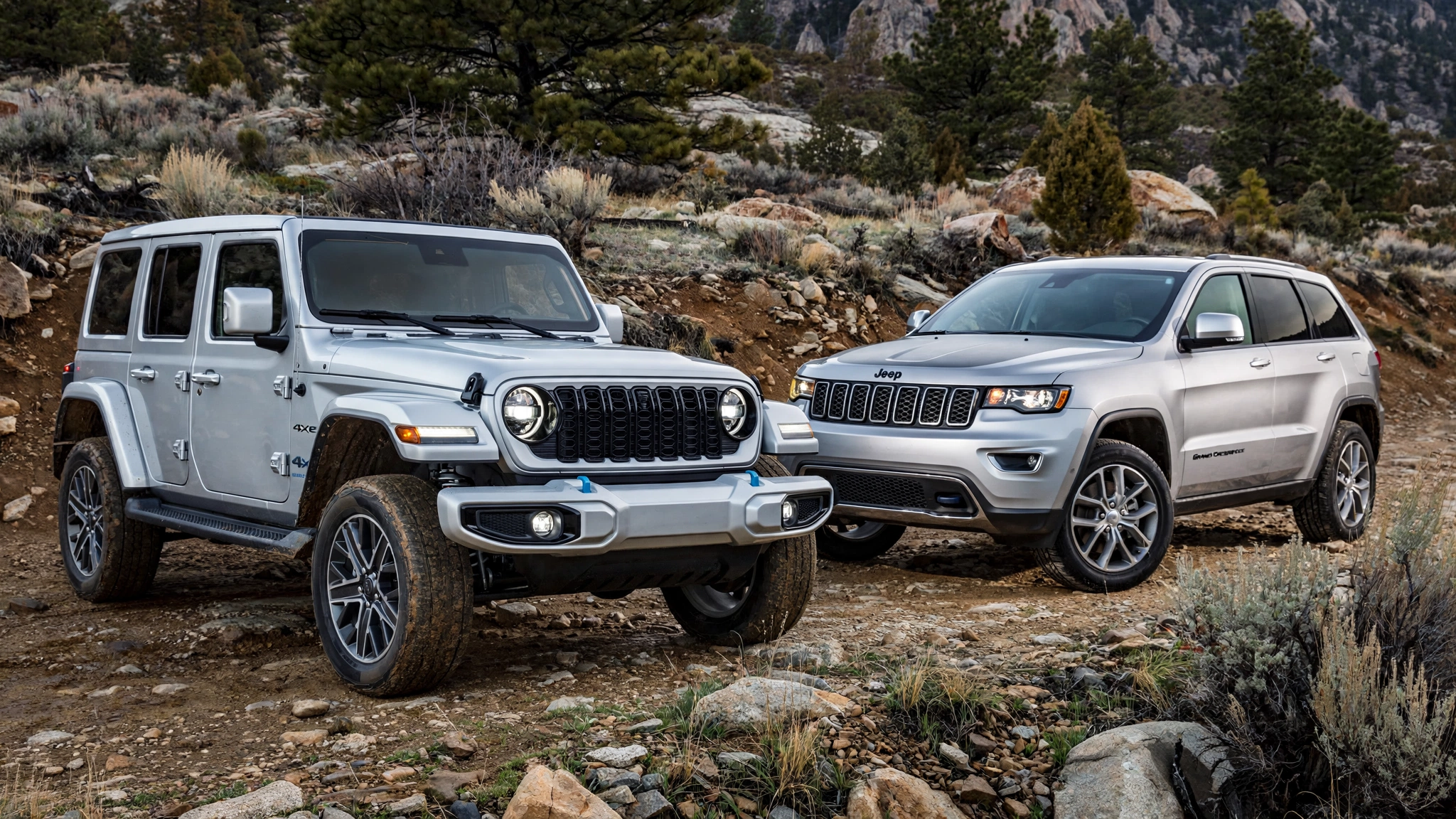
Jeep Wrangler & Grand Cherokee: What Actually Breaks
By DealShore Motors
You are doing 55 mph in a Wrangler, you hit a pothole, and the steering wheel tries to tear itself out of your hands. The whole front end shakes so violently you are sure a wheel is coming off. It does not stop until you brake down to about 12 mph, heart pounding, traffic stacking up behind you. That is death wobble, it is not rare, and fixing it properly costs $1,200 to $2,500 — not the $80 steering stabilizer a seller will swear already fixed it. Jeeps hold their value and their fans for real reasons. They also have a short, predictable list of expensive failures, and if you know the list before you buy, you can price every one of them into the deal — or walk away.
This guide covers the two Jeeps people actually cross-shop: the Wrangler (JK 2007–2018, JL 2018–present) and the Grand Cherokee (WK2 2011–2021, with notes on earlier and later years). Costs below are typical 2026 US independent-shop ranges, parts and labor combined unless stated. Dealer prices run higher.
Part 1: Jeep Wrangler — What Actually Breaks
1. Death Wobble: The One Everyone Has Heard Of
Affected years: Worst on the JK (2007–2018). It still occurs on the JL (2018–present). Any solid-front-axle Jeep can do it; mileage, wear, and lift kits make it more likely.
Symptoms: At roughly 45–65 mph, after hitting a bump, expansion joint, or pothole, the steering wheel oscillates violently side to side and the front axle shakes hard enough to shake the whole vehicle. It is not a vibration you can drive through. The only cure in the moment is slowing down — usually to around 10–15 mph — until it stops.
The lie to watch for: A worn steering stabilizer does not cause death wobble, and a new stabilizer does not fix it. The stabilizer is a damper. Replacing it masks the shake for a few thousand miles while the real worn part keeps getting worse. If a seller proudly says “just put a new stabilizer on it,” ask why.
Real causes: Play somewhere in the front steering and suspension lets the axle start oscillating, and then everything feeds it. The usual culprits, in the order shops check them:
- Worn track bar, track bar bushings, or loose/elongated track bar bolts and mounting holes — the single most common trigger
- Worn ball joints
- Worn tie rod ends and drag link ends
- Worn unit wheel bearings
- Incorrect caster and alignment — especially on lifted Jeeps, where bigger tires and changed geometry amplify every bit of play
Typical cost: A track bar alone runs $200–$450 for the part. Ball joints run $300–$600 per side at a shop. But one-part fixes fail, because by the time the wobble shows up, several parts are usually worn together. Budget $1,200–$2,500 for a proper front-end refresh, and $2,000–$3,500 for a comprehensive job covering track bar, ball joints, tie rod and drag link ends, bearings, and a correct alignment. On a lifted JK with big tires, stay at the top of that range.
2. TIPM Failures (JK, roughly 2007–2014)
Affected years: JK Wranglers, worst in the 2007–2014 window.
The TIPM — Totally Integrated Power Module — is the fuse-and-relay box under the hood that also acts as an electrical brain. When it fails internally, the symptoms look haunted: no-start, random stalling, fuel pump not running, horn, wipers, door locks, or windows doing things nobody asked them to do. Owners chase batteries, starters, and alternators for months because the codes point everywhere except the real cause.
Typical cost: $800–$1,500 for replacement plus programming. Diagnosis matters — a good shop confirms TIPM failure before ordering the part, because the part is not cheap and is often not returnable once programmed.
3. The 3.6L Pentastar V6 (2012 and up, JK and JL)
The Pentastar is, honestly, a decent engine — millions are on the road. But it has three known weak points every buyer should listen and look for:
- Rocker arm / cam follower tick: A ticking from the top of the engine that rises with RPM. Worn rocker arms and followers can eventually score the camshaft if ignored. Catch it early and it is a top-end repair; ignore it and the bill grows.
- Early 2012 cylinder head issue: Left-bank cylinder heads on early 2012 engines developed problems that led Jeep to extend warranty coverage on them. On any 2012, verify whether the head was replaced under that extension.
- Oil filter housing / oil cooler leak: The plastic housing in the valley of the engine cracks and leaks oil down into the valley, where it pools and eventually drips onto the transmission and exhaust. Owners top up oil for months thinking the engine burns it. The housing job runs $600–$1,000 at a shop — the part is not exotic, the labor to reach it is the cost.
4. The Rest of the Wrangler List
- Oil consumption and leaks: Valve covers, rear main seal area, and general seepage on higher-mileage JKs. Check the underside, not just the dipstick.
- Exhaust manifold bolts: Broken manifold bolts cause a ticking on cold start that quiets as the engine warms. Common, annoying, and a negotiation point.
- Manual transmission (NSG370) and clutch: The JK’s 6-speed manual pops out of gear on some trucks and the clutch and throw-out bearing wear is a known ownership cost. Test every gear under load, including reverse.
- JL door hinge corrosion (2018+): Paint bubbling around the aluminum door and hood hinges. Cosmetic, but it spreads, panel repair is not cheap, and it kills resale. Inspect every hinge closely on any JL.
- ESS auxiliary battery (JL): The small auxiliary battery for the stop-start system fails and causes no-starts and random electrical warnings — on a truck whose main battery tests fine. Replacement runs $200–$400. Strange electrical behavior on a JL? Test the aux battery before anything expensive.
- 2.0L turbo and 4xe: The 2.0T adds turbo and cooling-system complexity; the plug-in hybrid 4xe adds a high-voltage system on top of that, and the 4xe has been subject to recalls. As of 2026: on any 4xe, run the VIN through the NHTSA recall database and require proof every recall is complete before money changes hands. No exceptions.
5. Water Leaks: Annoying, Not Fatal
Hardtop and soft top Wranglers leak. Seals shrink, tops get mis-seated after removal, and water finds the footwells and the rear storage area. This is not a reason to reject a Jeep — it is a reason to check for the damage leaks leave behind: musty smell, stained or damp carpet, rust starting in the floor. A dry interior is worth real money over a wet one.
Scan it before you buy it — our research-backed picks
Electrical problems are the #1 budget-killer on both of these Jeeps, and a basic code reader that only reads engine codes will miss most of them. These two scanners are selected from owner data, specs, and reviews — not from first-hand testing by us:
- BlueDriver Bluetooth Pro OBD2 Scanner — reads ABS, SRS (airbag), and transmission codes, not just engine codes. That is exactly what you need to interrogate TIPM and electrical problems before you buy. See it on Amazon
- ANCEL AD410 — a budget wired scanner that covers the basics without a phone or a subscription. A sensible glovebox tool for any JK or WK2 owner. See it on Amazon
When you buy through our links, we may earn an affiliate commission at no extra cost to you.
Part 2: Jeep Grand Cherokee — What Actually Breaks
The WK2 Grand Cherokee (2011–2021) is a comfortable, genuinely capable SUV that shares showrooms with luxury brands. It also produced some of the most-complained-about electrical and suspension problems in Jeep’s modern history — concentrated, fortunately, in specific years you can simply avoid.
1. TIPM and the Fuel Pump Relay (WK2, 2011–2013 worst)
Affected years: 2011–2013 are the worst, with 2011 drawing roughly 741–755 complaints to NHTSA — one of the most-complained-about issues of its era, and the subject of class-action litigation.
Symptoms: The fuel pump relay lives inside the TIPM. When it fails, the pump stops: the engine cranks and will not start, or worse, stalls while driving. Same haunted-house electrical behavior as the Wrangler TIPM, with an added safety problem — a stall at speed.
The important part: Jeep issued recall 14V530, later superseded by 19V813, which fits an external fuel pump relay outside the TIPM. That recall repair is free. Before buying any 2011–2013 Grand Cherokee, run the VIN and verify the recall was actually done — do not take the seller’s word for it.
Typical cost if you pay out of pocket: A replacement TIPM runs $800–$1,500. Historically, owners reported average repair costs around $1,100 at roughly 52,000 miles. The free recall is why the VIN check matters more than the negotiating.
2. Quadra-Lift Air Suspension (2011+, Overland, Summit, Trailhawk)
Affected years/trims: 2011 and up, on higher trims — Overland, Summit, and Trailhawk models fitted with Quadra-Lift.
Symptoms: The truck sags overnight, usually nose- or tail-down by morning. The compressor runs longer and more often to keep up, which drains the battery and eventually burns out the compressor itself. Warning messages about the air suspension follow. What starts as a slow air spring or line leak becomes a dead compressor if you keep driving on it — the system fails in a chain.
Typical cost: Air spring or line repairs run $1,000 and up. A compressor runs $800–$1,200. A full system failure, with multiple corners and the compressor gone, passes $3,000 easily. The permanent alternative owners choose: a coil-spring conversion kit, typically $800–$1,500 installed, which deletes the air system, the warnings, and the repeat bills forever — at the cost of the adjustable ride height. On a high-mileage WK2, a truck that has already been converted is arguably worth more, not less.
3. The 2014–2015 8-Speed and the Shifter
Affected years: 2014–2015, the first years of the ZF 8HP 8-speed automatic in the Grand Cherokee.
Early 8-speeds had shift-quality complaints — harsh shifts, hesitation, hunting — and 2014 in particular accumulated transmission complaints. The same era brought the electronic monostable shifter, whose confusing operation (it always returned to center, making it easy to think you were in Park when you were not) led to a major recall. Later software and hardware updates improved both. A 2014 with full service records and all updates applied is a different truck from a neglected one.
Typical cost: Worst-case transmission repair or replacement runs $3,500–$5,000. On any 2014–2015 test drive, demand cold shifts, low-speed shifts, and a full-throttle merge — the transmission tells you the truth in the first ten minutes.
4. Engines: Pentastar and Hemi Weak Points
- 3.6L Pentastar: The same oil cooler / filter housing leak and rocker arm tick as the Wrangler above — same engine, same checks, same $600–$1,000 housing job.
- 5.7L Hemi: Water pump failures reported as early as 34,000–58,000 miles — look for coolant crust and weeping at the pump and listen for bearing noise. The Hemi also has its own lifter tick; a ticking Hemi at idle deserves a mechanic’s ears before you buy, because lifter and cam damage is where that sound can lead.
5. Interior and Cooling: The Slow-Motion Bills
- Leather dash delamination (2011–2014, with 2016 reports too): The leather dash cover bubbles and peels away from its backing. It looks terrible and it is not a cheap cosmetic fix — owners of 2011 models reported average dash repair costs around $1,600.
- Uconnect screen delamination (2017–2020, 8.4-inch): The touchscreen layers separate, producing bubbles and then “ghost touches” — the screen pressing itself, changing stations, dialing, and adjusting climate on its own. Screen replacement runs $800–$1,200. Test every corner of the screen on the test drive and look for bubbling at the edges.
- Radiator leaks around 75,000 miles (2018 reports): Check coolant level and look for dried coolant residue around the radiator on any WK2 near that mileage.
What to Check Before Buying Used — Both Jeeps
Wrangler checklist:
- [ ] Highway test at 45–65 mph over bumps — any steering shake starting is a $1,200+ negotiation, or a walk-away
- [ ] Ask what front-end parts were replaced, and when — “new stabilizer” alone is a red flag, not a fix
- [ ] On a 2012 Pentastar, verify the left-bank cylinder head history; on any Pentastar, look in the engine valley for pooled oil and listen for rocker tick
- [ ] JK: multiple cold starts — TIPM failures love a cold, parked overnight truck
- [ ] JL: inspect every door and hood hinge for paint bubbling; test for ESS/aux battery electrical weirdness
- [ ] 4xe: VIN recall check with proof of completion, as of 2026
- [ ] Pull the carpets: dampness, musty smell, floor rust from top leaks
- [ ] Manual trucks: every gear under load, watch for pop-out
Grand Cherokee checklist:
- [ ] 2011–2013: VIN verification that recall 19V813 (external fuel pump relay) is complete — non-negotiable
- [ ] Quadra-Lift trucks: park it, note the height, come back in an hour — sagging means the chain reaction has started; check whether the compressor sounds strained
- [ ] 2014–2015: cold and hot test drive focused on shift quality; confirm recall and software history
- [ ] Inspect the dash for bubbling and test the full Uconnect screen for ghost touches and edge delamination
- [ ] Hemi: water pump weep, coolant crust, lifter tick at idle. Pentastar: oil in the valley, rocker tick
- [ ] Both: full-module scan (ABS/SRS/transmission), not just an engine code read
Best and Worst Years — The Verdict
Wrangler: The late JK years (roughly 2015–2018) with the Pentastar and a documented front-end are the safest used buy; budget the oil housing job into any of them. Early JKs (2007–2011) combine TIPM trouble with the weaker early engines. The JL is the nicer truck, but buy it with hinge corrosion and the auxiliary battery in mind — and treat any 4xe without complete recall paperwork as unfinished business.
Grand Cherokee: Avoid 2011–2013 unless the TIPM/relay recall is documented and the price reflects the history — 2011 is the single worst year here. The 2014–2015 trucks are buyable only with transmission and shifter updates proven. Later WK2 years (2018–2021) are the sweet spot, with two checks left standing: the Uconnect screen and, on air-suspension trims, the Quadra-Lift sag test.
Neither Jeep is a bad buy. Both are bad blind buys. Every major failure on this page is known, documented, and checkable in a one-hour inspection — which means the informed buyer pays for the Jeep, and the uninformed buyer pays for the Jeep twice.
Shopping for a Jeep — or selling one honestly? DealShore Motors publishes problem guides like this every week, built from owner data, not brochures.
Sources: NHTSA complaints and recall records (including recalls 14V530 and 19V813), CarComplaints.com owner reports, and model-specific owner forums and Reddit communities (r/Wrangler, r/GrandCherokee, r/MechanicAdvice), as of 2026. Repair costs are typical independent-shop ranges and vary by region and vehicle condition.
Leave a Reply