BMW 3 Series: The N20 Timing Chain Problem (and How to Avoid It)
By DealShore Motors
A used 328i for $9,000 looks like the bargain of the year — until the high-pitched whine starts between 1,500 and 2,500 rpm. That whine is not a belt. It is not “normal BMW noise.” On a 2012 to early-2015 car with the N20 engine, it is often the sound of plastic timing chain guides coming apart inside the engine. Keep driving and the bill stops being a $3,000 chain job and becomes an $8,000 to $15,000 engine replacement — on a car you just bought for nine grand.
This is the most important problem guide we will ever publish on the F30 3 Series. The N20 is a good engine when it works: strong, efficient, genuinely quick. It also has one design flaw that can destroy it without much warning, and BMW never recalled it. Here is the real data — from NHTSA complaints, BMW’s own service bulletins, and the class-action settlement — plus exactly what to check before you buy one.
Which Cars Have the Problem?
The N20 is BMW’s 2.0-liter turbocharged four-cylinder, built from 2011 to 2017. In the 3 Series (F30 generation) it powered:
| Model | Years with N20 | Output | Notes |
|---|---|---|---|
| 320i | 2013–2015 | 180 hp / 200 lb-ft | Same chain risk, lower tune |
| 328i / 328i xDrive | 2012–2015 | 240 hp / 255 lb-ft | The volume seller — most failures reported here |
| 328i Gran Turismo / Wagon | 2014–2015 | 240 hp | Same engine, same risk |
| ActiveHybrid 3 | 2013–2015 | N55 six-cylinder | Not an N20 — different risk profile |
The same engine — and the same timing chain problem — also lives in the 228i, 428i, 528i, X1, X3, X4, and Z4 of the same years. Cars sold in California-emissions states often carry the N26, the SULEV (Super Ultra Low Emission Vehicle) version of the N20. Different emissions hardware, same chain and guides, same failure. If a seller tells you “it’s an N26, so it’s fine,” it is not fine.
The risk window is production up to late February 2015. BMW revised the timing chain hardware in early 2015 — a quiet admission, made through superseded part numbers, that the original parts were not good enough. For the 2016 model year the 328i gave way to the 330i with the newer B48 engine, which uses a far more robust timing setup. That one change is why later cars are the safer buy.
What Actually Breaks — and Why It Kills the Engine
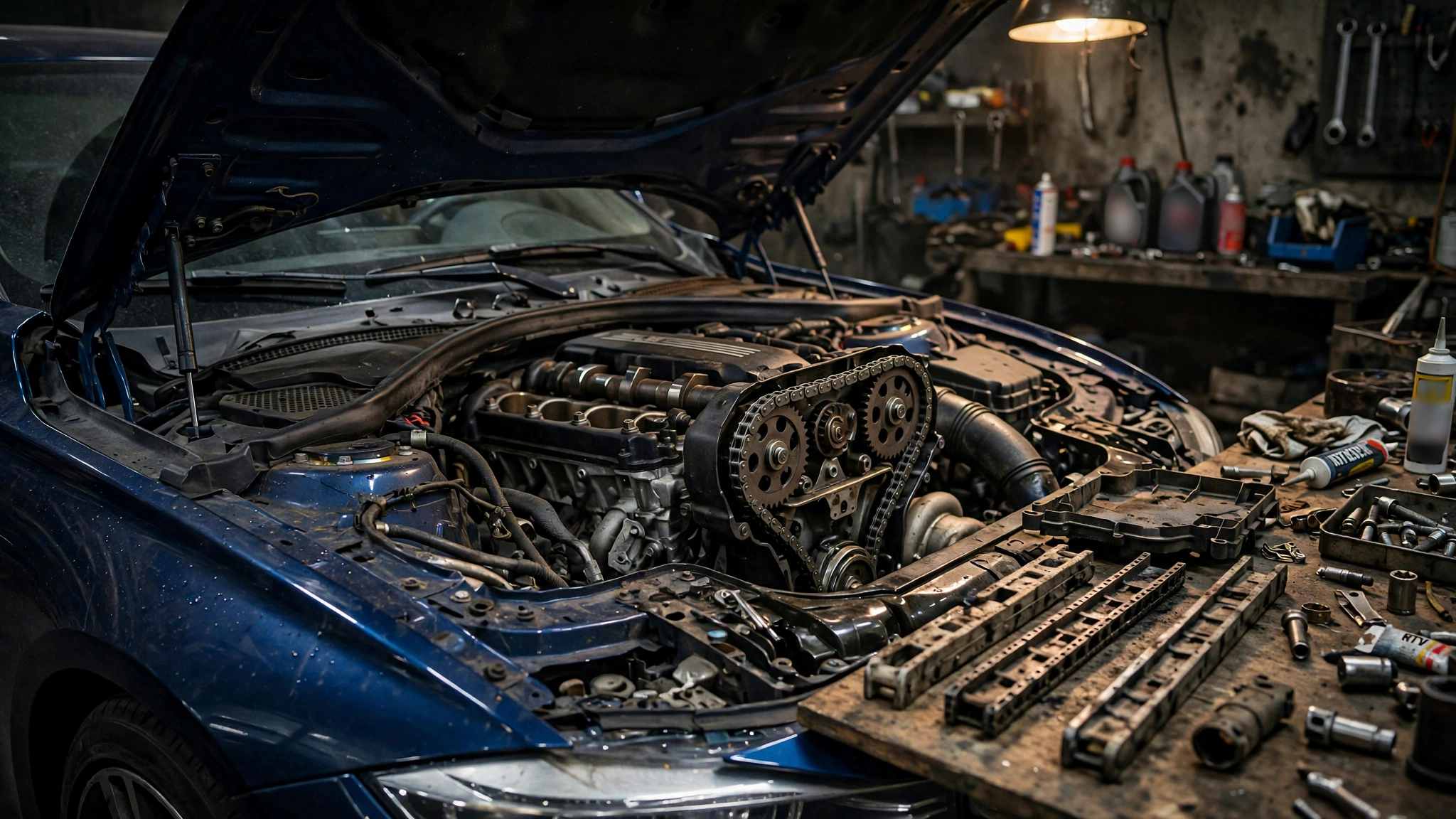
A timing chain is supposed to last the life of the engine. That is the whole point of using a chain instead of a belt. On the early N20, the chain itself is rarely the first thing to fail. The plastic guide rails that keep it taut and aligned are.
Here is the cascade, step by step:
- The guides get brittle. The original guides are an amber-colored plastic that heat-cycles every time you drive. Years of turbo-engine heat make it crack and splinter — typically between 60,000 and 120,000 miles, most often in the 80,000–100,000-mile window.
- The chain goes slack. Cracked guides can no longer control the chain. It starts to slap, whine, and wear its sprockets.
- Plastic debris clogs the oil pickup. Broken guide fragments fall into the sump and get sucked against the oil pump pickup screen. Oil pressure drops — sometimes before the chain itself lets go.
- The second chain fails too. The N20 has a separate, smaller chain that drives the oil pump, riding on the same family of parts. It can fail on its own and starve the engine of oil even while the main chain looks intact.
- Timing jumps. The chain skips teeth. The N20 is an interference engine, which means pistons and valves occupy the same space at different times. Out of sync, they collide. Bent valves, damaged pistons, a ruined head — the engine is done.
No oil change schedule prevents this. Shorter oil intervals (see below) slow wear and are worth doing, but the core defect is the guide material itself. BMW’s own bulletin SI B11 03 17 describes the diagnostic tell in plain language: a “whining noise” that rises with engine rpm from wear on the oil pump chain drive. Owners in NHTSA complaints describe the same sequence over and over — whine, drivetrain-malfunction warning, low-oil-pressure light, stall at highway speed, tow truck.
The Warning Signs — In the Order Owners Hear Them
- High-pitched whining or whirring from the front of the engine, loudest at 1,500–2,500 rpm. This is the signature sound. It often gets mistaken for a supercharger, a vacuum leak, or a bad pulley. On an early N20, assume chain until proven otherwise.
- Rattle on cold start that fades after a few seconds as oil pressure builds and takes up slack.
- Check-engine light with camshaft/crankshaft correlation codes — P0016 and related timing codes mean the computer can already see the timing drifting.
- Rough idle, hesitation, misfires, or a “drivetrain malfunction” message, especially under load.
- Low oil pressure warning. Park it. This can mean guide debris is already choking the pickup. Driving on can seize the engine in minutes.
- No-start or stall at speed. In NHTSA complaints this is how many failures end: a 2013 328i losing power at 65 mph when its guides broke, a 2012 car stalling at 114,000 miles and never restarting.
Rule that will save you money: whine today, inspection this week — not next month. Every mile on a slack chain is a gamble against a five-figure bill.
What It Costs to Fix in 2026
| Job | Independent BMW specialist | BMW dealer | If you ignore it |
|---|---|---|---|
| Full timing chain job (chain, guides, tensioner, oil pump drive chain, seals, oil) | $2,500–$4,500 | $5,000+ | — |
| Diagnosis (listen, scan, inspect chain through the oil filler) | $150–$300 | $200–$400 | — |
| Engine replacement after a jumped/broken chain | — | — | $8,000–$15,000+ |
Why the spread? It is a 10–15-hour job that requires locking the cams and crank with special timing tools. RepairPal’s national timing chain estimate across all vehicles is $2,120–$2,764 (updated September 2026), and FCP Euro puts a dealer N20 job at “upwards of $5,000” — the N20 job sits above the national average because of the labor and because a proper job replaces both chains and every guide, not just the noisy part. A cheap quote that only swaps a tensioner is not the same job. Ask for the parts list in writing.
The Warranty and Lawsuit — Read This Before You Count on Either
BMW extended the warranty on the N20/N26 timing chain and oil pump drive chain modules to 7 years / 70,000 miles (SI B11 03 17). The Gelis class-action settlement then added a sliding scale up to 8 years / 100,000 miles, reimbursing 100% inside 7 years/70,000 miles and a declining percentage (75% down to 40%) after that, with caps for independent-shop repairs.
Brutal honesty: as of 2026, that help is gone for essentially every affected car. The last covered cars were built in February 2015; eight years from their in-service dates ran out in 2023. There was never a recall. If you buy an early N20 today, the timing chain is your financial problem, not BMW’s. Price the car that way. A seller who says “BMW covers that” is either misinformed or hoping you are.
The Other N20 Problems (Because the Chain Is Not Alone)
Budget for these on any high-mileage example. They are the rest of the pattern owners report on CarComplaints, r/BMWTech, r/F30, and owner forums:
| Problem | Typical mileage | Typical cost | What to know |
|---|---|---|---|
| Oil filter housing gasket leak | 60,000–90,000 | $300–$800 | Oil drips onto the belt. A shredded belt can get pulled into the front crank seal — a small leak that can become an engine-out job. Fix it promptly. |
| Valve cover / gasket leak, cracked cover | 50,000–100,000 | $500–$1,000 | Burning-oil smell, smoke, oil in plug wells causing misfires. The plastic cover itself often cracks; a gasket alone may not cure it. |
| Electric water pump + thermostat | 80,000–120,000 | $600–$1,400 | Sudden overheating, fan running at full blast. No temperature gauge saves you here — when the warning comes, stop. |
| Turbo wastegate rattle / wear | 40,000–100,000 | $1,500–$3,000 for turbo work | Rattle on deceleration, underboost codes, lazy power. Worn wastegate linkage is extremely common. |
| Valvetronic / eccentric shaft wear | 120,000+ | $500–$1,500+ | Rough running that mysteriously improves after a restart can also be a weak battery confusing the system — test the battery first. |
| Oil consumption | 80,000+ | Varies | Up to a quart per 1,000 miles is reported on tired cars. Check the level history; the N20 has no dipstick, so the electronic reading and service records are all you get. |
Add it up honestly: a neglected 110,000-mile 328i can need the chain ($3,500), the oil filter housing gasket ($600), and a water pump ($900) in the same year. That is $5,000 on top of the purchase price — which is exactly why these cars look cheap in the listings.
How to Avoid the Problem: The Buying Rules
1. Buy the build date, not the model year. A car built after late February 2015 got the revised hardware. The build date is on the driver’s door jamb sticker. Better still, a 2016+ 330i with the B48 removes this specific fear entirely.
2. Demand proof the updated kit is already fitted. “Timing chain done” on a seller’s say-so is worth nothing. You want an invoice naming the chain, guides, tensioner, and oil pump drive chain, ideally from a BMW dealer or known independent specialist, with a date and mileage. That invoice is worth $2,500–$4,500 — pay more for a car that has it.
3. Cold-start the car yourself. The engine must be stone cold — overnight cold. A warmed-up car hides the rattle and the whine. Listen at idle, then hold 1,500–2,500 rpm. Any whine that rises with rpm = walk away or price in the full job.
4. Look through the oil filler cap. A mechanic can see part of the chain and check for scoring and slack. Shiny scored links and visible play are bad news.
5. Scan it — including permanent codes. Timing correlation codes that were cleared yesterday still leave traces. See the tools box below.
6. Check the oil history, then shorten it forever. BMW’s long factory intervals (up to 15,000 miles in early years) did these engines no favors. Cars with 5,000–7,500-mile oil changes age better. If you buy one, adopt that interval and use LL-01 specification oil.
7. Never tune a car on an original chain. A stage tune adds stress to exactly the parts that are already marginal. Chain first, tune later — if ever.
8. Keep a reserve or don’t buy it. The honest math: purchase price + $3,000 reserve for the chain (if undocumented) + $1,000 for the usual leaks and pump. If that total buys a B48 car instead, buy the B48 car.
Pre-Purchase Checklist for Any 2012–2015 N20 Car
- [ ] Door-jamb build date checked — before or after late February 2015?
- [ ] Timing chain invoice seen (parts listed, shop named, mileage recorded)?
- [ ] Stone-cold start done in person — no whine at 1,500–2,500 rpm, no cold rattle?
- [ ] Full scan done — no timing, VANOS, or underboost codes, no freshly cleared monitors?
- [ ] Oil filler inspection — no scored chain links, no excess slack?
- [ ] No oil at the filter housing, no burning smell, belt clean and dry?
- [ ] Coolant history and water pump age known?
- [ ] Oil change interval proven at 7,500 miles or less?
- [ ] Pre-purchase inspection booked with a BMW specialist (not the seller’s mechanic)?
- [ ] Price leaves a $3,000+ reserve if the chain is undocumented?
If three or more boxes stay empty, the car is not cheap. It is deferred maintenance with a roundel on the hood.
Tools that pay for themselves on this inspection
When you buy through our links, we may earn an affiliate commission at no extra cost to you.
- Best for a first scan — BlueDriver Bluetooth Pro OBD2 Scanner: reads and clears engine, ABS, airbag and BMW/Mini enhanced codes in North America, with vehicle-specific repair reports and no subscription fee. It will not replace a BMW specialist, but it will catch cleared-code games before you pay for the inspection. Check it on Amazon
- Best for BMW-deep diagnosis — FOXWELL NT510 Elite for BMW/Mini: full-system BMW scanner with oil service reset, battery registration, EPB and DPF functions — the level of access you need to interrogate timing and VANOS faults properly. Check it on Amazon
- Best for the whine test — Lisle 52500 Mechanic’s Stethoscope: put the probe on the timing cover and the whine either localizes there or it doesn’t. A $30 tool that settles arguments a seller wants to keep vague. Check it on Amazon
The Bottom Line
The F30 328i is fast, comfortable, and — in early N20 form — one bad plastic part away from a bill that exceeds the car’s value. That does not make it unbuyable. It makes it a car you buy with evidence: a late build date, or a documented updated timing kit, or a price low enough to fund the job yourself with money left over. Buy any other way and you are not getting a bargain. You are buying someone else’s ticking chain.
The smarter money, if your budget stretches, is the 330i with the B48. Same car, better engine, no guide roulette. DealShore Motors tells you that knowing it makes the cheap 328i listings less exciting — because our job is not to make listings exciting. It is to keep you from funding an engine swap you didn’t plan on.
Next in this problem-guide series: Hyundai and Kia’s Theta engine failures — which models, which years, and which ones received new engines for free.
Sources: BMW Service Information Bulletin SI B11 03 17 (N20/N26 timing chain and oil pump drive chain limited warranty extension to 7 years/70,000 miles, covering production through February 2015); Gelis v. BMW of North America class-action settlement terms (reimbursement and prospective coverage up to 8 years/100,000 miles, sliding scale, as summarized by CarComplaints); NHTSA owner complaints for 2012–2013 BMW 328i (including ID 11110686 — guides breaking at 99,000 miles at highway speed; ID 11638801 — timing chain failure at ~114,000 miles; ID 11318841 — $4,400 chain/tensioner quote at 120,000 miles); RepairPal timing chain replacement estimates (updated September 3, 2026); FCP Euro N20 timing chain guide (dealer labor 10–15 hours, dealer total upwards of $5,000); BMW F30 model/engine data (328i N20 2012–2015, 330i B48 from 2016). Prices are US independent-shop and dealer ranges as of October 2026 and vary by region.
Leave a Reply