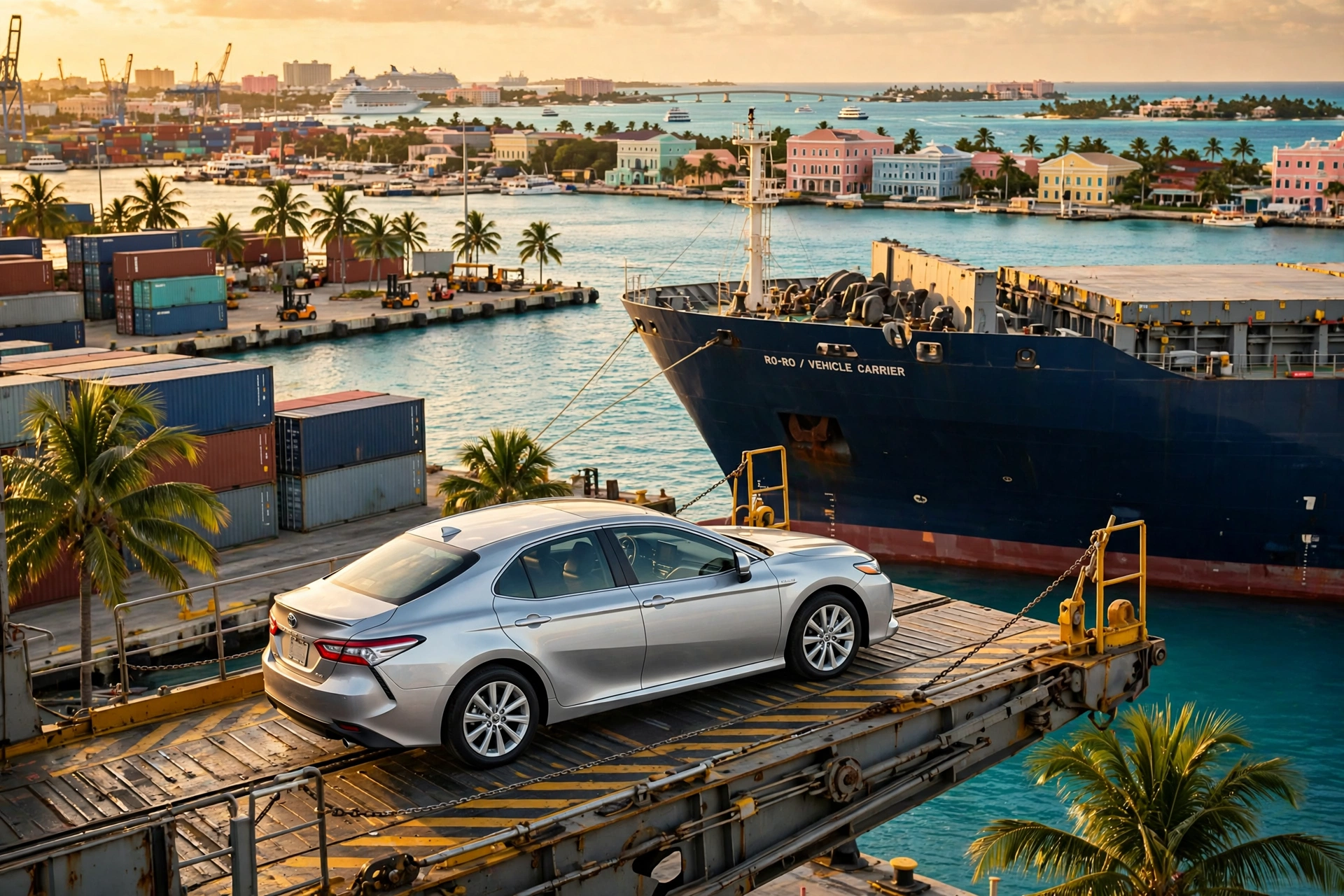
Exporting Cars to the Bahamas: Nassau Port Fees, Duty Rates, and LHD Survival
By DealShore Motors
Nassau is about 50 miles from Florida — the closest foreign car market to the United States — and it can still almost double the price of your car. An $8,500 Toyota Camry bought clean in Florida lands in the Bahamas at roughly $18,000–$19,000 once Bahamas Customs finishes with it, while the identical car as a hybrid can land thousands cheaper. The freight is not the problem. The freight is the cheapest line on the bill. The problem — and the opportunity, if you pick the right car — is a duty system that charges most gasoline cars 65% and hybrids and EVs just 10%, on a left-hand-traffic island that happily runs American left-hand-drive cars.
This guide walks the whole job: the duty tiers and the hybrid gap, a worked landed-cost example, the 10-year age rule, Nassau and Freeport port reality, Ro-Ro and container routes from Florida, the US export side, how a US-spec LHD car actually survives driving on the left, the salt-air corrosion fight, and the models that make money here. Every rate, law, and price below is dated as of 2026. Bahamas Customs assessments — made through its Click2Clear system — are final and change with budgets; verify your exact car with Bahamas Customs or a licensed Bahamian customs broker before you commit money. Nothing here is legal advice.
The Paradox: The Shortest Hop, One of the Steepest Tax Bills
Most Caribbean export guides start with distance. The Bahamas starts with arithmetic. The Bahamas has no income tax tradition to fall back on — customs duty is a core government revenue engine — so vehicles carry a heavy, deliberate tax load. Published Bahamas duty guidance (Bahamas Customs duty-rate search and importer guides, accessed October 2026) puts the standard rate for ordinary gasoline vehicles at 65% of CIF value — CIF meaning the car’s cost plus insurance plus freight. On top of that sit VAT, a processing fee, and an environmental levy. Understate the car’s value to dodge it and you run into the other 2026 story out of Nassau: the Consumer Protection Commission has warned about a surge in fraudulent vehicle imports, valuation fraud is exactly what customs officers are trained to hunt, and the car — not the paperwork trick — is what gets held.
The honest way to win in this market is not a fake invoice. It is vehicle selection, because the same tariff schedule that punishes a gasoline V8 rewards electrified cars to a degree no other island in this series matches.
The Duty Tiers: 65% for Gas, 10% for Hybrids and EVs
As of 2026, the commonly published Bahamas vehicle duty structure is:
| Vehicle type | Duty rate (as of 2026) | Notes |
|---|---|---|
| Gasoline / diesel cars, SUVs, pickups | 65% of CIF | The standard rate most US exports pay. Older value-tier tables (45% under $10,000 / 50% to $20,000 / 65% over) still circulate online — do not budget on them without a current Click2Clear assessment. |
| Hybrid vehicles ≤ $70,000 | 10% | The single biggest legal saving in the Caribbean export game. |
| Hybrid vehicles over $70,000 | 25% | Still far below the gasoline rate. |
| New electric vehicles ≤ $70,000 | 10% | Confirm how used EVs are classified for your exact car before buying. |
| New electric vehicles over $70,000 | 25% | — |
| Golf cars | 30% | A real Bahamas category — resort and Family Island transport. |
| Heavy vehicles (over 20 tons) | 85% | Commercial importers: get a written ruling first. |
| Antique / vintage vehicles | 65% | No collector discount in the duty itself. |
Then the stack on top of duty, as of 2026:
- VAT: 10%, applied to the landed (duty-paid) value.
- Customs processing fee: 1% of value (with published minimum/maximum caps).
- Environmental levy: a fixed amount on most vehicles (figures around $250 are commonly cited), rising sharply for older cars — vehicles over 10 years old have carried a 20% of landed cost environmental levy under the schedule published in 2024. Confirm the current levy for your car’s age in Click2Clear.
- Broker, port handling, and wharfage: budget a licensed broker (flat fees around $150–$300 per shipment are typical in regional guides) plus Nassau port handling; storage accrues daily if your documents are not ready when the vessel arrives.
Read next in this series: The US Customs 72-Hour Rule Explained · Ro-Ro vs Container Shipping: Which Is Safer, Cheaper, and Better? · The 2026 Vehicle Export Master Checklist
A worked example (illustrative, as of 2026)
A clean-title 2019 Toyota Camry 2.5L bought in Florida for $8,500, freight $1,400, insurance $150 → CIF $10,050:
- Duty at 65%: ~$6,533
- VAT 10% on CIF + duty ($16,583): ~$1,658
- Processing fee ~1% + environmental levy + broker/port: ~$600–$900
- Total tax-and-fees bill: roughly $8,800–$9,100 — the car lands at about $18,700–$19,000 all-in, before registration and insurance.
Now run the Camry Hybrid at the same CIF:
- Duty at 10%: ~$1,005
- VAT 10% on $11,055: ~$1,106
- Same fees: ~$600–$900
- Total bill: roughly $2,700–$3,000 — the hybrid lands about $6,000 cheaper.
That gap is the whole Bahamas strategy in one paragraph. It is also why Bahamian dealers are publicly arguing about the used-import market right now — and why a hybrid badge, a healthy battery, and a clean scan are worth more at Arawak Cay than any negotiation trick.
🛠️ Check It Before You Ship It
A hybrid’s 55-point duty saving is worthless if its battery is dying, and a cleared check-engine code at a Florida auction follows the car all the way to Nassau. Two cheap tools pay for themselves on the first pre-purchase check:
ANCEL AD310 OBD-II scanner — the best-selling budget code reader on the market. Plug it in before you pay: it reads and clears engine codes, shows live data and freeze-frame, and runs the I/M readiness check that exposes codes a seller cleared to hide a problem. Around $35. See it on Amazon
NOCO Boost GB150 jump starter (3,000A) — jump-starts gas engines up to 9.0L and diesels up to 7.0L, doubles as a power bank, with a 500-lumen light. Built for the dead-battery-at-the-port moment, which happens more often than anyone admits. See it on Amazon
When you buy through our links, we may earn an affiliate commission at no extra cost to you.
The Age Rule: 10 Years, and It Is a Wall With a Priced Gate
As of 2026, the Bahamas limits ordinary used-vehicle imports to 10 years from the year of manufacture. A vehicle older than 10 years needs special permission from the Ministry of Finance, and older vehicles attract the heavy environmental levy noted above. Bahamian dealer associations have publicly proposed cutting the limit to 7 years to push the fleet newer and cleaner — that is a proposal, not the law as of 2026, but it tells you which direction Nassau is leaning. Plan on 10, and do not build a business on 12-year-old inventory.
Two more refusals to know before you buy:
- Wrecked vehicles without a rebuilt title are prohibited. A salvage car that cannot prove a proper rebuild does not clear. Even with a rebuilt brand, expect scrutiny — buy clean-title for the Bahamas unless a broker has cleared your exact car in writing first.
- There is no steering ban. Unlike Jamaica or Trinidad, the Bahamas does not mandate right-hand drive. That is the next section — and it is why this market belongs to US exporters.
LHD Survival: Driving on the Left in an American Car
The Bahamas drives on the left — a British inheritance — but most cars on Bahamian roads are left-hand-drive imports from the US, with a large minority of right-hand-drive Japanese imports beside them. Both are legal. “Left-hand traffic, left-hand-drive car” sounds like a contradiction until you live with it; Bahamians do, every day. Brutal honesty about what it actually costs you:
- Overtaking is the real hazard. In an LHD car on a left-driving road, you sit on the outside of the road, away from the center line. To see past the vehicle ahead before passing on the right, you must edge out farther. On New Providence’s two-lane roads, the discipline is simple: hang back for sight lines, never pass on blind rises, and let faster traffic go.
- Roundabouts run clockwise and you yield to traffic already circulating from your right — in an LHD car your right-side blind spot does the work. Adjust the passenger mirror wider than you would in Florida and use it.
- Nassau rewards small. Congested streets, tight parking, and Family Island roads punish wide American trucks. An F-150 is legal, wanted for work, and miserable as a Nassau daily. A Corolla or RAV4 is none of those problems.
- Headlights and paperwork need no conversion. US-spec beam patterns, MPH speedometers (Bahamas speed limits are posted in mph — 25 mph in settled areas, up to 45 mph on open roads), and US safety equipment are the local norm, not an exception to argue for. That zero-conversion reality is worth thousands against RHD markets like Jamaica, where a US car is refused outright (see Jamaica’s import policy in this series).
- Licensing runs through the Road Traffic Department: the vehicle is inspected, registered, and licensed (traditionally renewed in the owner’s birth month), and at least third-party insurance is mandatory. Carry the insurance certificate in the car.
Verdict: LHD does not just “survive” in the Bahamas — it is the default. The survival skill is driver technique, not vehicle modification.
Ports, Routes, and Freight Costs (As of 2026)
- Receiving ports: Nassau — the Arawak Cay / Nassau Container Port complex on New Providence — takes the bulk of vehicle traffic. Freeport, Grand Bahama is the second gateway and the right destination for Grand Bahama buyers; shipping a Freeport car to Nassau and ferrying it back is a beginner’s tax. Family Island delivery adds an onward inter-island leg and its own charges — quote it separately, never assume it.
- US departure ports: Palm Beach / Riviera Beach (Tropical Shipping’s home port, with multiple sailings a week to Nassau), Port Everglades / Fort Lauderdale and Jacksonville (Crowley Bahamas services, historically next-day arrivals in Nassau), and Miami. This is the densest Florida–Caribbean sailing schedule in this entire series.
- Transit reality: the sea leg itself is hours to overnight. The 7–12 days total that shipping guides quote for Florida→Nassau is port handling, US export inspection, and Bahamian clearance — not sailing. Your documents, not the ocean, set the schedule.
- Freight planning ranges (as of 2026, ocean freight only, before Bahamas taxes and local charges): Ro-Ro roughly $1,200–$2,500 for a standard running car from Florida; shared/dedicated container roughly $1,500–$3,500+, with full 20-foot container quotes running higher. Get a written, dated quote for your exact car, port pair, and sailing — hurricane season and December move these numbers.
- Ro-Ro vs container, honestly: Ro-Ro is cheapest and fastest on this short hop, but the car must run, drive, and steer, rides exposed to salt air, and carries nothing inside it. A container protects a high-value or freshly detailed car and is the better call for anything you have already corrosion-proofed. Full comparison: Ro-Ro vs Container Shipping.
Clearance runs through Click2Clear (the Bahamas Electronic Single Window, besw.gov.bs): register and file the Home Consumption Entry before the vessel arrives, with your broker, so the car is assessed and released instead of sitting on the quay accruing storage while Nassau traffic drives past it.
The US Side: Clear Export Before the Car Moves
US law is federal and unforgiving (19 CFR Part 192; CBP’s “Exporting a Motor Vehicle” guidance):
- Present the original Certificate of Title (or a state-issued certified copy), lien-free and in the exporter’s name, plus the VIN to CBP at the port of export at least 72 hours before the vessel loads — weekends and federal holidays do not count toward the 72 hours.
- File the EEI in AES/AESDirect and provide the ITN.
- Present the vehicle for CBP inspection and certify the purchase was bona fide and non-stolen.
- Bahamas-side paperwork: ocean bill of lading, commercial invoice / bill of sale, title copy, importer’s passport or Bahamian ID, and the Click2Clear entry filed by you or your licensed broker.
The Florida-specific trap, repeated in exporter forums every month: buying from a dealer whose lien release takes weeks. No lien-free title, no 72-hour filing, no sailing — and a missed weekly sailing to Nassau is still a week of storage on both ends. Insist on lien status in writing at purchase.
Salt Air: The Corrosion Fight Starts Before Loading
The Bahamas is salt spray, limestone dust, standing water after storms, and short trips that never fully dry a car out. A Florida car that looked rust-free can bloom underneath within two Nassau years if you ship it naked. The pre-shipment protocol that actually works:
- Pressure-wash the underbody and let it dry fully before treatment — coating over trapped salt is worse than no coating.
- Treat cavities and seams (rocker panels, door bottoms, subframe rails) with a rust inhibitor / cavity wax, and touch up every stone chip on exposed edges.
- Service what salt kills first: battery terminals (clean, protect, and load-test — heat plus salt eats Bahamas batteries fast), brake hardware, and any bare-metal suspension fasteners.
- After arrival: a fresh-water underbody rinse routine, especially after coastal driving or flooding, is the cheapest life-extension a Bahamian car can get. There is no winter road salt here — the ocean does the job year-round instead.
Skip the cosmetic detail and spend the same money underneath. In Nassau, resale value dies from the frame rails up, not from swirl marks down.
Which Cars Actually Make Sense for the Bahamas
As of 2026, the import math and the roads point to the same short list:
- Toyota Corolla and Camry (especially Hybrid) — the default answer twice over: every Nassau mechanic knows them, parts cross the Florida strait in days, and the hybrid versions cut duty from 65% to 10%. The Camry Hybrid is arguably the single best Bahamas import play in this series.
- Toyota RAV4 and RAV4 Hybrid — ground clearance for Family Island roads and storm debris, Toyota parts depth, and the same hybrid duty advantage.
- Honda Accord and CR-V — strong second-brand picks with real local familiarity; the gasoline duty applies, so buy them right.
- Ford F-150 and work trucks — wanted for construction and Family Island work, taxed hard at 65%, and sized for open roads, not downtown Nassau. Ship them to a buyer, not on speculation.
- Nissan Cube and compact Japanese models — a long-standing Bahamas niche: small, cheap to run, easy to park. Verify steering and age on each unit; Japanese-source cars follow the same 10-year and duty rules.
What does not work: anything over 10 years old without written Ministry permission, wrecked cars without a rebuilt title, undervalued invoices (customs’ current enforcement focus), thirsty V8 luxury SUVs bought “cheap” in Florida whose 65% duty is calculated on customs’ value rather than your bargain, and any hybrid whose battery health you did not scan — a $3,000 battery replacement erases half the duty saving on day one.
Step-by-Step: Florida Driveway to Bahamian Plates
- Pick the powertrain before the car. Hybrid first (10% duty), gasoline second (65%) — then choose the model inside that decision.
- Verify age and title: manufacture year within the 10-year limit, clean (or properly rebuilt) title, lien-free, in your name.
- Scan it and load-test it: OBD-II readiness, hybrid battery health where equipped, VIN match everywhere.
- Corrosion-proof the underbody and photograph the car on all sides before loading.
- Get freight in writing: carrier, port pair (Palm Beach / Port Everglades / Miami → Nassau or Freeport), Ro-Ro vs container, dated quote.
- Clear US Customs: title + EEI/ITN filed 72+ hours before loading.
- File Click2Clear before arrival with your licensed Bahamian broker: entry, valuation documents, duty + VAT + fees assessed.
- Clear, inspect, register: pay Bahamas Customs, take the vehicle to the Road Traffic Department for inspection and licensing, bind insurance — then it is legally yours to drive on the left.
Cross-check every step against The 2026 Vehicle Export Master Checklist, and compare this market with its neighbors in How to Export and Ship Cars from the US to Haiti and Shipping a Car to the Dominican Republic — three islands, three completely different age-and-tax games.
FAQ
What documents do I need to ship a car to the Bahamas?
On the US side: the original (or state-certified) lien-free title in your name, plus the AES/EEI filing and ITN for CBP’s 72-hour rule. For the Bahamas: ocean bill of lading, commercial invoice / bill of sale, title copy, importer ID, and a Home Consumption Entry filed in Click2Clear (besw.gov.bs), usually through a licensed Bahamian customs broker. Verify the exact list with your broker — rules are as of 2026 and change.
How much duty and tax will I pay in the Bahamas?
As of 2026, budget duty at 65% of CIF (cost + insurance + freight) for gasoline and diesel vehicles, 10% for hybrids and new EVs valued at $70,000 or less (25% above that), plus 10% VAT on the duty-paid value, a 1% processing fee, an environmental levy, and broker/port charges. On a $10,050-CIF gasoline sedan that is roughly $8,800–$9,100 in taxes and fees; the same car as a hybrid is roughly $2,700–$3,000. Bahamas Customs’ Click2Clear assessment of your exact car is final.
What is the maximum vehicle age for the Bahamas?
Ten years from the year of manufacture for ordinary imports, as of 2026. Vehicles over 10 years old require special Ministry of Finance permission and attract a heavy environmental levy (20% of landed cost under the schedule published in 2024). Wrecked vehicles without a rebuilt title are prohibited at any age.
Can I drive a US left-hand-drive car in the Bahamas?
Yes. The Bahamas drives on the left, but US left-hand-drive vehicles are legal, common, and the majority of imports — no steering conversion is required or expected. The adjustment is technique: extra care overtaking (you sit away from the center line), clockwise roundabouts, and wider right-mirror checks. Speed limits are posted in mph, and US-spec equipment is standard.
How much does the shipping itself cost, and how long does it take?
Ocean freight only, as of 2026: Ro-Ro roughly $1,200–$2,500 and container roughly $1,500–$3,500+ from Florida ports (Palm Beach, Port Everglades, Miami, Jacksonville) to Nassau or Freeport. The sea crossing is overnight at most; allow 7–12 days total for port handling, US export clearance, and Bahamian customs. That excludes Bahamas duty, VAT, broker, and port charges — get a written, dated quote.
Disclaimer: Laws, duty rates, valuations, and freight prices in this guide are as of 2026 and change without notice. This article is general information, not legal, tax, or customs advice. Verify your specific vehicle, taxes, and documents with Bahamas Customs, a licensed Bahamian customs broker or freight forwarder, and the Road Traffic Department before shipping.
Sources: Bahamas Customs duty-rate guidance and vehicle duty tables (65% standard gasoline rate; 10% / 25% hybrid and EV rates by $70,000 threshold; VAT 10%; 1% processing fee) via Bahamas Customs duty search, Importable and Interworld Freight Bahamas guides (accessed October 2026); vehicle age limit (10 years, Ministry of Finance permission and environmental levy for older vehicles) and Click2Clear / Road Traffic Department procedures via Expat Focus Bahamas and Japanese Car Trade Bahamas import guides (accessed October 2026); Consumer Protection Commission warning on fraudulent Japanese vehicle imports and dealer proposal to reduce the age limit, Bahamas Local / Eyewitness News (July 2024, accessed October 2026); left-hand traffic with LHD vehicles, speed limits and licensing via Expat Focus and Rhino Car Hire Bahamas driving guides (accessed October 2026); US Customs and Border Protection, “Exporting a Motor Vehicle,” 19 CFR Part 192; ocean freight planning ranges and Florida–Nassau sailing patterns from A1 Auto Transport Bahamas / Nassau pages (updated September–July 2026), All Transport Depot Nassau Ro-Ro guide, Crowley and Tropical Shipping Florida–Bahamas service notices (accessed October 2026).
Leave a Reply