Texting While Driving Laws in Every State: The 2026 Guide
By DealShore Motors
Sending or reading a text takes your eyes off the road for 5 seconds. At 55 mph, that’s the entire length of a football field — driven blind. The National Highway Traffic Safety Administration puts it exactly that way, and it is the single most quoted fact in road safety for a reason: no other five-second decision you make behind the wheel is quite so ordinary, or quite so likely to end a life.
Here is the national picture as of 2026: 49 states plus the District of Columbia ban texting while driving for all drivers. One state — Montana — still has no statewide texting ban at all. And beyond texting, the trend is much bigger: roughly 33 states plus D.C. now ban holding a phone in your hand while driving, period — no texting required for the ticket. New states are joining that list almost every year, fines are climbing, and some states are starting to treat a phone in your hand like a suspended license waiting to happen.
Important note: This article is general information only — not legal advice. Laws change between legislative sessions, and details like fine amounts and points vary. Before you drive through a state, check that state’s Department of Motor Vehicles or highway safety office for the current rules. Everything below is dated as of 2026.
The National Map, As of 2026
Distracted-driving law in the U.S. works on two separate tracks, and understanding the difference matters:
- Texting bans — prohibit writing, sending, or reading texts (and usually emails, instant messages, and social media) while driving. As of 2026, 49 states plus D.C., Puerto Rico, Guam, the Northern Mariana Islands, and the U.S. Virgin Islands have one. Montana stands alone without it.
- Handheld / hands-free bans — prohibit holding a phone at all, regardless of what you’re doing with it. This is the stricter standard, and it closes the loopholes texting-only bans leave open (checking maps, scrolling Instagram, watching a video — none of which is “texting” in the old statutory sense). About 33 states plus D.C. have full all-driver handheld bans, per the Governors Highway Safety Association (GHSA).
There’s also a third concept that determines whether a law has teeth: primary vs. secondary enforcement. Under primary enforcement, an officer can pull you over for the phone violation alone. Under secondary enforcement, they can only cite you for it if they already stopped you for something else. Most texting and handheld bans are primary offenses. The exceptions matter — Nebraska and Ohio still classify their texting bans as secondary offenses, and Alabama and Missouri have secondary-enforcement handheld provisions, meaning an officer can’t stop you just for holding your phone there.
Every state also has some form of novice-driver restriction: drivers under 18, or on learner’s and intermediate licenses, face tighter phone rules than adults everywhere in the country.
The Newest Laws: 2025–2026 Changed the Map
If you drove cross-country in 2022, the rules were noticeably different than they are today. The last two years brought a wave of new hands-free laws:
- Iowa — full hands-free law effective January 1, 2026, expanding the old texting ban to all handheld phone use. First offense: $100 plus court costs, a simple misdemeanor.
- Pennsylvania — “Paul Miller’s Law” bans holding or physically supporting a phone while driving, even at red lights and in traffic jams. After a one-year warning period (June 2025–June 2026), officers began issuing citations on June 5, 2026. Base fine is $50 plus court costs, and the violation is a primary offense.
- South Carolina — hands-free law effective September 1, 2025. The first 180 days were warnings only; since March 2026, violations carry a $100 first-offense fine, and repeat offenses within three years cost $200 plus 2 points on the license.
- Missouri — the Siddens Bening Hands-Free Law, enacted in August 2023, reached full citation enforcement in 2025. That’s a landmark: Missouri used to be one of only two states with no adult texting ban at all. Now a first offense runs $150, a second within 24 months $250, and a third $500.
- Arizona — on June 4, 2026, the governor signed HB2109, raising the repeat-offense maximum fine to $400 and adding a $150 surcharge for violations involving motorcycle collisions. First offenses run $75–$149.
- Colorado — its hands-free law has already shown results: telematics data recorded a 4.7% annual reduction in distracted driving after enactment.
The trend is one-directional. Federal grant money — about $10.35 million a year under the Bipartisan Infrastructure Law — is specifically earmarked to push states toward stronger distracted-driving laws, and since 2020 at least ten states have passed new hands-free laws or substantially raised texting fines.
The Strictest States
A few states stand out for how hard they come down on a phone in your hand:
- New York was the first state in the nation to ban handheld phone use, back in 2001 — a quarter-century of enforcement. A cell phone violation there adds 5 license points, among the stiffest point penalties in the country.
- Virginia prohibits holding a phone at all while driving (Va. Code § 46.2-818.2) — the officer doesn’t need to prove you were texting; holding it is enough. First offense: $125 fine and 3 DMV demerit points on your record for three years. Second offense: $250. In a highway work zone, it’s a mandatory $250.
- Alaska technically has one of the most fearsome penalties on paper: texting while driving can carry fines of up to $10,000 in extreme aggravated circumstances, though standard first-offense fines are far lower.
- California bans all handheld use, and a June 2025 appeals court ruling closed a popular loophole: holding your phone to look at a maps app — even without touching the screen — counts as a violation. No more “I was just looking at GPS.”
- Oregon goes beyond most states by folding GPS devices and computers into the handheld ban, and drivers under 18 are barred from phones entirely.
Fines vary widely nationwide. Most first offenses land between $25 and $250 (Alabama starts at $25, Arkansas at $25–$100), escalating into the hundreds for repeat violations. Whether a ticket adds points to your license depends on the state — New York’s 5 points and Virginia’s 3 are on the high end, while Pennsylvania’s hands-free citation carries no points for non-commercial drivers. Points matter beyond the fine: they stay on your record for years, push your insurance premiums up, and in many states they accumulate toward a license suspension.
The Holdouts
Montana is the headline: the only U.S. state with no statewide ban on texting while driving and no handheld ban for any driver. It’s not that the state hasn’t tried — Senate Bill 359, which would have created distracted-driving penalties, failed in the 2025 session. That failure followed the death of 25-year-old Chloe Worl, killed by a driver who was texting. In the absence of state action, two counties (Anaconda-Deer Lodge and Butte-Silver Bow) and nine cities — including Billings, Bozeman, Missoula, and Helena — passed their own local ordinances.
A handful of other states still run texting bans with weaker enforcement or scope:
- Nebraska — texting banned, but secondary enforcement only.
- Ohio — full handheld ban, but its texting provision remains secondary enforcement; the state also has the unusual exception that holding a phone to your ear during a call is allowed.
- Florida, Texas, and New Mexico — have statewide texting bans but no all-driver handheld ban, so talking on a handheld phone is still legal there.
Even where no ban exists, drivers aren’t untouchable: reckless-driving and careless-driving laws apply in every state, and a crash caused by phone distraction will typically be treated as negligence regardless of whether a specific texting statute was broken.
A Scannable Reference: Where Each State Stands
Compiling all 50 states’ full statutory text is beyond what one article can verify reliably — and the details shift every legislative session. What follows is a representative reference of notable states, grouped by how strict their laws are as of 2026. For the complete state-by-state chart, the GHSA’s distracted driving laws page is the authoritative public reference, updated directly from state highway safety offices.
Full hands-free (handheld ban for all drivers, primary enforcement):
Arizona ($75–$149 first), California, Colorado, Connecticut, Delaware, Georgia, Hawaii, Idaho, Illinois, Indiana, Iowa ($100 first), Kentucky, Maine, Maryland, Massachusetts, Michigan, Minnesota, Nevada, New Hampshire, New Jersey, New York (5 points), North Carolina, Ohio, Oregon, Pennsylvania ($50, citations began June 2026), Rhode Island, Tennessee, Utah, Vermont, Virginia ($125 / 3 points first), Washington, West Virginia, plus D.C.
Recent additions (full bans enacted 2023–2026):
Missouri ($150/$250/$500 — full enforcement 2025), South Carolina ($100 first, $200 + 2 points repeat — warnings until March 2026), Louisiana (expanded hands-free enforcement in 2025).
Texting ban for all drivers, but no full handheld ban:
Alabama ($25; handheld ban exists but is secondary enforcement), Alaska (up to $10,000 maximum in extreme cases), Arkansas ($25–$100), Florida, Kansas, Mississippi, New Mexico, North Dakota, Oklahoma, South Dakota, Texas, Wisconsin, Wyoming.
Weaker or secondary enforcement:
Nebraska (texting ban, secondary), Ohio (texting ban secondary; handheld ban allows holding phone to ear), Montana (no statewide texting or handheld ban).
Check your state DMV or the GHSA chart before a road trip — this is a snapshot, not a statute book.
The Crash Data Behind the Laws
The numbers driving these laws come from NHTSA’s Fatality Analysis Reporting System and the agency’s April 2026 research note on distracted driving in 2024:
- 3,208 people were killed in distraction-affected crashes in 2024 — about 8% of all U.S. traffic fatalities. That was the ninth consecutive year above 3,000.
- Another 315,167 people were injured in distraction-affected crashes.
- 437 people died in 2024 in crashes where at least one driver was engaged in cellphone-related activity — about 14% of all distraction-affected fatal crashes.
- Distraction was a factor in 8% of fatal crashes, 13% of injury crashes, and 12% of all police-reported crashes.
- The highest cellphone involvement was among drivers aged 25–34: 27% of drivers in that group involved in these crashes were using a phone.
And those are the reported numbers. Experts agree distraction is badly undercounted — drivers rarely admit it after a crash, and police reports capture only a fraction. A 2023 NHTSA study estimated that accounting for unreported incidents, distraction may have been involved in as many as 29% of all crashes in 2019 — more than 10,500 fatalities, over triple the official count.
The behavioral data is, if anything, worse. A September 2025 report from GHSA and Cambridge Mobile Telematics found that drivers with high levels of phone distraction are 240% more likely to crash. Telematics shows one in three crashes in 2024 happened within a minute of the driver using a phone, and drivers still spend roughly two minutes per driving hour interacting with phone screens — a slight improvement from the pandemic peak, but an enormous exposure at highway speeds.
How Enforcement Actually Works
A hands-free law only matters if it’s enforced, and enforcement mostly comes down to one thing: officers watching for the glow and the glance. Police look for drivers looking down at their laps, phones lit up in dark cabins, and the tell-tale one-handed steering with the other hand out of sight. At red lights and in stop-and-go traffic, many states’ bans still apply — in Pennsylvania, Arizona, and others, holding your phone at a red light is the same violation as holding it at 70 mph. Virginia lets you handle the phone when lawfully parked, but “parked” means out of the travel lane, not paused at a light.
School and work zones often carry enhanced penalties — Virginia’s mandatory $250 work-zone fine is the clearest example. Several states also run enforcement waves, like the April Distracted Driving Awareness Month campaigns coordinated with NHTSA, where citation rates spike.
And there’s a quiet deterrent most drivers miss: a hands-free citation is a citable fact. If you cause a crash after being warned, or even just have the ticket on record, that violation becomes evidence of negligence in a civil lawsuit. The $125 fine is the cheap part.
The Practical Playbook: Stay Legal Without Thinking About It
The good news: complying with hands-free laws is mostly a one-time setup, not an ongoing effort.
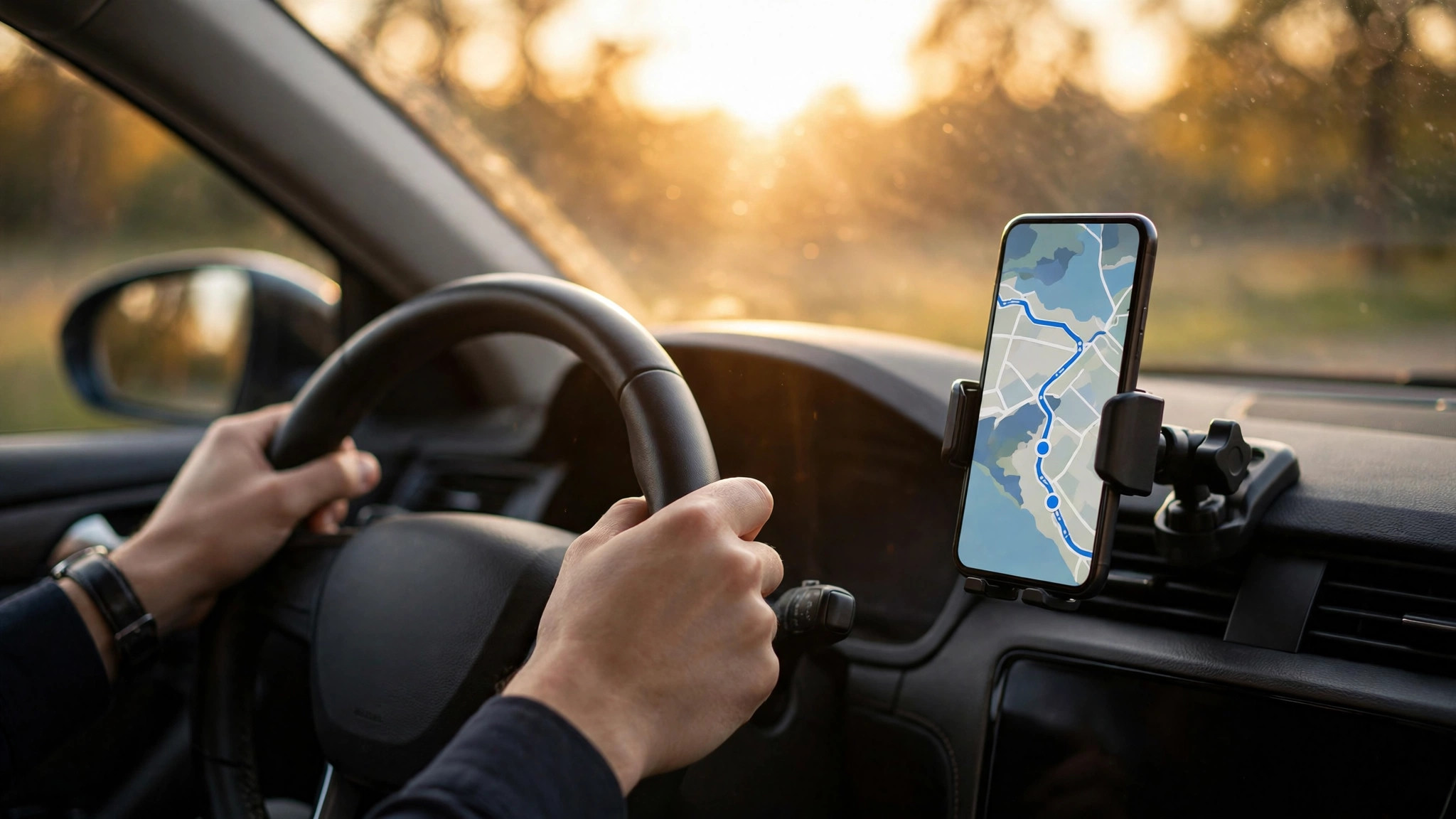
- Mount the phone, don’t hold it. A $15–$25 dashboard or vent mount turns your phone into a legal GPS screen in every state. In several states, a single tap or swipe on a mounted phone to start or end a call is explicitly allowed.
- Pair Bluetooth or use your car’s system. Apple CarPlay and Android Auto (mentioned by name only) route calls, texts, and navigation through the car’s screen and speakers. In cars without them, a basic Bluetooth connection covers calls and voice assistant commands.
- Turn on Do Not Disturb While Driving. Both major phone platforms can silence notifications and auto-reply to texts when the car is moving. It’s free, it’s built in, and it removes the temptation entirely.
- Set navigation before you roll. Enter the destination while parked. If you need to change it, pull over — in most hands-free states, reprogramming a handheld GPS while driving is the violation.
- Use voice for everything. “Call Mom,” “text Dad I’ll be ten minutes late,” “navigate to the nearest gas station” — voice assistants handle all of it hands-free.
- Make it a passenger’s job. Riding with someone? Hand them the phone. It’s the simplest compliance strategy ever invented.
- Teens and new drivers: remember that nearly every state has stricter rules for drivers under 18 — often a total phone ban, hands-free included. If your kid just got licensed, their rules are harsher than yours. Model the behavior you want from them.
The Bottom Line
The direction of travel is clear: 49 states ban texting, Montana is the lone holdout, and the all-driver handheld ban — the real teeth — has spread to roughly 33 states plus D.C., with new states joining almost every legislative session. Fines start small but points, insurance hikes, and the evidence trail after a crash make the true cost much higher. Set up your car once — mount, Bluetooth, Do Not Disturb — and you’ll never have to think about which state you’re in.
This article reflects laws as of 2026 and is general information, not legal advice. Laws change; check your state DMV or the GHSA distracted driving laws chart for the current rules before you drive.
Sources: National Highway Traffic Safety Administration, Distracted Driving in 2024 (Research Note DOT HS 813 790, April 2026); NHTSA Fatality Analysis Reporting System 2020–2024; Governors Highway Safety Association distracted driving laws chart (ghsa.org); GHSA / Cambridge Mobile Telematics distracted driving report (September 2025); Insurance Institute for Highway Safety electronic device laws chart (October 2026); Federal Communications Commission distracted driving guide.
Leave a Reply