By DealShore Motors
Ship the wrong SUV to Haiti and you will pay for it twice: once at the auction in Florida, and again every month on Route Nationale. A low crossover with a CVT, low-profile tires, and electronics that hate water will look cheap on Copart — right up until the first flooded crossing outside Cap-Haïtien, the first pothole that bends a control arm, and the first mechanic who tells you the part has to come from Miami.
Haiti does not kill cars with mileage. It kills them with clearance, heat, bad fuel, broken pavement, and parts nobody stocks locally. The five SUVs below survive because they get those five things right. Every pick is left-hand drive, shippable from the US with no steering conversion, and honest about its failures — because in this market, a known $900 repair beats a mystery $3,000 one every time.
This is the companion to our pillar guide, How to Export and Ship Cars from the US to Haiti: The Complete Cap-Haïtien & Port-au-Prince Guide. Read that first for the 72-hour US Customs rule, Ro-Ro vs container, and Haiti’s layered duties. All rules and prices below are as of 2026 — verify with a licensed customs broker or freight forwarder before you commit money. This is not legal advice.
How We Ranked Them — The Haiti Test
Forget US magazine rankings. We scored each SUV on what actually matters after the port:
- Ground clearance and underbody toughness — can it clear ruts, rocks, and floodwater without tearing off plastic?
- Suspension simplicity — leaf-simple, widely understood designs beat air suspension and adaptive dampers that need a dealer laptop.
- Engine tolerance — port-injected, naturally aspirated engines tolerate variable fuel quality. Direct-injection (GDI) and small turbos do not.
- Parts and mechanic familiarity in Haiti — if a mechanic in Cap-Haïtien or Port-au-Prince cannot source it locally, it does not matter how reliable it was in Ohio.
- Duty math — Haiti taxes larger engines harder, including an excise layer on engines of 2,200cc and above (see Post #55). A 4.7L V8 costs more to land than a 2.5L four — that has to be worth it.
The short verdict: Best overall for Haiti is the Toyota 4Runner (2007–2009 V6, or 2010–2012 if budget allows). Best value is the Toyota RAV4 2.5L (2009–2012). The luxury workhorse is the Lexus GX 470 — buy it only with a documented timing-belt service.
At a Glance
| SUV | Best years for Haiti | Engine to pick | Clearance | Biggest known risk | US buy price guide* |
|---|---|---|---|---|---|
| Toyota 4Runner | 2007–2009; 2010–2012 | 4.0L V6 (1GR-FE) | ~9.0–9.6 in | Frame rust; early 2003–2005 head-gasket reports | $9,000–$16,000 |
| Toyota RAV4 | 2009–2012 | 2.5L (2AR-FE) | ~6.3–7.5 in | 2006–2008 2.4L oil burning — avoid | $6,500–$10,500 |
| Lexus GX 470 / Prado 120 | 2005–2009 | 4.7L V8 (2UZ-FE) | ~8.3 in (more lifted) | Timing belt overdue; rear air suspension sag | $9,500–$15,000 |
| Suzuki Grand Vitara | 2009–2012 | 2.4L (J24B, post-mid-2009) or 3.2L V6 | ~7.9–8.1 in | Timing-chain rattle; early 2.4L head/block issues | $4,500–$7,500 |
| Honda CR-V | 2010–2011 | 2.4L (K24) | ~6.7–7.3 in | A/C compressor failure in heat | $6,000–$9,500 |
*Rough US market guides as of 2026 for clean-title, running examples. Auction prices vary by condition, mileage, and title. Not a quote.
1. Toyota 4Runner — The One That Takes the Beating
Pick: 2007–2009 4.0L V6. Stretch pick: 2010–2012 fifth generation.
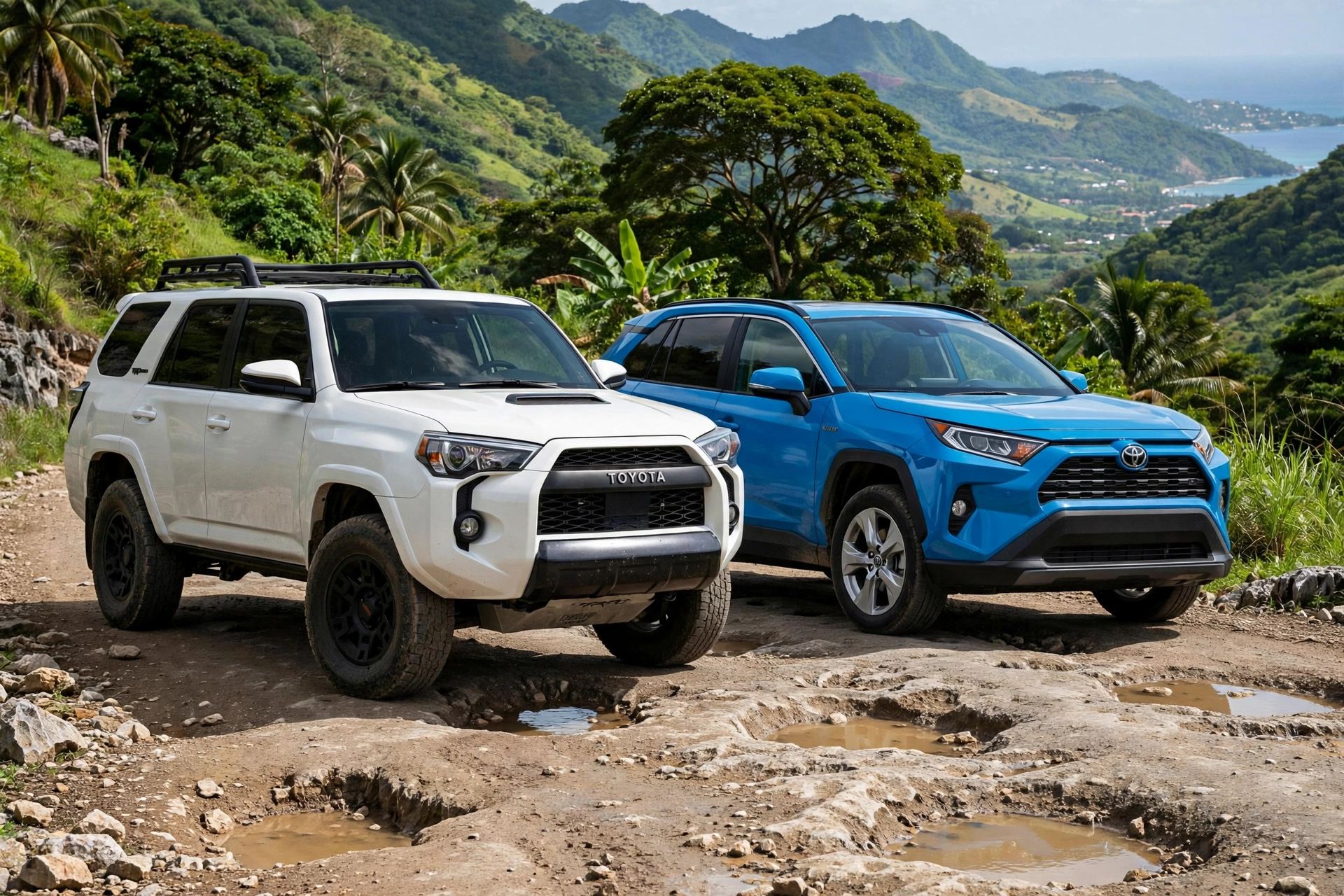
The 4Runner is body-on-frame — a separate ladder frame under the body, like a pickup truck. On broken Haitian roads that matters more than any spec sheet: a frame flexes and can be repaired in sections; a unibody that cracks its subframe mounts is a much harder fix. Add real 4WD with low range, ~9 inches of clearance, and the 1GR-FE 4.0L V6 — a port-injected engine Haitian mechanics know well — and you have the default answer for anyone driving beyond paved city streets.
Brutal honesty section:
- Avoid 2003–2005 V6 examples unless the price truly reflects risk. Owner and mechanic reporting clusters early fourth-generation V6 head-gasket failures and severe frame corrosion in that window, with head-gasket work commonly quoted in the $2,000–$4,000 range in the US. A cheap 2004 can become the most expensive 4Runner you ever own.
- Frame rust is the deal-breaker on any year. Salt-belt US trucks can look clean on top and be perforated underneath. Put it on a lift, tap the rails near the rear axle and suspension mounts, and walk away from flaking or holed frames. Surface rust is normal; structural rust is not fixable at Haiti prices.
- Check the 4WD actuators. Trucks that lived in 2WD for a decade often resist engaging 4WD. Test low range before you buy, not after it lands.
- Suspension wear is guaranteed, not a defect. Budget for ball joints, bushings, and shocks ($600–$1,400 in US parts and labor, less labor in Haiti) — Route Nationale will finish whatever the previous owner started.
Before you ship: compression check, frame inspection photos, fresh fluids, and all-terrain tires with real sidewall — not low-profile street tires.
2. Toyota RAV4 (2009–2012, 2.5L) — The Value Pick That Actually Lasts
Pick: 2009–2012 with the 2.5L 2AR-FE. Avoid: 2006–2008 2.4L.
The RAV4 is the opposite bet from the 4Runner: unibody, lighter, cheaper to buy, cheaper on fuel, and cheaper on Haiti duty because the 2.5L still sits above the 2,200cc excise line but well below a V8 bill. For Cap-Haïtien and Port-au-Prince city use plus decent dirt roads, it is the smart money. For deep ruts and river crossings, it is not a 4Runner — do not pretend otherwise.
The year split is everything:
- 2006–2008 2.4L (2AZ-FE): avoid for export. NHTSA complaint data and owner reporting consistently flag excessive oil consumption on these years — in bad cases a quart every 1,000–2,000 miles — linked to piston-ring design. The 2007 model year alone carries roughly a thousand NHTSA complaints and double-digit recalls in federal records. Toyota’s old warranty enhancement for this issue has expired, so the repair is now on the owner.
- 2009–2012 2.5L (2AR-FE): the sweet spot. The later third-generation cars avoid the worst oil-burning record, keep a conventional automatic (no CVT in this generation), and are new enough to find with service history but old enough to be affordable.
- Steering complaints appear on early third-gen cars — check for clunks and intermediate-shaft play on a test drive; US independent-shop steering repairs cluster around ~$700.
- AWD is not 4WD. RAV4 AWD helps on wet dirt. It has no low range. If the buyer’s route needs low range weekly, buy the 4Runner instead.
Before you ship: cold oil-level check, oil-consumption history, rear differential fluid on AWD models, and a spare tire that actually holds air — RAV4s eat tires on broken pavement.
3. Lexus GX 470 (2005–2009) — The Prado in a Suit
Pick: any year with a documented timing-belt job in the last 90,000 miles. No paperwork = price in the job or walk.
In most of the world this truck is the Toyota Land Cruiser Prado 120. In the US it was sold as the Lexus GX 470, which is exactly why it is the export cheat code: US auctions are full of well-maintained GXs, and underneath the leather is a body-on-frame Prado with the 4.7L 2UZ-FE V8 — one of the most durable V8s Toyota ever built.
Why it works in Haiti: frame construction, real 4WD, excellent cooling when maintained, and Prado parts knowledge across the Caribbean. Why it can burn you:
- The 2UZ-FE is an interference engine with a timing belt due about every 90,000 miles. If the belt snaps, valves meet pistons. A full belt + water pump service in the US typically runs $900–$1,600. No record? Assume it is overdue.
- Rear air suspension sags. Leaking air springs and height sensors are the GX’s signature age failure. Many owners convert to conventional coil springs ($500–$950 in parts in owner reporting) — for Haiti, a coil conversion done before shipping is a feature, not a flaw.
- Secondary air injection pump failures trigger warning lights and limp behavior; US repair quotes commonly run $500–$1,100. Scan it before you bid.
- Duty hurts. At 4.7L, the GX pays the full large-engine penalty in Haiti. Run the landed math in Post #55 before falling in love with a cheap auction hammer price.
Before you ship: timing-belt proof, air-suspension cold-start height check (photograph it after sitting overnight), radiator condition, and a full OBD-II scan.
4. Suzuki Grand Vitara (2009–2012) — The Budget Real-4WD Outsider
Pick: 2009–2012, ideally post-mid-2009 2.4L or the 3.2L V6. Avoid: 2006.
Most cheap crossovers are front-wheel-drive cars in costume. The Grand Vitara is not: it offers a proper 4WD system with low range in a small, light body, with about 8 inches of clearance. On narrow mountain roads where a 4Runner feels huge, the Suzuki fits — and its US prices are the lowest on this list because Suzuki left the US market and resale values fell.
That orphan status is both the deal and the risk. Parts are available, but not on every corner in Haiti the way Toyota parts are. Buy the best example, ship it with a spares kit (filters, belts, brake pads, a coil pack), and it earns its place.
- 2006 is the year to skip — owner reporting clusters engine and transmission trouble there.
- 2.4L J24B caution: early builds (mainly 2007–2008, pre-July 2009) have reported head/block cracking with coolant loss; later builds are the safer buy. At high mileage the timing chain and tensioner can rattle on cold starts — a chain kit job is typically $800–$1,800 in US shop pricing. Fresh oil history is your best protection.
- Cooling check is mandatory. Owner reviews flag overheating under hard work and towing, sometimes linked to air trapped in the cooling system. Pressure-test it, service it, and burp it properly before the container closes.
- Manual-gearbox recall: a 2017 recall covered 2008–2013 five-speed manuals for a gear-shift shaft that could fracture. If you buy a manual, verify completion by VIN.
Before you ship: cold-start listen for chain rattle, cooling-system pressure test, 4WD low-range test, and that spares kit in the cargo area (declared properly if you container-ship — Ro-Ro forbids personal items inside).
5. Honda CR-V (2010–2011) — The City-and-Highway Honest Compromise
Pick: 2010–2011. Buy 2007–2009 only with A/C and timing-chain proof.
The CR-V makes this list with an asterisk, and we will say it plainly: it is the least off-road-capable SUV here. Unibody, modest clearance, no low range. What it offers instead is the best paved-road manners, strong fuel economy from the K24 2.4L, and Honda parts familiarity. For a buyer who lives in the city, drives paved highways, and only occasionally faces dirt, a good 2010–2011 CR-V is a rational, cheaper-to-run choice. For mountain tracks, buy any Toyota above it on this list.
- A/C compressor failure is this generation’s defining defect (2007–2011) — failures commonly reported between 60,000–100,000 miles, sooner in hot climates, with replacement typically $800–$1,200 in the US, and $1,500–$1,800 if a failed compressor contaminates the whole system. In Haiti, A/C is not a luxury. Test it ice-cold, listen for clutch grinding, and ask for service records.
- Timing-chain rattle on cold starts (esp. 2007–2009) signals stretch; replacement runs $1,200–$2,000 in US pricing. The 2010–2011 cars have the better record here — another reason they are the pick.
- Do not export a 2017+ 1.5T CR-V thinking it is the same bet. That is a different article (oil dilution) and a worse Haiti bet than the simple K24 cars.
Before you ship: 20-minute A/C soak test in heat, cold-start video from the seller, brake pads (this generation wears them faster, roughly 30,000–40,000 miles in owner reporting), and fresh transmission fluid.
The Prep List Every One of These Needs Before It Sails
Do this in the US, where parts are cheap and lifts are everywhere — not at the port:
- Full fluid reset: engine oil, transmission, transfer case, both differentials, coolant, brake fluid.
- Cooling system proof: pressure test, radiator cap, hoses, thermostat. Haiti heat finds weak cooling in the first week.
- Suspension honesty check: ball joints, tie rods, sway-bar links, shocks. Replace worn rubber now; it is cheaper than a breakdown plus a tow on a mountain road.
- Tires with sidewall, plus a full-size spare. Low-profile tires are a liability. Check the spare holds pressure.
- Flood discipline: never ford water above the hubs without knowing the intake height; after any deep crossing, check differential breathers and fluids for milky contamination. If water entered the cabin in a US flood car — walk away before you ever ship it; saltwater flood electronics die slowly and expensively in tropical humidity.
- Scan it. Read codes, live data, and readiness monitors. A cleared-code car with incomplete monitors is a seller hiding something (see our pre-purchase guides).
🛠️ Ship-It Kit — Three Tools Worth Sending With the Car
ANCEL AD310 OBD-II scanner — reads and clears codes, live data, freeze-frame, and I/M readiness. Around $35. See it on Amazon
NOCO Boost GB150 jump starter (3,000A) — jump-starts gas engines up to 9.0L and diesels up to 7.0L, doubles as a power bank, with a 500-lumen light. Built for the dead-battery-at-the-port moment. See it on Amazon
AstroAI S1 portable tire inflator (12V, 150 PSI) — preset pressure with auto shutoff. Pothole roads mean pressure checks weekly, not yearly. See it on Amazon
When you buy through our links, we may earn an affiliate commission at no extra cost to you.
Selection note: these are research-backed picks from specs and owner reporting, not first-hand lab tests by DealShore Motors.
What Owners Say
Recurring themes paraphrased from owner forums, r/MechanicAdvice-style threads, and complaint databases — not invented quotes: 4Runner owners praise frame toughness but warn every newcomer to inspect the frame before the engine; RAV4 owners love the 2009–2012 cars and warn strangers away from oil-burning 2006–2008s unprompted; GX owners repeat one rule — “timing belt paperwork or it didn’t happen”; Grand Vitara owners call it underrated off-road and admit parts hunting takes longer; CR-V owners in hot states talk about A/C compressors the way other owners talk about tires — as a scheduled expense.
Bottom Line — Which One Should You Ship?
- One SUV, any road in Haiti: 4Runner 2007–2009 V6.
- Tightest total budget, mostly city + decent roads: RAV4 2009–2012 2.5L.
- Comfort + capability, budget for the belt and the duty: GX 470 with paperwork.
- Smallest price, real low range, willing to carry spares: Grand Vitara 2009–2012.
- Paved-road life, best manners, A/C proven cold: CR-V 2010–2011.
Whatever you pick, the model matters less than the specific truck: service history, a lift inspection, and a cold-start video will save you more money than any ranking — including this one.
📋 Free download: the Vehicle Export Document & Port Inspection Checklist — every document, deadline, and inspection point for US-to-Haiti shipping in one printable PDF.
FAQ: Shipping SUVs to Haiti
What documents do I need to ship an SUV to Haiti?
US side: original vehicle title (or state-certified copy) presented to CBP at least 72 hours before export, plus an AES/EEI filing with an ITN number. Haiti side: original title, ocean bill of lading, passport or ID, bill of sale, and cargo manifest. Full walkthrough in Post #55.
How much is customs duty on an SUV imported to Haiti?
There is no single rate. As of 2026, Haiti layers a base duty on CIF value, 10% TCA (VAT), a 10% excise on engines of 2,200cc or more, and a verification fee — effective totals commonly 25–50%+ of CIF, with larger engines paying materially more. Get a written broker quote before you buy.
Is there a maximum vehicle age for Haiti?
No hard age ban as of 2026 — unlike the Dominican Republic’s 5-year cap. Duties scale with engine size and customs valuation, not the calendar, which is why 2007–2012 SUVs remain viable.
Which is better for Haiti — Ro-Ro or container?
Ro-Ro is usually cheaper (roughly $1,400–$3,200 per standard vehicle from South Florida as of 2026) but the vehicle must run, steer, and brake, with nothing stored inside. Container costs more but is more secure and suits non-runners. Full comparison in this series: Ro-Ro vs Container Shipping.
What should I check before buying a used SUV for export?
Frame or subframe rust on a lift, cold-start engine noises, oil level and consumption history, cooling-system pressure test, 4WD engagement (including low range), A/C performance under heat, and an OBD-II scan for codes and readiness monitors. Model-specific checks are listed under each pick above.
Related Guides in This Series
- How to Export and Ship Cars from the US to Haiti: The Complete Cap-Haïtien & Port-au-Prince Guide (Post #55)
- The US Customs 72-Hour Rule Explained: How to Avoid Port Staging Fines
- Ro-Ro vs Container Shipping: Which Is Safer, Cheaper, and Better?
- The 2026 Vehicle Export Master Checklist: From US Purchase to Foreign Registration
- Shipping a Car to the Dominican Republic: The Strict 5-Year Age Limit Rule Explained
Sources
- Export & Shipping blueprint and Post #55 research file, DealShore Motors (2026) — Haiti duty layers, port guidance, model shortlist
- NHTSA complaint and recall records as summarized in owner-data reporting for RAV4 model years 2006–2012 (2007: ~1,000 complaints; 2006–2008 oil-consumption cluster)
- CarComplaints and owner-forum reporting on RAV4 oil consumption, 4Runner frame corrosion and early fourth-generation head-gasket reports, GX 470 timing-belt interval (~90,000 miles) and rear air-suspension failures, Grand Vitara timing-chain and cooling reports, CR-V 2007–2011 A/C compressor and timing-chain reports — repair ranges are typical US independent-shop ranges as of 2026
- U.S. Customs and Border Protection, “Exporting a Motor Vehicle” (19 CFR Part 192; 72-hour rule)
Rates, duties, and regulations change. This guide is dated October 2026 and is not legal advice — confirm every figure with a licensed customs broker and your freight forwarder before committing money.
Leave a Reply