By DealShore Motors
Here’s something most car people don’t know: the turbocharger was patented in 1905 — three years before the Model T existed. Your EcoBoost, your WRX, your 911 Turbo — they’re all running on an idea a Swiss engineer named Alfred Büchi sketched out when cars still had hand cranks. Patent No. 204630, November 1905: use the engine’s wasted exhaust heat to spin a turbine, and use that turbine to cram more air into the cylinders.
It took almost 60 years before anyone bolted one onto a production car. And when they did, it was gloriously weird.
The First Turbo Car Ran on “Rocket Fluid”
In April 1962, Oldsmobile dropped the Jetfire — a compact with a 215 cubic-inch aluminum V8, a Garrett turbocharger, and 215 horsepower. One horsepower per cubic inch, which was a magic number in those days. It beat Chevrolet’s turbocharged Corvair Spyder to showroom floors by a matter of weeks, making it the first turbocharged production passenger car ever sold.
Here’s the part nobody believes: the Jetfire had a tank under the hood filled with “Turbo-Rocket Fluid” — a mix of water and methanol you had to top up like washer fluid. Without it, the engine would knock itself to pieces under boost. Owners didn’t maintain it, dealers didn’t understand it, and Oldsmobile killed the car after two years and fewer than 10,000 units. America wouldn’t get another turbo V8 production car until 1980.
Superchargers got there first, by the way. The supercharged “Blower” Bentleys were terrorizing race tracks in the late 1920s — crank-driven blowers howling away decades before turbos went mainstream. And in the 1980s, Formula 1 ran 1.5-liter turbo engines making over 1,000 horsepower in qualifying trim. From 1.5 liters. Let that sink in.
So after 120 years of development, which one is actually better? It depends on what you’re asking it to do.
How a Turbocharger Works
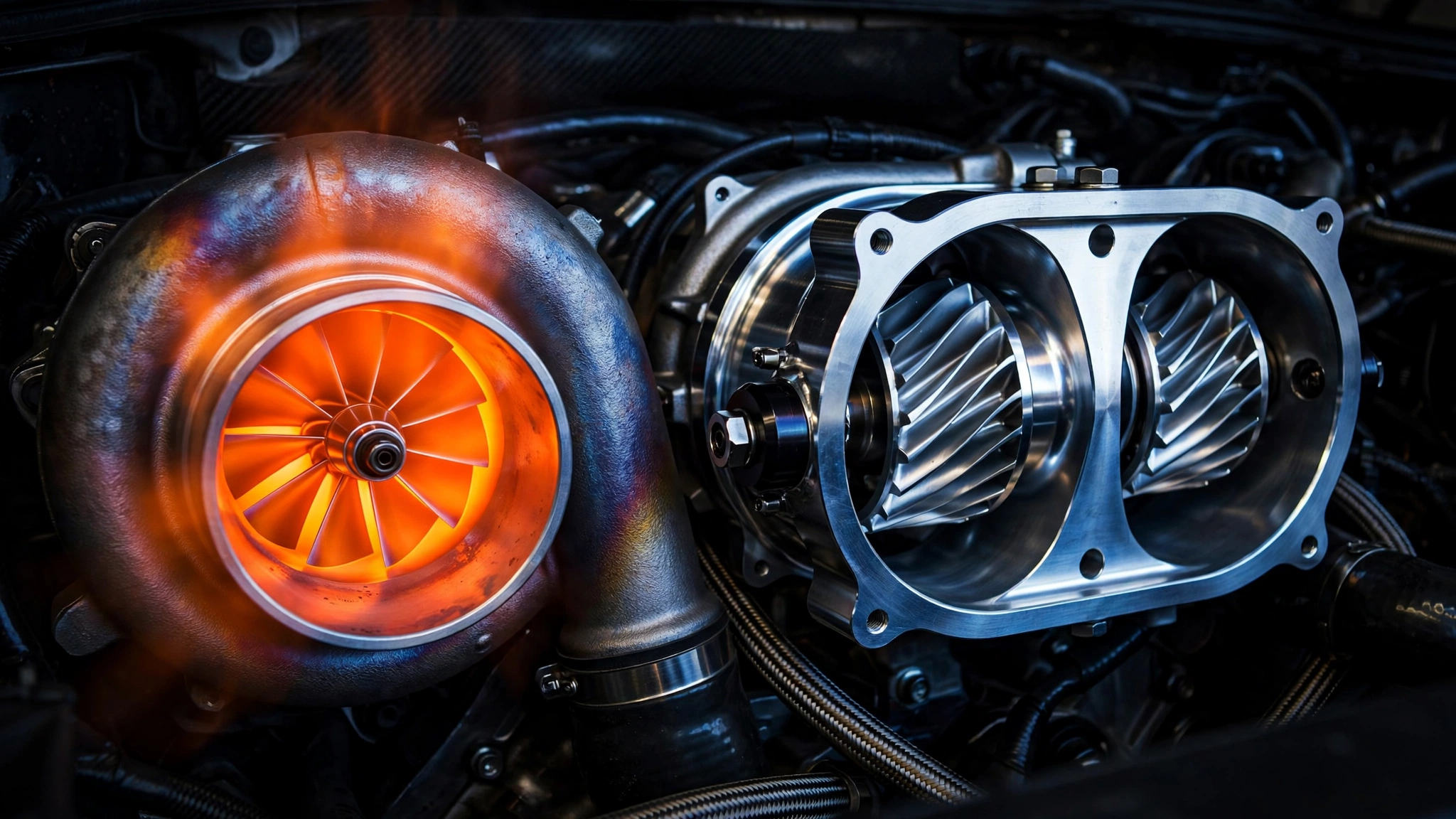
A turbo is two wheels on one shaft. Hot exhaust gas blasts through the turbine wheel, which spins the compressor wheel on the other end. The compressor sucks in fresh air, squeezes it, and shoves it through an intercooler into the engine. More air + more fuel = bigger bang.
Key facts:
- The shaft spins at 100,000 to 250,000+ RPM. That’s not a typo.
- It’s powered by exhaust energy that was headed out the tailpipe anyway — which is why turbos are the efficiency kings.
- It’s not free power, though. The turbine creates backpressure in the exhaust, which costs some efficiency. Just far less than the alternative.
- The downside everyone knows: turbo lag. At low RPM there isn’t enough exhaust flow to spin the turbine, so boost arrives late — then hits all at once.
Because the turbine side glows cherry red (up to ~1,000°C), heat management is everything. A good intercooler isn’t optional — it’s what keeps the intake charge dense and the engine out of detonation.
How a Supercharger Works
A supercharger skips the exhaust entirely. It’s belted (or geared) directly to the crankshaft — the engine turns the blower, the blower makes boost. There are three flavors:
- Roots blower — the classic. Two counter-rotating lobes act like an air pump, shoving air into the manifold. Instant boost, but thermally inefficient (~50–60%). This is the whine you hear on a Hellcat or a Jaguar F-Type.
- Twin-screw — intermeshing helical rotors that compress air inside the unit before discharging it. Smoother and more efficient (~70–75%) than a Roots.
- Centrifugal — basically a turbo’s compressor wheel driven by a belt through step-up planetary gearing. The impeller can spin 50,000+ RPM. Most efficient of the three (~75–80%+), and it runs cooler since it’s nowhere near the exhaust.
The supercharger’s party trick: boost is instant. Rotor speed is locked to crank speed, so there’s zero lag — you get a flat wall of torque right off idle. That’s why they’re the weapon of choice for towing, heavy trucks, and drag launches.
The price: a big twin-screw on a V8 can eat 30 to 80+ horsepower just turning the rotors at redline. You’re spending power to make power, and fuel economy feels it.
The Real Trade-Off
Strip away the engineering and it comes down to one question: where does the compressor get its energy?
| Turbocharger | Supercharger | |
|---|---|---|
| Power source | Waste exhaust heat | Crankshaft (belt) |
| “Cost” of boost | Exhaust backpressure (small) | 30–80+ hp of drag (large) |
| Throttle response | Lag, then a surge | Instant |
| Heat problem | Turbine heat soak (~1,000°C) | Compression heat, worst on Roots |
| Best at | Efficiency, top-end power | Low-end torque, drivability |
Modern engineering has blurred the lines: twin-scroll turbos and lightweight turbine wheels have nearly erased lag, variable-geometry turbos act small at low RPM and big at high RPM, and 48-volt electric superchargers spin the compressor up in tenths of a second before exhaust gas takes over. Some cars (Volvo’s twin-charged engines) just run both — supercharger off the line, turbo for the mid-range.
Buying Used? Here’s What to Check
This is the part that matters if you’re shopping. Forced induction adds failure points, and they all leave clues:
Turbocharged cars:
- Service history is everything. Turbos spin at 200,000 RPM on a film of oil. Skipped oil changes kill them. No records? Walk away or price in a replacement.
- Blue smoke on startup or boost = worn turbo seals.
- A loud siren-like whine under boost = dying bearings.
- Check intercooler piping for heavy oil coating — some oil mist is normal, pools of it aren’t.
- After a hard drive, give the turbo 30–60 seconds of idle before shutdown so oil keeps flowing while it cools. (Modern water-cooled turbos are more forgiving, but the habit is free insurance.)
Supercharged cars:
- Rattle at idle that goes away under throttle = worn blower coupler (common on Eaton/Magnuson units). Cheap part, annoying job.
- Check the belt for cracking and glazing, and ask when the blower oil was last changed — yes, superchargers have their own oil, and yes, people forget it exists.
- Boost leaks show up as a check-engine light and lazy throttle response. A $20 boost gauge or a scan tool tells the truth fast.
Either way: a pre-purchase inspection by a mechanic who knows forced induction is the best $150 you’ll ever spend. Boost is wonderful until it isn’t, and the difference is almost always maintenance.
The Bottom Line
Turbos won the efficiency war — that’s why nearly every new car with a small engine has one. Superchargers won the feel war — nothing hits like instant, lag-free torque. After 120 years, the fight isn’t settled. It’s just better engineered.
Shopping for something with boost? DealShore Motors is building the enthusiast’s guide to buying smart — more deep dives like this every week.
Sources: U.S. Patent and historical records for Büchi’s 1905 turbocharger patent (No. 204630); Oldsmobile Jetfire production history (April 1962 launch, Garrett AiResearch turbo, “Turbo-Rocket Fluid” injection); period supercharger and Formula 1 turbo-era records.
Leave a Reply