By DealShore Motors
In late September 2026, armed gangs shut down Port-au-Prince’s main container terminal. Land access was closed September 26–29. Ships were fired on while trying to dock. A crane operator was shot, two Filipino crew members were kidnapped off a cargo vessel, and containers were looted. Customs clearance was suspended, and Haiti-bound cargo started diverting to the Dominican Republic and Jamaica instead.
Here is the brutal truth about shipping a car from the US to Haiti in 2026: the paperwork is simple, the freight is affordable, and the one decision that can wreck your whole shipment has nothing to do with either. It’s which port you choose. There are two Haitis for vehicle shippers right now, and only one of them reliably works.
This guide walks the full process — buying an exportable car, clearing US Customs, picking the route, surviving Haiti’s layered duty system, and getting your keys out of the port. Every rate and rule below is dated as of 2026. Haiti changes fast: verify everything with a licensed customs broker before you commit money. Nothing here is legal advice.
Why Haiti Is a Genuinely Good Export Market
Strip away the headlines and the fundamentals are strong:
- Left-hand drive, like the US. No steering conversion, no RHD mandate (unlike Jamaica or Trinidad). A US-spec car is a Haiti-spec car.
- No hard age ban. The Dominican Republic caps imports at 5 years old; Jamaica demands right-hand drive and young cars. Haiti has flexible age rules — duties scale with engine size and value, not the calendar. Old workhorses are welcome.
- The diaspora is the pipeline. Hundreds of thousands of Haitians in Florida, New York, and Massachusetts buy cars in the US for family back home or for resale. The demand is constant.
- Mechanics know the playbook. Toyota Hilux, Tacoma 4×4, RAV4, Corolla, Land Cruiser Prado, Isuzu NPR — parts and know-how are everywhere in Haiti.
- Timing favors buyers. US wholesale prices have softened for three straight months — the Manheim index fell 1.1% in September 2026 — which widens the export arbitrage spread: buy cheaper at US auction, sell into steady Haitian demand.
The vehicles that win in Haiti are the ones that survive Route Nationale potholes, unpaved mountain grades, and flood season: body-on-frame trucks and simple, naturally-aspirated SUVs. We break down the exact models in our companion guide — The 5 Most Reliable Used SUVs to Ship to Haiti — but the short list is Toyota everything, plus the Isuzu NPR for commercial work.
Step 1: Buy a Car You Can Actually Export
Not every US car can legally leave the country. Get this wrong and US Customs seizes the vehicle at the port.
- Clear title, lien released. CBP requires proof of ownership. If a bank still holds the lien, you need the lien release in hand. No exceptions.
- Clean title beats salvage. US Customs will export a salvage-titled vehicle — that’s legal. But Haiti’s customs authority (AGD) can make salvage paperwork painful on arrival. If you want a smooth clearance, ship clean titles and leave the rebuilt wrecks to the pros who know the local game.
- The VIN must match everywhere. Title VIN, dashboard VIN, door-jamb VIN — all identical. CBP cross-checks every VIN against the national stolen-vehicle database. An altered or removed VIN means seizure and forfeiture under 19 U.S.C. 1627a. This is the single most common reason first-time exporters lose cars.
- Skip flood cars. Saltwater-flooded vehicles with compromised wiring harnesses die fast in Haiti’s heat and humidity. The “cheap” auction car becomes the most expensive mistake of the year.
- Engine size matters for the duty bill. Haiti has historically taxed engines of 2,200cc and above harder. A 1.8L Corolla clears cheaper than a 5.7L Tundra — sometimes dramatically. We’ll do the math in Step 5.
🛠️ Our Pick for Auction Day
ANCEL AD310 OBD-II scanner — the best-selling budget code reader in the business. If you’re buying at Copart or IAAI for export, plug this in before you bid: it reads and clears engine codes, shows live data and freeze-frame, and runs the I/M readiness check that reveals cleared codes from a seller hiding problems. Around $35. See it on Amazon
When you buy through our links, we may earn an affiliate commission at no extra cost to you.
Step 2: Clear US Customs — the 72-Hour Rule
This is federal law, not a suggestion. Under 19 CFR Part 192 (U.S. Customs and Border Protection’s “Exporting a Motor Vehicle” guidance, last modified August 7, 2026):
- Submit your documents to CBP at least 72 hours before vessel export. You need the original Certificate of Title (or a state-issued certified copy — notarized copies are NOT acceptable) plus the VIN.
- File your export declaration. File Electronic Export Information (EEI) in the AES/AESDirect system and give CBP the ITN filing citation at least 72 hours before export.
- Present the vehicle. The car itself must be presented to CBP at the port of export. CBP authenticates the documents and returns the originals in most cases.
- Certify the purchase. The owner must certify in writing that the purchase was a bona fide transaction and the vehicle is not stolen.
Two details that burn beginners: the 72-hour clock excludes weekends and federal holidays — file early in the week, not Friday afternoon. And if the documentation is missing or wrong, the vehicle does not sail. There are no emergency exceptions.
Most first-time exporters hand this to their freight forwarder, who presents documents and the vehicle to CBP at the port director’s designated location. If you go DIY, know exactly where your port’s CBP export office is before the car arrives.
(Our full breakdown: The US Customs 72-Hour Rule Explained — coming in this series.)
Step 3: Pick Your Port — This Is the Whole Game
Port-au-Prince (APN): the port that makes the news
The Autorité Portuaire Nationale and its main container terminal, Caribbean Port Services, handle the bulk of Haiti’s cargo — roughly 800 ships, 2.78 million tonnes of cargo, and 86,000 TEUs a year, per industry data. It’s also the port gangs have attacked repeatedly.
Documented through September 2026: terminal gates shut for days, land access blocked, vessels fired on while trying to dock, a crane operator shot, crew kidnapped off a cargo ship, containers looted, customs clearance suspended. Shipping lines have diverted Haiti-bound cargo to the Dominican Republic and Jamaica; CMA CGM has been calling the Lafito terminal instead of Port-au-Prince’s main terminal. As of October 2026, Cap-Haïtien remains on normal schedules.
Can you still ship to Port-au-Prince? Sometimes. But you are accepting delay risk, possible security surcharges, and the very real chance your car sits in a paralyzed port while demurrage accrues. Before booking any PAP sailing, get written confirmation from your carrier that the route is actually operating. “We usually sail Thursdays” is not confirmation.
Cap-Haïtien: the port that works
Haiti’s second port, on the northern coast near the Dominican border — roughly 450 ships and 88,000+ tonnes of cargo a year. It has stayed far more consistently operational through the capital’s crises, and for much of the north of the country it’s the closer port anyway.
Our recommendation for 2026: default to Cap-Haïtien for vehicle shipments. Get a Port-au-Prince quote too, compare, but understand exactly what risk you’re buying with the cheaper number.
One practical note: ocean carriers serving Cap-Haïtien include regional lines like Antillean Marine, which runs Miami to both Cap-Haïtien and Port-au-Prince (plus Puerto Plata and Rio Haina in the DR). Container lines such as CMA CGM also call at Cap-Haïtien.
Step 4: Ro-Ro vs Container — Cost, Risk, and Transit Time
Two ways to put a car on a ship. The choice is mostly about money and what else you’re sending.
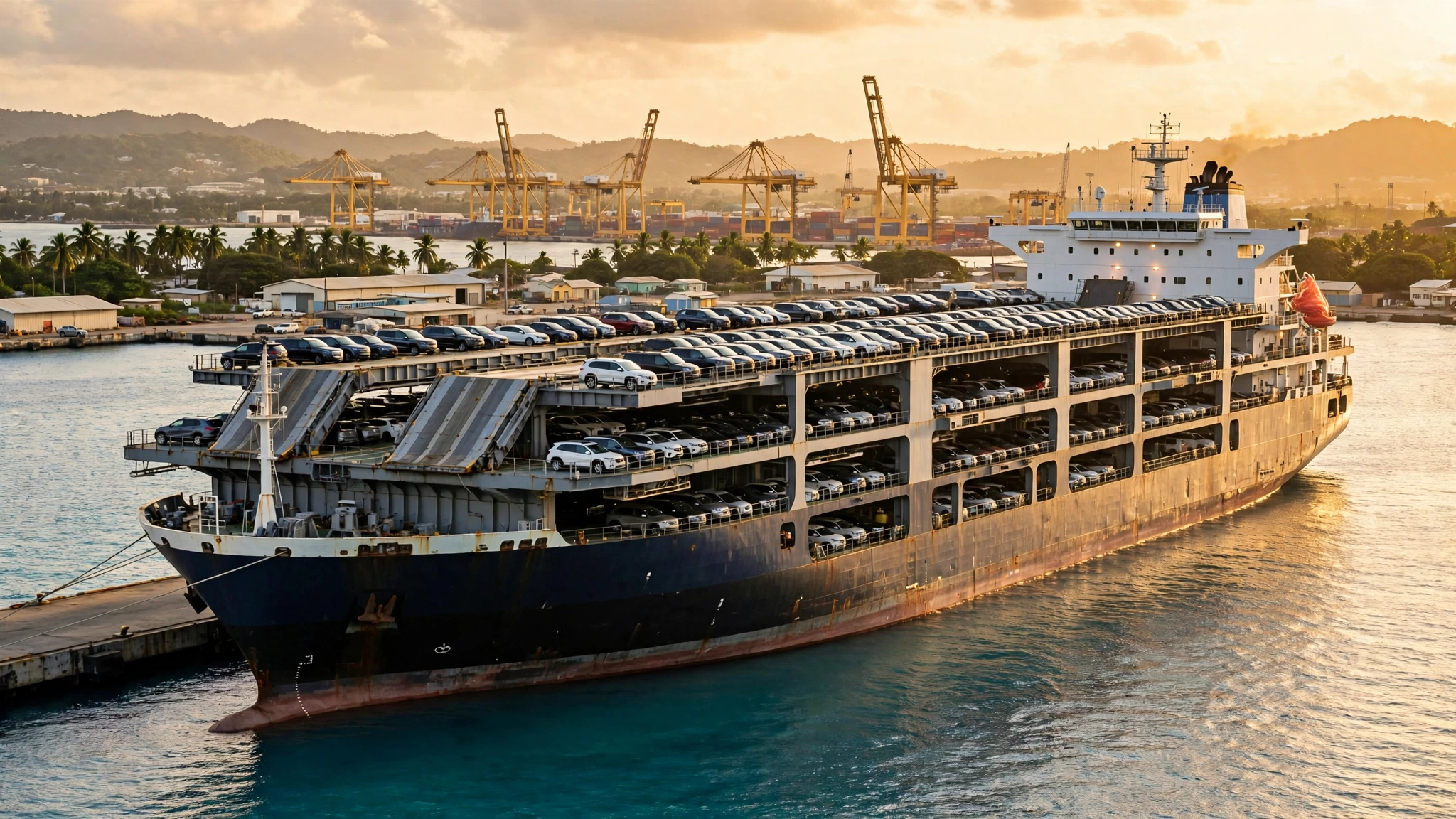
Ro-Ro (roll-on/roll-off) is the workhorse for Haiti. The car is driven onto the vessel’s vehicle deck, strapped down, and driven off at destination. For Caribbean routes, plan around $1,400–$3,200 per standard vehicle for ocean freight (2026 market range — get a firm quote; SUVs and trucks cost more). Rules: the car must run, steer, and brake, and you cannot leave personal belongings inside — Ro-Ro is vehicle only.
Container shipping puts the car in a sealed box — a shared 40-footer split with other vehicles runs roughly $3,000 per car, and you can pack household goods in the leftover space. More secure, slower to arrange (the container has to fill), and better for non-running vehicles.
Transit time: roughly 2–4 weeks port-to-port from South Florida to Haiti, plus time for terminal cutoffs and customs on both ends. Book with buffer — hurricane season (June–November) and port disruptions add weeks, not days. One cost pressure to date: Hapag-Lloyd raised Eastern Caribbean transport surcharges effective October 2026 (running through March 2027), so container quotes are climbing — get yours in writing and watch the expiry date.
Insurance: buy ocean marine cargo insurance separately. The carrier’s liability is not your insurance. On a route with Haiti’s risk profile, all-risk coverage is not the place to save $150.
(Full comparison in this series: Ro-Ro vs Container Shipping: Which Is Safer, Cheaper, and Better?)
Step 5: Survive Haiti’s Customs — the Layered Duty System
Haiti’s customs authority is the AGD (Administration Générale des Douanes), running on the ASYCUDA World system. The duty structure is layered — there is no single “import tax” number, which is exactly how first-timers get blindsided. As of 2026, the layers historically look like this (verify every line with a licensed Haitian customs broker — valuations and rates shift):
| Layer | What it is | Typical rate (as of 2026) |
|---|---|---|
| Customs duty | Base import duty on CIF value (cost + insurance + freight) | ~5% for passenger cars; used vehicles carry additional taxes up to ~30% in older schedules |
| TCA (VAT) | Value-added tax on imports | 10% |
| Excise tax | Levied on cars with engines of 2,200cc or more | 10% of CIF |
| Verification fee | Inspection/processing charge | ~5% of CIF |
Effective total: commonly 25–50%+ of CIF value, driven mostly by engine displacement. That 2.2L threshold is the line that matters — a 1.8L Corolla and a 4.0L 4Runner with the same purchase price can have duty bills thousands of dollars apart.
Three more realities:
- AGD uses reference valuations. Your bill of sale is a data point, not the verdict. If customs thinks your $5,500 Corolla is “worth” $7,000, you pay duty on $7,000.
- There is no DR-style age ban. Haiti’s edge over its neighbors is flexible age rules. An older truck in good shape clears; it just pays its layered duties.
- Rates change. The only number you should trust is the one your broker quotes you this month, in writing.
Step 6: Get It Out of the Port Before the Meter Runs
The car has arrived. Now the clock that matters is Haiti’s, not yours.
Documents you’ll need: original vehicle title, ocean bill of lading, passport or ID, bill of sale, and the cargo manifest. Have originals — Haitian customs has historically required original documents, and “non-negotiable” copies have been rejected.
Hire a local customs broker (courtier en douane) before the ship sails. Not after it docks. A good broker pre-files in ASYCUDA, meets the vessel, and walks the car through AGD inspection. This is the single highest-ROI $200–$400 you’ll spend in the whole process.
Move fast. Haiti’s shipping lines have historically allowed roughly a 17-day window before demurrage charges begin, and customs storage duties run about 2% of the customs value per month after that. Every idle week is real money — and in Port-au-Prince, idle weeks have a way of finding you.
A Worked Example: What a $5,500 Corolla Actually Costs Landed
Example only — 2026 estimates, not a quote. Your numbers will differ.
| Line item | Estimate |
|---|---|
| Purchase (Florida auction, 2012 Corolla 1.8L) | $5,500 |
| Inland transport to Miami port | $400 |
| Ro-Ro ocean freight | $1,800 |
| Marine insurance | $250 |
| CIF value | $7,950 |
| Haiti duties & taxes (~35% of CIF) | ~$2,780 |
| Broker + port handling | ~$600 |
| Landed cost | ~$11,130 |
Now run it with a 4.0L SUV instead of the 1.8L Corolla: freight climbs (bigger vehicle), and the 10% excise on engines ≥2,200cc adds roughly $800 to the duty line alone. Engine displacement is a cost decision, not just a preference.
Scams and Traps (Read This Before You Wire Money)
- The “demurrage hostage.” Unlicensed port agents who inflate fees and hold your paperwork until you pay cash. Use vetted, licensed brokers; pay duties through official channels.
- Forwarder fraud. Anyone can build a website that says “we ship cars to Haiti.” Verify your freight forwarder’s FMC (Federal Maritime Commission) licensing and get the bill of lading in your name — not the forwarder’s.
- Wire fraud. Never wire thousands to an overseas “agent” you met on WhatsApp. Letters of credit and escrow exist for a reason.
- The too-cheap freight quote. If one quote is 40% below the rest, something was left out — usually destination charges, which appear when your car is already on the water. Get all-in, door-to-port-to-cleared quotes in writing.
(Full playbook in this series: How to Avoid Getting Scammed by Overseas Buyers and Unlicensed Port Agents.)
📋 Free download: the Vehicle Export Document & Port Inspection Checklist — every document, deadline, and inspection point from this guide in one printable PDF. The exporters who get burned are the ones who wing the paperwork. Don’t be one of them.
FAQ: Shipping a Car from the US to Haiti
What documents do I need to ship a car to Haiti?
On the US side: the original vehicle title (or state-certified copy), filed at least 72 hours before export, plus an AES/EEI filing with an ITN number. On the Haiti side: the original title, ocean bill of lading, passport or ID, bill of sale, and cargo manifest. Have originals of everything — copies have been rejected by Haitian customs.
How much is customs duty on a car imported to Haiti?
There is no single rate. Haiti layers a base customs duty (~5% of CIF for passenger cars, with additional taxes on used vehicles), 10% TCA (VAT), a 10% excise tax on engines of 2,200cc or more, and roughly a 5% verification fee. Effective totals commonly land at 25–50%+ of the CIF value (as of 2026). Get a written quote from a licensed Haitian broker before you buy.
Is there a maximum vehicle age for importing cars to Haiti?
No — unlike the Dominican Republic (5-year cap) or Jamaica (strict age and RHD rules), Haiti has flexible age limits. Duties scale with engine size and customs valuation, not the calendar. Older workhorses clear fine.
Which port should I use — Port-au-Prince or Cap-Haïtien?
As of 2026, Cap-Haïtien. Port-au-Prince handles more cargo but has a documented history of gang attacks, terminal shutdowns, and suspended customs clearance — most recently in late September 2026, when the main terminal shut for days and shipping lines diverted cargo elsewhere. Cap-Haïtien has stayed more consistently operational. Always get written confirmation from your carrier that your chosen route is actually sailing.
How long does it take to ship a car from Miami to Haiti?
Roughly 2–4 weeks port-to-port, plus terminal cutoff time and customs clearance on both ends. Add buffer for hurricane season (June–November) and any port disruptions.
Related Guides in This Series
- The US Customs 72-Hour Rule Explained: How to Avoid Port Staging Fines
- Ro-Ro vs Container Shipping: Which Is Safer, Cheaper, and Better?
- The 2026 Vehicle Export Master Checklist: From US Purchase to Foreign Registration
- The 5 Most Reliable Used SUVs to Ship to Haiti: Terrain, Floods, and Suspension Breakdown
- How to Avoid Getting Scammed by Overseas Buyers and Unlicensed Port Agents
- How to Buy Used Cars at Copart and IAAI Specifically for International Export
Sources
- U.S. Customs and Border Protection, “Exporting a Motor Vehicle” (guidance last modified August 7, 2026)
- 19 CFR Part 192 — Export Control (U.S. Code of Federal Regulations)
- U.S. Census Bureau, Foreign Trade Regulations §30 — AES filing requirements for used self-propelled vehicles (72-hour ITN rule)
- International Association of Movers, Haiti Country Guide (2024) — motor vehicle import documentation
- Haiti Country Commercial Guide — customs duty and tax structure, port demurrage terms
- Kuehne+Nagel customer advisory — booking restrictions for Port-au-Prince imports
- Maritime Executive / MarineLink / Reuters — reporting on the September 2026 gang attacks against Caribbean Port Services and the APN terminal (terminal shutdown, vessels fired on, kidnapped crew, cargo diversions)
- Container News — Hapag-Lloyd Eastern Caribbean surcharge increase (effective October 2026–March 2027)
- Cox Automotive / Manheim — US wholesale used-vehicle index, September 2026 (down 1.1% MoM, third straight monthly decline)
- Port Technology — Antillean Marine service profile (Miami to Cap-Haïtien and Port-au-Prince)
Rates, sailing schedules, and regulations change. This guide is dated October 2026 and is not legal advice — confirm every figure with a licensed customs broker and your freight forwarder before committing money. DealShore Motors publishes export and shipping deep-dives every week.
Leave a Reply