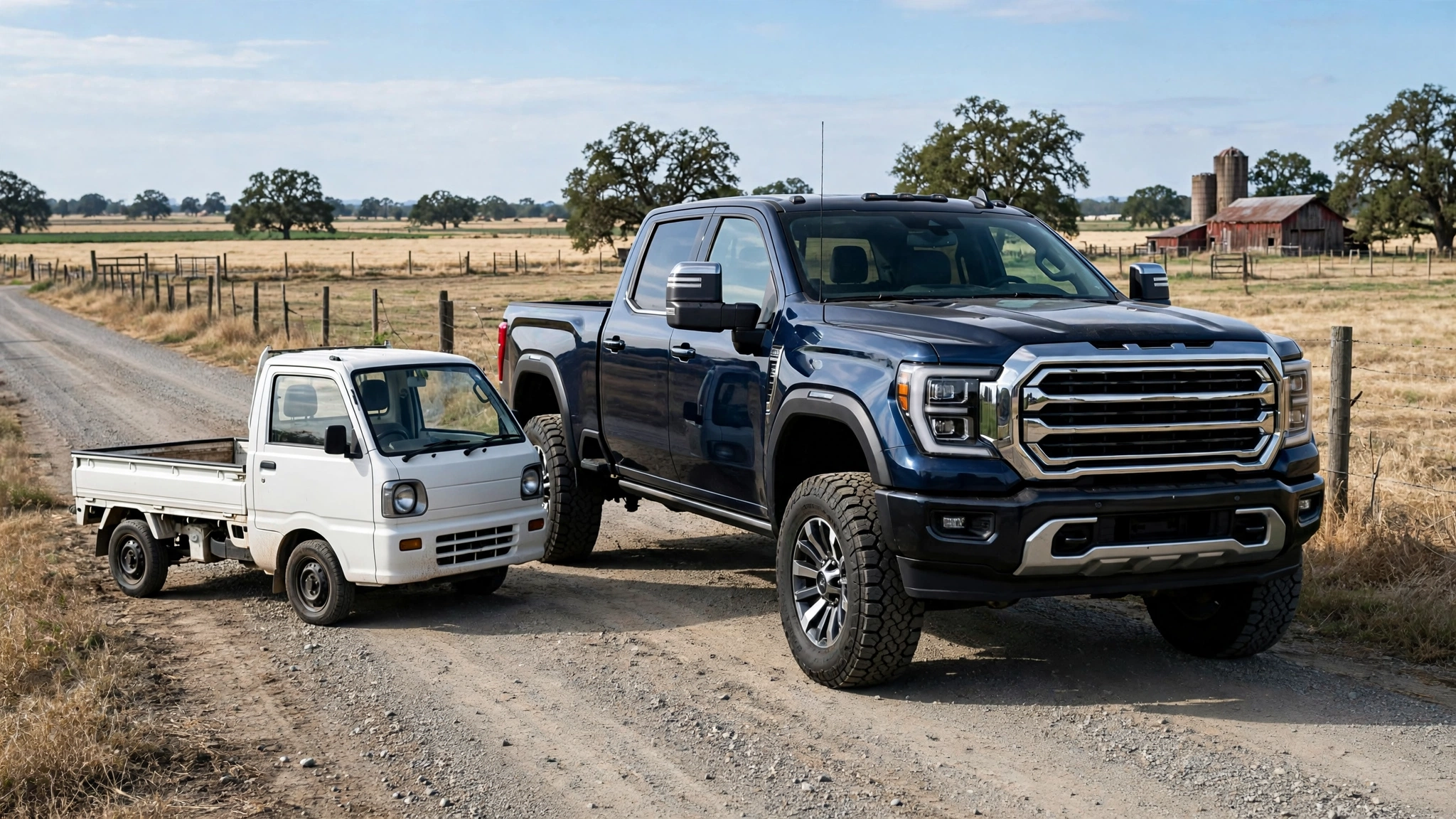
Kei Trucks: Why These Tiny Japanese Pickups Are Blowing Up on YouTube
By DealShore Motors
A new American crew-cab pickup now averages around $70,000. A running, four-wheel-drive Japanese kei truck — real steel bed that folds down on three sides, dump option on some models, around 40 mpg — can land in the United States for $5,000 to $11,000. It weighs about 1,500 pounds, fits where your riding mower parks, and hauls 770 pounds of feed or firewood without complaint. That gap is the entire story — and why your feed is full of trucks smaller than a side-by-side. It is also why buyers overpay for rusty ones.
The Verdict, Up Front
Perfect for: a second vehicle for property, farm, homestead, or small-business work — short trips, real loads, in a state that will title it for the road.
Terrible for: your only vehicle, a daily highway commute, or anyone needing modern crash safety, strong A/C, or room for a 6-foot-plus frame.
The one rule: check your state’s registration path before you bid. Federal import legal does not mean your state will give you plates.
That last line is what hype videos bury at minute nine. On kei trucks, the downsides decide whether you bought a bargain tool or a lawn ornament you cannot legally drive.
What a Kei Truck Actually Is
“Kei” is not a brand. It is a Japanese legal class — kei jidosha, “light vehicle” — with hard limits. Since 1998:
| Rule (since 1998) | Limit |
|---|---|
| Max length | 3.4 m (134 in) |
| Max width | 1.48 m (58 in) |
| Max height | 2.0 m |
| Max engine | 660cc |
| Typical weight | ~700 kg (~1,500 lb) |
| Payload | 350 kg (770 lb) |
| Typical bed | ~78 x 54 in, fold-down sides on all three sides |
That bed is the trick. At ~78 by 54 inches, a standard Carry or Hijet bed sits in the same size class as a crew-cab F-150 short bed — except its sides fold flat on all three sides: forklift loading, a flatbed in seconds. The cab-over layout (cab over the front wheels) is how a 134-inch truck gets a bed that long. The trade is power: 660cc, roughly 36 to 64 horsepower, real-world fuel economy claims of 35–45 mpg (~40 mpg is the figure owners repeat), and an ungoverned top speed around 120 km/h (75 mph) that many imports never comfortably reach in practice.
The Models You Will Actually See
| Model | Engine / power | Notes |
|---|---|---|
| Suzuki Carry | 660cc F6A/K6A, 36–50 hp NA, turbo to 64 hp, 770 lb payload | The default buy; deepest US parts knowledge |
| Daihatsu Hijet | 659cc, 38–53 hp | Jumbo-cab and dump versions are the wanted ones — and cost more |
| Honda Acty | 660cc | Production ended 2021; simple, beloved, rising collector premium |
| Subaru Sambar | 660cc, rear-engine | The oddball; rear engine changes traction and feel |
| Mitsubishi Minicab | 660cc | Solid worker, thinner US following |
| Mazda Scrum | 660cc | A rebadged Carry — do not pay a “rare Mazda” premium |
Most are 5-speed manual or automatic, RWD or part-time 4WD, right-hand drive. The 4WD versions are the US sweet spot: farm, snow, mud, and trails are what 1,500 pounds and a low first gear do best.
The Boom, in Numbers
- ~30,000 imported over the past ~5 years (NHK World via The Drive, October 18, 2026). Japanese TV travelled to Pennsylvania to film it — Lancaster Mini Truck imports 15–20 a month, and its owner described, in paraphrase, not being able to stop for fuel without being asked about the truck.
- Imports roughly tripled to ~7,500 a year (Japan Used Motor Vehicle Exporters Association data via CNN).
- ~74,000 US Google searches a month for “kei truck” (WC Shipping guide, September 2026).
- Prices are climbing: a clean 4WD Carry/Hijet was ~$4,000 at Japanese auction two years ago; now $5,500–$7,000. Landed US cost is typically $5,000–$11,000; dealer retail $5,000–$16,000.
Honest read: the bargain is shrinking. The trucks did not improve in two years — demand did. At $6,500, this needs an inspection, a title plan, and a rust check, not an impulse bid.
Why YouTube Loves Them
- Contrast: a $6,000 truck the size of a refrigerator outworking a $70,000 pickup is an instant thumbnail.
- Cheap content: buy it, lift it, paint it, break it — every stage costs less than a new truck’s options package, and every stage is a video.
- Real work on camera: dump beds, 4WD, log loads — farm, homestead, and fleet utility films itself.
- Access: it fits in a garage and down side-by-side trails and gates no full-size truck passes.
- It undercuts the toys: less to buy and run than many golf carts and UTVs, while being an enclosed truck with heat, wipers, and a bed.
All true. What the videos cut is the next section.
The 25-Year Rule — and the Political Noise
Kei trucks are not sold new in the US. The fleet exists under the 25-year rule: at 25+ years old, vehicles import under federal EPA/DOT exemptions. 2001 models became eligible in 2026, putting buyers in the fuel-injected era — easier starting, better parts behaviour, the sweet spot to shop.
In 2025–26, President Trump and DOT officials praised kei trucks and talked about clearing paths for US production. As of 2026, that is reported political attention, not a change in import law. The 25-year rule still runs every import. Do not pay a “soon they’ll be legal new” premium on a speech.
Brutal Honesty: The Downsides, in Full
1. State registration is a patchwork. Federal legal ≠ state road legal. Some states refuse or restrict on-road titles even for legally imported trucks; others title freely; others restrict use. It changes, too. Check your DMV before you bid — an off-road-only truck may still be worth it, but not at an on-road price.
2. No modern crash safety. No US-standard crash structure or airbags, and cab-over puts you at the very front. At farm speeds owners accept that. In a highway crash with a 6,000-pound SUV, physics does not care how charming it is.
3. 660cc + highway = wrong tool. Sustained 70 mph is high-rev misery with no reserve; hills and payload make it worse. Built for Japanese towns and farms, not interstate merging. A 45-minute highway commute disqualifies it, full stop.
4. Right-hand drive in a left-hand-drive country. Drive-thrus, gates, tolls, and passing visibility all suffer. You adapt for slow work in a week. You never adapt into better overtaking sightlines.
5. Parts split in two. Consumables cross-reference well — the Carry/Hijet community mapped them. Body, trim, glass, and specific parts ship from Japan, with waits. A cracked windshield is not a same-day fix.
6. A/C, rust, and tall drivers. A/C struggles in the smallest cabs on the hottest days. Japanese trucks rust, fast in US salt states, worst under the bed and at cab mounts. And over-6-foot drivers: sit in one first. Knees and headroom are not adjustable.
7. Insurance and title vary. Some insurers say yes easily; others limit use or quote oddly because the truck fits no box. Get both answers before it is on a ship.
8. The No. 1 mistake: overpaying for a rusty auction grade-3 truck. Hype taught sellers “kei” sells itself. Low grade, blurry underbody photos, boom pricing — that is the trap. You are buying that truck: its rust, its belt history, its title path.
What to Check Before You Buy One Used
In this order — the first item can end the deal for free:
- Title path in your state first. No title path, no on-road price.
- Rust under the bed and at cab mounts. Surface rust is normal at 25 years; structural rot is a walk-away.
- Timing belt history. Many are interference engines — a snapped belt can kill the engine. No history, budget the job now.
- 4WD engagement. Test it. A dead 4WD system makes it a 2WD truck at a 4WD price.
- Auction sheet, properly translated. Grade, damage map, notes — never the seller’s summary alone.
- Landed-cost math. Auction + shipping + broker + port + duty. WC Shipping cites 25% duty on trucks (“chicken tax”) — as of 2026, verify your exact classification and total with your broker before bidding.
- Sit in it. Five minutes answers height, knees, pedals, and A/C better than any photo.
A small, honest inspection kit
ANCEL AD310 OBD-II scanner — framed honestly: many early kei trucks are pre-OBD-II or use Japanese diagnostics, so this will not read every kei truck. It earns its place for later fuel-injected models where OBD applies, and for the other used vehicles on your list.
AstroAI S1 portable tire inflator — imports arrive on old, low, or mismatched tyres too often. Correct pressures make a test drive honest.
When you buy through our links, we may earn an affiliate commission at no extra cost to you.
Research-backed selections, not first-hand testing.
Who Should Actually Buy One
Buy one as a second vehicle for land, a yard, a farm, or a small fleet — in a title-friendly state, doing work too heavy for a golf cart and too small to justify a full-size truck. There, it is not a meme: ~40 mpg, 770 lb of payload, parks anywhere, simple maintenance.
Do not buy one as your only vehicle, highway commuter, or family hauler, or before confirming your state will plate it and you have read its auction sheet and checked its rust. The boom rewards patient buyers and punishes excited ones — same trucks, same rust, very different prices.
The Bottom Line
The contrast is real: a 1,500-pound, 660cc truck with an F-150-short-bed-sized bed, doing genuine work at ~40 mpg for a tenth of a new truck’s price. Thirty thousand imports, 74,000 searches a month, Japanese TV in Pennsylvania — that is a movement. But the same truck is slow on the highway, thin on crash protection, right-hand drive, patchy to register, and pricier every season. Buy it for the job it is brilliant at, in a state that will title it, after the rust, belt, and paperwork checks. Do that and you will understand the boom. Skip it, and the boom will understand your wallet.
Rules on import, title, duty, and registration change — verify with your state DMV and a licensed customs broker or importer before buying. Data current as of October 2026.
Sources
- Kei limits, payload, bed, fuel economy, model specs: Japanese kei regulations (post-1998) and Suzuki, Daihatsu, Honda, Subaru, Mitsubishi, and Mazda specifications.
- ~30,000 imports in ~5 years; Lancaster Mini Truck (15–20/month): NHK World via The Drive, October 18, 2026.
- Imports tripled to ~7,500/year: Japan Used Motor Vehicle Exporters Association data via CNN.
- ~74,000 US searches/month, landed and retail prices, auction movement, 25% truck duty: WC Shipping kei truck guide, September 2026.
- 25-year EPA/DOT exemption; 2001 eligibility in 2026: US federal import rules, as of 2026.
- Trump/DOT kei comments, 2025–26: contemporary US reporting — attention only, no import-law change as of October 2026.
Leave a Reply